The Art Of Staying No 1: How Market Leaders Guard Their Turf
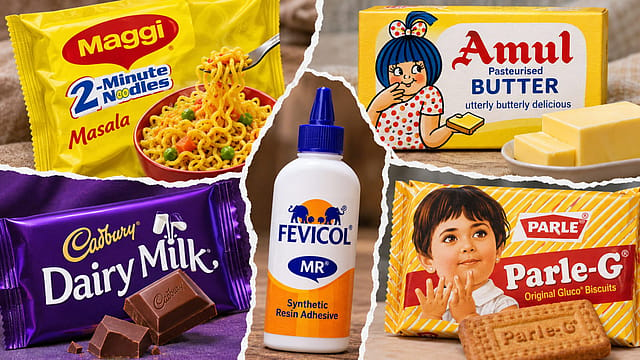
Recently, my friend Raghu Mohan — consulting editor with a pink paper — threw an interesting challenge at me. Name two brands that are serious competitors to Maggi Noodles in India. I immediately said: Top Ramen and Sunfeast YiPPee! Neither, he said, came anywhere close to Maggi in terms of market share and brand recall. He then asked me how come this one brand has dominated the Indian market, including rural areas, for over four decades without anybody coming close. It was food for thought.
What makes Maggi's dominance extraordinary is that the brand survived a crisis that could have destroyed it. In 2015, Maggi disappeared from store shelves following a nationwide regulatory ban. Its competitors had a golden opportunity to capture the market. But they could not dislodge it. Such was the deep-rooted loyalty. Sure enough, within a few months, Maggi bounced back. It not only survived but went on to thrive.
The Era of Forever Wars
30 Oct 2026 - Vol 05 | Issue 44
Coping with an explosive Middle East
That made me think. How come brands like Maggi, Cadbury, Fevicol, Colgate, Amul and a few others have remained market leaders for decades? Why have competitors been unable to displace them? What is their secret sauce?
And on the flip side, how come seemingly invincible giants like Nokia and Kodak lost their pre-eminence? According to a World Intellectual Property Organization research paper, Nokia's global mobile phone market share was 49.2% in 2007 but slid to just 3% in 2013.
What emerges loud and clear is that becoming No 1 is one thing, but staying No 1 is a different ball game altogether.
Warren Buffett describes the competitive advantages that protect businesses from rivals as an economic moat — a structural barrier that helps keep competitors at bay for decades.
Now, let's examine some popular brands in India that have dominated their respective markets for decades and how they have guarded their turf.
Nestlé created the instant noodles segment in India virtually from scratch in 1983. So much so that Maggi has become almost synonymous with instant noodles, much like Xerox with photocopying, Godrej with steel cupboards and Fevicol with adhesives. India is now the largest market globally for the Maggi brand, consuming roughly 6 billion servings every year.
Maggi dominates the Indian instant noodles market with an estimated 55% to 60% share. Its closest competitor, ITC's Sunfeast YiPPee!, is a distant second with a market share of around 15% to 20%.
Maggi is distributed across more than 2.2 million retail touchpoints in India. By aggressively pushing low-priced, single-serving packs — traditionally priced at Rs 5 or Rs 10 — Nestlé ensured that Maggi penetrated deep into rural kirana stores and roadside tea stalls (tapris). It became an affordable, ubiquitous convenience food for students and low-income workers alike.
Is it Maggi's proprietary masala that tickles the palates of millions of Indians, something competitors have been unable to replicate? Or is it the emotional connection the brand has built over generations?
For instance, with consumers becoming increasingly health-conscious, Baba Ramdev's Patanjali launched Atta Noodles, a wheat-based alternative. But it failed to make a significant dent in Maggi's dominance. Clearly, Maggi enjoys an emotional connection with Indian consumers that competitors find difficult to break.
A similar story is that of Cadbury, which faced a major crisis in October 2003 when the Maharashtra FDA seized stocks of Cadbury chocolates after consumers reported finding worms in Dairy Milk bars. This triggered a massive media backlash and a sharp drop in sales.
The problem was attributed largely to poor storage conditions at the retail level. The company responded by launching Project Vishwas, improving packaging and introducing heat-sealed wrappers. To restore consumer confidence, it roped in actor Amitabh Bachchan as its brand ambassador. Big B vouched for the brand's quality improvements and reassured families that Cadbury chocolates were safe.
Today, Cadbury commands roughly 65% to 70% of the Indian chocolate market, with Dairy Milk as its flagship brand.
Importantly, Cadbury did not merely overcome a one-off crisis. Its repositioning strategy — transforming chocolate from a children's indulgence into an alternative to traditional Indian sweets (mithai) during festivals and everyday celebrations — struck a chord with consumers. Its iconic Kuch Meetha Ho Jaaye campaign helped make chocolate an integral part of Indian celebrations.
In the case of Fevicol, its name has become synonymous with glue. Here, too, the brand has virtually become a generic name. Its maker, Pidilite Industries, commands over 70% of India's branded adhesives market, leaving competitors far behind.
Instead of merely marketing to consumers, Pidilite built the Fevicol Champions Club — a vast loyalty and community network for carpenters and contractors. When the experts trust Fevicol, the end consumer readily accepts their recommendation. In a way, it reminds me of Intel's Intel Inside campaign, which influenced consumer choice through the endorsement of a component brand.
And, of course, who can forget the genius of advertising guru, the late Piyush Pandey? He transformed a boring industrial product into a household name through humorous, culturally rooted advertising. The memorable Fevicol ka mazboot jod hai, tootega nahi resonated with the masses.
Amul butter, the undisputed king of the butter segment, commands a staggering 85% market share, leaving a relatively small portion for competitors like Mother Dairy, Britannia and local dairies.
What's Amul's USP? Being a cooperative owned by millions of dairy farmers, Amul combines scale, an extensive distribution network and competitive pricing. Unlike a conventional profit-driven company, its cooperative structure also seeks to maximise returns to its farmer-members. This gives it a distinctive business model that competitors find difficult to replicate.
Amul has also connected with the masses through its iconic Amul Girl, who has been keeping Indians amused since 1966. Its topical hoardings, often commenting humorously on current events, regularly go viral on social media. By remaining relevant to successive generations, the brand has woven itself into the country's social fabric.
How can one forget Parle-G, which has stood tall for generations despite stiff competition from Britannia and ITC? Parle-G is affordable, enjoys an extensive distribution network and has extraordinary brand recognition among India's 140 crore-plus population. I have not seen a Parle-G advertisement for a long time. Yet, the brand remains firmly etched in consumers' minds. That's the power of loyalty.
Talking of loyalty and consumers' reluctance to change their habits, I am reminded of the competition between The Times of India and The Indian Express in Mumbai.
In September 1988, The Times of India, which was printing around 3.5 lakh copies daily, was hit by labour problems. A 72-day strike disrupted operations at the newspaper's premier Mumbai establishment.
With the Times unavailable, the obvious alternative was The Indian Express, which was printing around 1.5 lakh copies daily. Faced with a sudden surge in demand from readers and advertisers, the Express doubled its print order to 3 lakh copies.
Interestingly, when the strike ended after 72 days, readers and advertisers returned to the Times. The newspaper regained its readership and advertisers, while the Express went back to printing around 1.5 lakh copies.
That's the power of a brand.
The point is that a temporary vacuum enabled the Express to take advantage of the situation, but only for a limited period. It did not result in a permanent shift in reader or advertiser loyalty.
To twist the Times tagline: Here, the reader guarded the leader.
Why do some brands remain seemingly invincible while others bite the dust? There is no easy answer. But what works for market leaders is the sum total of several factors — brand loyalty, distribution muscle, continuous reinvention, deep pockets, an understanding of changing consumer preferences and, sometimes, national sentiment. Above all, it is their ability to connect emotionally with consumers.
To my mind, Maggi survived and thrived because consumers had grown accustomed to its distinctive taste and were unwilling to change. In certain categories, consumers are particularly finicky and resistant to switching brands.
But the same yardstick does not necessarily apply to technology. In Nokia's case, consumers wanted something fundamentally different — smartphones with better operating systems, applications and user experiences. Samsung and Apple were better positioned to meet those changing expectations.
And therein lies the difference between a market leader that survives and one that disappears.
Finally, the biggest threat to a market leader may not be a competitor selling a better version of the same product. It may be a disruptor who changes the market itself.