Owaisi’s Azad Gamble: A Dalit-Muslim alliance in Uttar Pradesh works only on paper
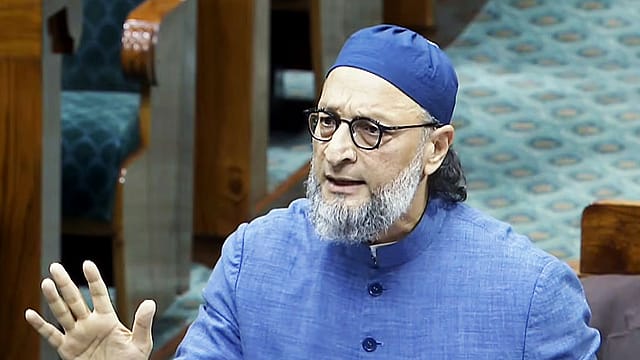
Uttar Pradesh (UP) politics has acquired a new front. Ahead of the 2027 Assembly election, the All India Majlis-e-Ittehadul Muslimeen (AIMIM) leader Asaduddin Owaisi and Chandrashekhar Azad of the Azad Samaj Party (Kanshi Ram) (ASP) have announced an alliance, the Samajik Parivartan Morcha. The two leaders announced it in Lucknow on November 12, promising to contest all 403 seats with Azad as chief ministerial candidate. Analysts read it as an attempt to forge a Dalit-Muslim bloc. The questions follow naturally. What is the alliance’s future? Will Dalits and Muslims actually vote for both parties? Can AIMIM and ASP transfer votes to each other? And what becomes of the Samajwadi Party (SP), the Bahujan Samaj Party (BSP) and Congress, all of which claim a share of these votes?
History offers some answers. For decades after Independence, Congress held a strong hold over Dalit and Muslim voters, in UP and across the country, and the two communities voted for it together. Since the 1990s, no party has commanded both communities in the same way or persuaded them to vote as one in successive elections. BSP, Congress and SP have each won a section of both, but in fragments, never as a bloc.
In 2017, Mayawati revived BSP’s Dalit-Muslim social engineering formula, fielding 99 Muslim candidates across the state. It largely failed: only a handful won, and the party finished a distant third with 19 seats. It courted minority voters again in 2022, winning a single seat, and in the 2024 Lok Sabha polls, when it gave more than a fifth of its UP tickets to Muslims and won nothing. The record of such experiments is one of repeated failure.
Why have such efforts failed so consistently? One interpretation is that over the past few decades, Hindutva consciousness has emerged assertively among a section of Dalit castes, and many of them are uncomfortable voting alongside Muslims for a favoured party. Communities such as the Pasis, Sonkars and Valmikis carry memories of communal riots in which they faced violent attacks from sections of the Muslim community and had to resist them. That popular memory remains vivid today, and it may hinder cohesion between the two groups. It is also why Mayawati could not transfer Dalit votes to her Muslim candidates.
Now AIMIM and ASP are about to repeat the experiment. Talking to Dalit respondents, we sensed that the same popular consciousness persists among a section of the community and may obstruct electoral mobilisation between the two groups at the grassroots. Without joint village and block-level meetings to build chemistry between the communities, an electoral alliance will struggle to succeed. Unity at the top does not guarantee unity at the booth.
Time is also short. The alliance was announced only a few months before the election, too little time to build such chemistry. The two parties may try to bridge the gap through strategic ticket distribution, but many Dalit respondents feel this alone will not deliver results.
Each leader also faces a challenge of his own. Azad, the Nagina MP, has yet to widen his influence among Dalit voters, especially the Jatavs, who remain firmly under Mayawati’s sway. Owaisi, for his part, must mobilise enough Muslim voters in his favour to transfer their votes to his ally.
If the alliance works, it could make a few seats winnable for itself. More importantly, it may hurt the prospects of SP, BSP and Congress which have long claimed influence over Muslims. And if Azad expands his influence into other parts of UP, he could make major inroads into BSP’s base. Even a modest showing could therefore reshape the arithmetic of the opposition in the state.
(Badri Narayan is vice chancellor, Tata Institute of Social Sciences, Mumbai and the author of Republic of Hindutva)