The Perils Of Being Surrounded By Yes-Men: Who Wins, Who Loses?
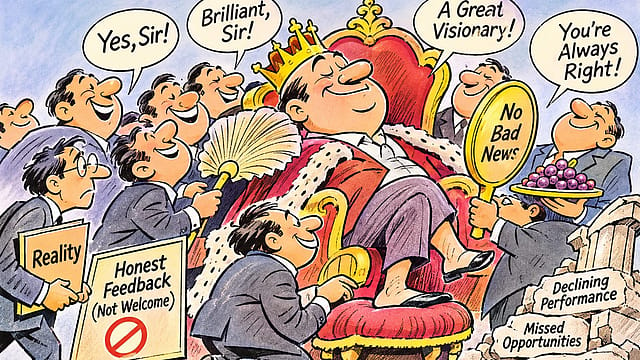
The fairy tale from my school days, The Emperor’s New Clothes, flashed through my mind when I heard Rahul Gandhi’s speech at his mother Sonia Gandhi’s book launch. His disclosures, to my mind, must have stunned everybody. He recalled how his parents frequently displayed affection, with his mother, Sonia, often sitting on his father Rajiv Gandhi’s lap during family meals – something he assumed was normal in every Indian household.
In the fairy tale, a small child in the crowd speaks the truth and says that the emperor is naked. But the emperor’s ministers and the general public either remain silent or praise the non-existent clothes out of fear. The child, unburdened by social pressure or the fear of being judged, states the obvious.
Hot Pursuit
27 Nov 2026 - Vol 01 | Issue 02
The Shah Doctrine of Internal Security
In the Congress party, nobody seems to dare tell Rahul that his narrative is wrong or that the issues he is picking up against the BJP may not yield political dividends. There are many who appear to have tried and paid the price, going by the number of MPs, MLAs and spokespersons who have quit the Grand Old Party over the last decade.
According to the non-profit Association for Democratic Reforms, the Congress witnessed the highest number of defections between 2014 and 2021, losing 222 electoral candidates and 177 MPs and MLAs to other parties. The BJP was the biggest beneficiary of these defections, with 253 candidates and 173 legislators joining it during the same period.
Who can forget one of the most memorable examples of political sycophancy? The slogan coined by the then Congress president Dev Kant Barooah during the Emergency: “India is Indira and Indira is India.”
Fast-forward to August 2020. As many as 23 senior Congress leaders, popularly known as the G-23, wrote to Sonia Gandhi seeking organisational reforms. Instead of their suggestions being welcomed, several party insiders questioned their intentions.
Diehard Congressman Ghulam Nabi Azad, when he quit the party in August 2022, wrote a five-page resignation letter in which he accused Rahul Gandhi of dismantling the party’s consultative mechanism and allowing a coterie of “inexperienced sycophants” to run the organisation.
There is no point in getting into granular details here. Today, the Congress is in power in only four states.
What happens when people in power begin to surround themselves with people who tell them what they want to hear rather than what they ought to know?
Here, I am reminded of Bollywood superstar Rajesh Khanna. He was a phenomenon, particularly in the seventies. During his unprecedented streak of 15 consecutive hits between 1969 and 1971, Rajesh Khanna essentially became a king holding court.
Sycophancy was arguably one of the biggest reasons for his downfall.
Biographer Yasser Usman, in his book Rajesh Khanna: The Untold Story of India’s First Superstar, describes how the coterie convinced him that he was infallible and beyond the rules of the industry.
According to the book, whenever honest friends, directors or his wife, Dimple Kapadia, tried to warn him about his tardiness or choice of scripts, his sycophants dismissed them as jealous or disrespectful.
When his hits dried up in the mid-1970s, he needed the constant validation of his entourage even more, keeping them around until dawn just to feel like a superstar. This further disrupted his schedule the following day.
In short, thanks in part to his sycophants, arrogance and indiscipline sealed his fate when disciplined, hungry actors like Amitabh Bachchan arrived on the scene.
Let me turn to the business world.
This anecdote was narrated to me by my late friend Ravi Shyam, a media trainer who trained the who’s who of the corporate world in India and neighbouring countries. During one of his sessions, he was sitting with the chairman of a large conglomerate with a strong presence in the infrastructure sector. Also present in the chairman’s cabin was the group’s executive director (ED).
As the conversation progressed, the ED suddenly got up, picked up a samosa from a plate that had been placed on the table earlier and went across to feed the chairman. As if that were not enough, he proceeded to wipe the chairman’s face with a paper napkin. It was a rather embarrassing sight, and my friend tried to look the other way. But what surprised him was that the chairman seemed quite unperturbed by this display of servility in front of an outsider.
Remember, he was not a personal attendant but an ED.
The Bengaluru-based company in question is a listed entity. It is still around but has landed in a financial mess because of its over leveraged balance sheet. It has had to sell some of its businesses. How can a company thrive if it follows a feudal style of management?
As for the executive director, I wonder whether he had climbed the corporate ladder because of his professional competence or his ability to bend over backwards to please his boss.
Over the years, as a journalist, I have come across several such instances of brown-nosing, apple-polishing and kowtowing in corporate India. But this “sterling” quality is not confined to corporate India alone. It is equally rampant in politics, the bureaucracy and the entertainment industry.
On one occasion, I teamed up with media trainer Ravi Shyam for a session with one of the top 10 business houses in the country. During the training session, one director was praising the chairman – the word ‘gushing’ comes to mind. He was giving the chairman all kinds of certificates: a great man, a great visionary, a noble soul… The blah-blah of a chamcha went on and on. It was nauseating.
From a journalist’s point of view, I told the chairman that this director was doing him and his company more damage by singing his praises. The media would think he was surrounded by a flock of yes-men – sycophants. The chairman took my observation in the right spirit and ticked off the director in front of everybody. I was impressed.
The Mumbai-based business house in question is growing from strength to strength. The chairman’s son has moved centre stage. They are creating waves in the corporate world.
Reading this one on the internet, I almost fell off my chair. Surely, every mobile phone user on Planet Earth has heard of Nokia. So, what led to its downfall? All these years, I was under the impression that Nokia had been turfed out by its competitors because it had failed to keep pace with technology.
But the findings of two professors came as quite a revelation.
In 2015, professors Quy Huy of INSEAD and Timo Vuori of Aalto University published a study on Nokia’s dramatic decline, drawing on 76 interviews with managers, engineers and external experts.
They found that:
- Middle-level managers were scared of antagonising their superiors.
- Senior managers had a reputation for losing their temper.
- Employees feared demotion, dismissal or loss of status.
- Bad news was filtered out before it reached top management.
- Managers allowed their superiors to believe that unrealistic software development deadlines could be met.
Nokia was not short of intelligent people, resources or engineering talent. But fear within the organisation undermined its ability to respond effectively to Apple’s iPhone.
The researchers subsequently wrote an article with a fascinating headline: Who Killed Nokia? Nokia Did.
When an establishment repeatedly sidelines outspoken employees, it sends a signal down the line that being a yes-man may be more rewarding than being competent.
In India, in many organisations, particularly promoter-driven companies, employees (read: incompetent and insecure ones) quickly learn to identify the real power centres. It may not necessarily be the CEO or the chairman.
It could be the chairman’s wife, son, daughter, personal secretary or a trusted lieutenant who enjoys disproportionate influence.
Generally speaking, insecurity and professional inadequacy often drive people to resort to sycophancy, brown-nosing or apple-polishing. They use flattery to compensate for their inherent shortcomings.
This is why every CEO, political leader and powerful celebrity should periodically ask themselves one simple question: When was the last time somebody in my inner circle told me I was wrong?
If they cannot remember, they have a serious problem.
Finally, in the short run, the sycophant may win and the outspoken professional may lose. But, in the long run, the entire organisation could end up paying the price.
So, beware of yes-men. Don’t shoot the messengers lest you stop receiving messages.