Competitive Coexistence: Quad, APEC, ASEAN and the changing dynamics of global power
The diplomatic engagements of November 2026 offer an instructive snapshot of the changing contours of international politics. The Association of Southeast Asian Nations (ASEAN) Summit in Manila, the Quad Leaders’ Summit, and the APEC Economic Leaders’ Meeting in Shenzhen collectively underscore the emergence of an international order characterised less by rigid bloc politics than by competitive coexistence. At a time when geopolitical rivalries remain acute, these engagements demonstrate that strategic competition has not foreclosed the possibilities of pragmatic cooperation. What is striking is the centrality of the Indo-Pacific to this evolving landscape. The region is no longer merely an arena in which established powers compete for influence; it is increasingly becoming a site where the parameters of the emerging international order are being negotiated.
The 49th ASEAN Summit, hosted by the Philippines from November 15-17 under the theme ‘Navigating Our Future, Together’, reflected the organisation’s enduring commitment to regional resilience and functional integration. Timor-Leste’s full integration as ASEAN’s 11th member was an important institutional milestone, reinforcing the organisation’s aspiration to maintain regional inclusivity despite persistent political and security challenges.
The ASEAN Summit underscored the organisation’s growing emphasis on functional economic integration, particularly through the landmark Digital Economy Framework Agreement, aimed at expanding the regional digital economy to $2 trillion by 2030. Progress on the ASEAN Power Grid, AI cooperation and migrant worker protection further reinforced regional resilience. However, persistent challenges, including the Myanmar crisis and delays in concluding the South China Sea Code of Conduct, exposed ASEAN’s limitations. This contrast reflects ASEAN’s broader predicament: advancing economic integration while managing geopolitical divisions. Its continued engagement with competing powers underscores its commitment to strategic autonomy, inclusivity and ASEAN centrality.
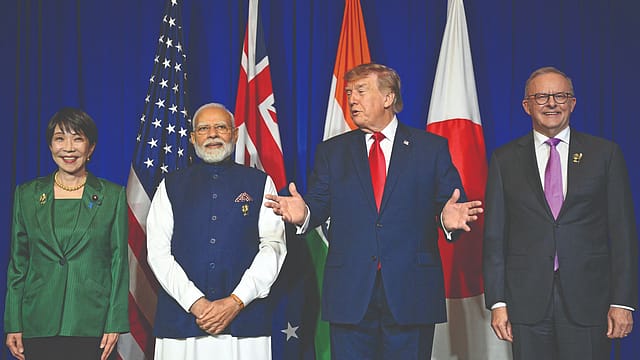
The Quad Leaders’ Summit on November 17 added another important dimension to the emerging regional order. Bringing together the US, India, Japan and Australia, the meeting was significant as it was the first leaders’ summit in about two years and the first to be held in a non-Quad country. The announcements reflected an effort to translate the Quad’s strategic convergence into tangible institutional and operational outcomes. The proposed Quad Business Leaders’ Forum, expected in early 2027, seeks to deepen private-sector participation in regional economic cooperation. The Indo-Pacific Maritime Surveillance Collaboration points towards greater interoperability and enhanced maritime domain awareness.
Equally significant was the emphasis on trusted AI, cybersecurity, critical minerals, supply-chain resilience and undersea cable infrastructure. These initiatives suggest that the Quad is expanding its understanding of regional security beyond traditional military considerations. Economic security, technological standards and the protection of critical infrastructure are now integral to its strategic agenda. However, the Quad’s significance should not be measured solely through the prism of its capacity to counter China. Its members have consistently emphasised ASEAN centrality and an inclusive regional architecture. The grouping’s continued engagement with Southeast Asian institutions also reflects an awareness that the Indo-Pacific cannot be effectively shaped through exclusive strategic arrangements.
The continuity of the Quad under Trump’s second administration is noteworthy. It suggests that the grouping has acquired a degree of institutional resilience beyond the preferences of any particular American administration. Yet its long-term effectiveness will depend on whether its members can sustain political commitment and translate strategic convergence into measurable outcomes.
If Manila demonstrated the growing importance of regional institutional frameworks, Shenzhen illustrated the continuing relevance of great-power diplomacy. China’s hosting of the 33rd APEC Economic Leaders’ Meeting reaffirmed Beijing’s ambition to position itself at the centre of regional economic multilateralism. The Shenzhen Outlook, the Trade Digitalization Cooperation Framework for 2027-2030 and the updated Connectivity Blueprint reflected a familiar Chinese emphasis on economic integration, technological innovation and infrastructure connectivity. Beijing’s financial contribution of $20 million towards APEC cooperation and the establishment of a new research centre further strengthened its institutional engagement.
The most consequential political development, however, was the first-ever trilateral summit involving Trump, Xi Jinping, and Vladimir Putin on November 19. The immediate outcomes of the meeting were more declaratory than transformative. Fundamental disagreements over Ukraine, the international order and the distribution of global power remain unresolved. But, their willingness to engage in a common diplomatic exercise shows that strategic rivalry does not necessarily eliminate the incentives for dialogue.
These three engagements reveal several important features of contemporary international politics. First, multipolarity is increasingly expressed through overlapping institutional arrangements rather than competing, mutually exclusive blocs. ASEAN and APEC provide platforms for inclusive economic cooperation, while the Quad advances a more focused framework for strategic and technological coordination. Simultaneously, the Shenzhen trilateral demonstrates that great-power diplomacy can continue across geopolitical divides.
Second, economic and technological considerations are increasingly shaping the vocabulary of strategic competition. Digital trade, AI, critical minerals, energy security, supply-chain resilience and connectivity featured prominently across all three engagements. The emerging contest for influence is therefore not simply about territorial control or military superiority; it is also about shaping the rules, standards and infrastructure of the global economy.
The immediate outcomes of the APEC meeting were more declaratory than transformative. But their willingness to engage in a common diplomatic exercise shows that strategic rivalry does not necessarily eliminate the incentives for dialogue
Third, the importance of middle powers and regional institutions is growing. ASEAN’s insistence on strategic inclusivity and the Quad’s endorsement of ASEAN centrality show that regional actors, in the great-power competition, are steadily attempting to shape its terms by diversifying partnerships and resisting binary strategic choices. Finally, there is a widening gap between diplomatic symbolism and substantive outcomes. High-profile summits can generate political momentum, but their significance depends on implementation. The practical achievements associated with digital integration and regional infrastructure may prove more consequential over time than the declaratory outcomes of the APEC.
The November 2026 diplomatic engagements emphasise an emerging international order defined by competitive coexistence rather than rigid bloc confrontation. States are simultaneously balancing strategic rivals, pursuing economic partnerships and engaging through overlapping institutional frameworks. For the Indo-Pacific, this presents both opportunities and challenges, as regional institutions and middle powers acquire greater agency amid intensifying great-power competition. The future of the international order will therefore depend not merely on Washington or Beijing, but also on the ability of regional actors to reconcile strategic autonomy with pragmatic cooperation. Institutional flexibility and selective engagement are likely to shape global politics, and India has already shown the way in this regard.