The French and German Right Consider Their Policies in Power
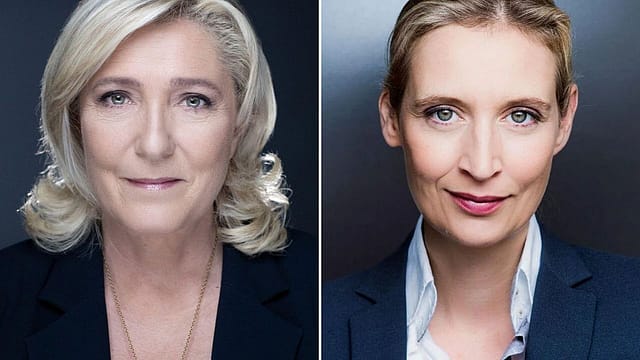
Marine Le Pen in France and Alice Weidel in Germany are the female leaders of the right-wing parties National Rally (RN) and Alternative for Germany (AfD), that currently lead the polls in their respective countries, and are in strong political positions.
After AfD’s showing in September in the German Saxony-Anhalt’s regional election, it is likely to form a local government for the first time and Alice Weidel stated, “It is our aim to assume governmental responsibility after the next federal election.”
In France, a recent poll by the Institute of French Opinion Polls puts Marine Le Pen at 34 to 38 percent in the first round of the presidential election next year, making her easily the front runner. Among all her rivals, she probably benefits most from the recent waves of popular unrest across France.

The Wealth Issue 2026
06 Nov 2026 - Vol 05 | Issue 45
Portraits of Dreamers and Doers under 35
Possible end of Franco-German drive for European Integration
If these two leaders come to power, they would mark the end of the long-standing Franco-German partnership that has driven European integration, and would have a bearing on the future of the European Union. Neither party at present advocates leaving the EU, but both wish to reshape it into a grouping of fully sovereign states with weak centralized EU institutions and reduced powers for the EU Council and Commission.
Alice Weidel spoke about ‘A New Deal for Europe’ shortly after Le Pen had herself outlined her vision for Europe. AfD proposes to introduce opt-outs to enable Germany to bypass certain EU policies, and both parties oppose continued financial support for Ukraine, the EU’s regulatory burden, deeper integration, and the considerable powers of EU institutions. But in power, they could differ on fiscal policy, energy, and how far their countries should break from the rules of the common market.
Ukraine
Both Le Pen and Weidel agree on ending financial support for Ukraine in its war with Russia. At a press conference, Le Pen maintained that France’s strained public finance resources could no longer sustain aid to Kiev and she called for the lifting of EU sanctions against Russia. "We obviously agreed to train their soldiers, their army, to provide them aid in terms of equipment, but we can no longer finance Ukraine, so this funding will stop," she declared. For her part, Weidel states that she wants a peace treaty and calls for a “reasonable diplomatic approach” which takes into account “the security interests of both Ukraine and Russia”. Recently, she maintained that Ukraine had lost the war and pledged to end German support for Ukraine.
Fiscal Policy
The most significant divergence appears in the couple’s approach to fiscal policy. Le Pen wants to harmonise taxes on tobacco, alcohol and large companies at the EU level to prevent fiscal dumping across Europe and suggests that the European Central Bank (ECB) revise its mandate to give weight to economic growth instead of focusing on price stability. “I have always believed the ECB must rethink its course of action. It is essential that it take into account employment, growth and innovation, given that the monetary easing policies pursued between 2010 and 2022 were not targeted at future investments," she said.
The AfD on the other hand opposes any transfer of fiscal sovereignty to supranational institutions, and claims that the ECB should strictly confine itself to price stability. "There is a ban on the European Central Bank financing state debt,” claimed Weidel, “And what is it doing? It's financing state debt."
However, both parties firmly oppose common EU debt, and wish to reduce their contributions to the EU budget. Le Pen aims to cap France’s contribution at five billion Euros a year. Weidel’s ‘New Deal for Europe’ specifies no figure but emphasizes the need to “end Germany’s role as paymaster.”
Climate Change and Energy
On energy and climate policy both leaders criticize the EU’s Green Deal and support nuclear power, but differ somewhat in their approaches. Le Pen rejects the ‘climate-sceptic’ label for her party, backs an EU carbon border tax, and proposes tying member states’ contributions to the EU budget to their carbon emissions, thereby incentivizing the transition to green energy. "The further a country deviates from the [Paris] agreement targets, the more it should have to contribute," she said.
The AfD on the other hand stresses total freedom to determine the national energy mix, implying that Germany must be free to choose nuclear energy, coal, gas, and renewable energy according to the needs of its economy. "Now we rely completely on an ideological energy transition of wind and solar power. We see this development also throughout Europe, through the implementation of the Green Deal, the building energy law, and above all the ban on combustion engines. This is a blatant disruption of the free market economy," said Alice Weidel.
Reshaping the EU and the sovereign member states
Both parties wish the European Commission stripped of powers and reduced to a “secretariat at the service of member states”, as Le Pen puts it. "If the Commission wants to assume the powers of a state, we don't want it," she said, rejecting any EU involvement in security, diplomacy or intelligence. Le Pen also wishes to abolish the European Committee of the Regions and the European Economic and Social Committee, two advisory bodies representing local authorities and social interests.
Alice Weidel shares a similar position; "We don't want an unelected Commission to intrude and disturb your private life and Member States’ decision-making, " she said. The AfD also questions the legitimacy of the European Parliament and advocates a Europe fully based on sovereign nation-states. One of the proposals in the ‘New Deal for Europe’ states: "The European Parliament should no longer be elected directly, but instead be composed of delegates appointed by national parliaments."
Marine Le Pen envisages reshaping the EU following next year’s elections in Spain, France, Italy and Poland, where rightwing parties are expected to win or to make significant gains. Poland’s Law and Justice Party could return to power, while Spain’s Vox could join the government along with the Popular Party. In France, Marine Le Pen could be the first female and first right-wing president; “This will be our shared undertaking for the years and decades to come. It will not simply consist of undoing what has been very badly done over the past 30 years on the European stage," she said, claiming a new "Europe of Nations" will comprise EU institutions not exercising any authority over the member states.
Alice Weidel identifies 2029, when federal elections are due, as the pivotal year for European reform when the European elections could deliver a “patriotic rightwing majority in the European Parliament.” Her party floats the possibility of ‘disruptive national options’ should its planned reform of the EU fail. These include making extensive use of opt-outs for Germany in areas such as free movement, defence, taxation, social policy and migration. "If the Schengen visa system …doesn't work, we need to get out of Schengen and protect our borders," Weidel said, pointing to challenges to free movement amid episodes such as the large-scale arrival of illegal migrants in Ceuta last July. The opt-out on migration would mean that Germany “will no longer participate in any European distribution mechanisms of migrants or asylum quotas” thereby disrupting the bloc’s migration policy. Berlin currently holds the largest quota in the EU and is in charge of relocating about 4600 asylum seekers from frontline member states this year.
Membership of the European Union
If far-reaching reform of the EU’s structure proves unattainable, the AfD’s plan is that ‘The German people should decide for themselves,” which could be an implicit reference to a referendum on EU membership – though Weidel has not raised this possibility publicly. Marine Le Pen, once a strong advocate of France leaving the EU, has gradually come to favouring the radical transformation of the EU from within.
Various European experts consider withdrawal from the EU to be an unlikely scenario, pointing out that even in Britain, that withdrew in 2020, there is a debate about rejoining the union. Most right-wing parties have reassessed their position towards the EU over the past years, and there is now no political party that advocates leaving the Union.
Krishnan Srinivasan is a former foreign secretary