Agrarian Power: Biofuels, Flex-Fuel, and the Political Economy of Energy Self-Reliance
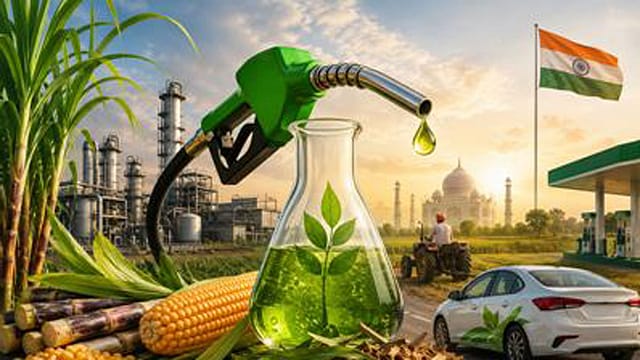
India’s quest for energy independence is not just about offshore oil fields, solar parks, and battery makers. It is increasingly visible on sugarcane plantations, maize fields, and ethanol distilleries, where farming feeds into the country’s energy strategy. Now it is expected to contribute to energy security as well, not just to food security alone as was thought. In the process, India is forging a new political economy where farmers, oil companies, automobile manufacturers, and the government become partners to achieve strategic autonomy. The change reveals systemic weakness. According to the Ministry of Petroleum and Natural Gas, India imports 88 percent of its oil needs and is the third largest importer of crude oil in the world. Despite lower global oil prices than those following the Russia-Ukraine conflict, the cost of the country’s crude oil imports was more than US$137 billion in FY2024-25. Any rise in world oil prices worsens the current account deficit, fuels inflation, and raises transportation and manufacturing costs throughout the economy. Successive governments have sought to diversify the energy portfolio of India. But in the last decade, biofuels have gained extraordinary strategic relevance. The National Policy on Biofuels, 2018 (updated in 2022), expanded the list of approved feedstocks for ethanol production to include sugarcane juice, maize, damaged food grains, and surplus rice supplied by the Food Corporation of India. At the same time, the government has brought forward its target of achieving 20 per cent blending of ethanol (E20) in petrol from 2030 to the ethanol supply year (ESY) 2025-26. The progress has been tremendous. India is one of the world’s fastest-growing ethanol blending markets, and ethanol blending has grown from 1.53% in 2013-14 to almost 20% in early 2025, said the Ministry of Petroleum and Natural Gas. The government feels that the scheme has led to savings of thousands of crores of foreign exchange, reduction of greenhouse gas emissions, and increase of farmers’ earnings through assured demand for agro-feedstocks.
The economic implications are most clearly visible in the Indian sugar industry. For decades, sugar mills were caught in a cycle of overproduction, low sugar prices, and mounting farmer debt. Ethanol has changed that business strategy fundamentally. Rather than only relying on sugar sales, mills have the option of diverting the sugarcane juice and molasses to ethanol production, creating a new source of income that improves liquidity and hastens payments to farmers. Uttar Pradesh and Maharashtra, which together contribute a big chunk of sugar production in the country, have emerged as the main winners of the ethanol industry. The project is also changing the cropping pattern. Governments are trying to reduce dependence on water-hungry sugarcane, and maize has become an increasingly important feedstock. States such as Bihar, Madhya Pradesh, and Karnataka are witnessing increased investments in maize-based ethanol production. This reflects a desire to diversify the feedstock and geographical base of the biofuel industry. Agriculture is not the only sector in transition. Toyota Kirloskar Motor, Bajaj Auto, and TVS Motor have also started scouting for flex-fuel technology that can run on higher ethanol blends. Unlike battery electric vehicles that rely heavily on imported lithium and other critical minerals, ethanol uses existing agricultural and refining infrastructure in India. For the policy-makers this is not just a climate program but an industrial strategy to reduce external dependence while opening up new markets for rural India. But the program is much more than simple ethanol-blending targets. It is an effort to reorient Indian agriculture in the larger economic and geopolitical context of the country. Farmers are no longer just food producers; they are also becoming important energy resource providers. What the next phase of India’s energy revolution will be depends on whether this new marriage of agriculture and energy ultimately strengthens the country’s economic resilience or triggers new conflicts over water, food security, and regional inequality.

Losing Memory
16 Oct 2026 - Vol 05 | Issue 42
The making of a medical and social emergency
Ethanol may have become a symbol of India’s energy ambitions, but it has also revealed the painful trade-offs that come with the country’s transition. The biofuels initiative offers the prospect of reduced oil imports, higher farm income, and cleaner transportation. But it poses questions about water use, food security, and the uneven distribution of economic rewards. For policy-makers the question is not whether biofuels should be expanded, but how to do so without creating new vulnerabilities. There is a huge reliance on sugarcane, and that is a worry. According to NITI Aayog and the Commission for Agricultural Costs and Prices estimates, sugarcane occupies about 2.5% of the total planted area in India but accounts for about 70-80% of irrigation water in major sugar-producing regions. Maharashtra is a particularly striking example. Despite recurring droughts, the state still devotes huge tracts of irrigated land to sugarcane, thanks to assured procurement, political clout, and now, rising demand from ethanol production. A scheme to cut reliance on imported oil could exacerbate another strategic problem: water shortage. The government has recognized this imbalance and has attempted to diversify the sources of ethanol feedstock. This method has been applied to maize, damaged food grains, and crop waste. The long-term goal is to shift to second-generation (2G) biofuels that use agricultural waste products like rice straw, sugarcane bagasse, etc., rather than food crops. Besides reducing pressure on farms, these technologies can also help in solving the problem of stubble burning in Northern India. However, commercial-scale implementation is still limited, and the first-generation ethanol is still the dominant production method.
And then there is the whole question of food security. India’s ethanol program has become increasingly dependent on surplus rice and maize, especially in years of record harvests. Yet agriculture remains vulnerable to erratic monsoons and climate change. When food inflation rose in 2023, the Union government banned the use of rice from the Food Corporation of India for ethanol production, illustrating how quickly fuel policy and food policy can come into conflict. What the experience proved was an important reality: farm commodities, unlike oil, have many uses, and governments must constantly balance the competing demands of consumers, farmers, and energy producers. The economic benefits of the biofuel project are also unevenly spread. Sugar cooperatives, integrated distilleries, and large agribusinesses can invest in ethanol production, but many small and marginal farmers remain raw material suppliers rather than value-added producers. States with a developed sugar industry, such as Uttar Pradesh and Maharashtra, have benefitted the most, similarly, but rain-fed agricultural regions have still to see such investment. Without storage infrastructure, processing facilities, and a range of other feedstocks outside of the traditional sugar belt, the biofuel economy could exacerbate regional imbalances rather than alleviate them.
India, however, is on a different path than several advanced economies pursuing decarbonization. In order not to rely only on electric transport, New Delhi has adopted a multi-fuel approach, incorporating ethanol, compressed biogas, green hydrogen, and electric vehicles into its strategy. The logic is both technological and geopolitical. India does not have the supplies of lithium, cobalt, and nickel, the key minerals used in battery manufacturing, but it has rich agricultural resources and one of the world’s largest refining networks. Biofuels, therefore, provide a route to greener transport that is less dependent on external supply chains. This practice has foreign policy implications as well. India is expected to see one of the largest increases in global oil demand over the next decade, according to the International Energy Agency (IEA). Reducing some of that dependence makes India more resilient to geopolitical crises, sanctions, and volatile energy markets. Biofuels are not a substitute for imported oil, but they can help moderate future demand growth and diversify the country’s domestic energy supply.
The wider relevance of the biofuel program is in how it redefines the function of agriculture. The Indian farm policy since independence has focused largely on food production, procurement, and rural welfare. Agriculture is ever more closely integrated into industrial policy, climate obligations, and energy planning. Farmers are not just food providers anymore; they are a component of a broader economic resilience approach. The decisions of the next decade will determine whether this change is successful or not. The way India’s biofuel revolution is shaped – through the expansion of second-generation biofuels, the promotion of less water-intensive feedstocks, the protection of food security, and the sharing of benefits with smaller farmers – will determine whether it becomes a model of sustainable development or another example of resource-intensive growth. The Green Revolution created food sovereignty in India. The biofuel revolution aims to increase the country’s energy sovereignty. The two aims need not be in conflict—but striking the right balance will take policies that prize water as much as oil, food as much as fuel, and long-term sustainability as much as short-term self-reliance. Only then will India’s farms become not just the granary of the nation but also a long-term pillar of its energy future.