From Mill Gates to Gig Workers: Are Trade Unions Making a Comeback?
Last fortnight, two incidents reported in the national dailies caught my eye. One was a front-page story in Mumbai Mirror with a headline shouting, “When A Rs 2.5 Lakh Ganapati Bonus Is Not Enough.” The other was in Business Standard: “Bank strike hits ops across states.”
In the case of the bank strike, the general public did not feel much impact, thanks to ATMs, digital banking, GPay and other payment options. In most metros, it was business as usual. Sure, the strike affected over-the-counter transactions and cheque clearances. According to Business Standard, disruption was felt in tier III and IV cities in Madhya Pradesh, Goa, Telangana and Uttar Pradesh.
The corporate story in Mumbai Mirror, which was not reported by the business papers, surprised me. In this day and age, Navi Mumbai-based Sulzer Pumps had paid its 150 workers a handsome bonus of Rs 2.5 lakh. Yet, the rival union faction, once headed by Rajan Raje, was complaining that the Rupesh Pawar-led union had not struck a good enough deal with the management.

Zeroing In on ECI
09 Oct 2026 - Vol 05 | Issue 41
Constitutional legitimacy versus political opportunism
According to the Mumbai Mirror report, in 2017 the company had paid a Rs 2.5-lakh bonus when the union was led by Raje, who retired in 2018. Nearly a decade later, the management has paid the same amount and the workers’ union is happy.
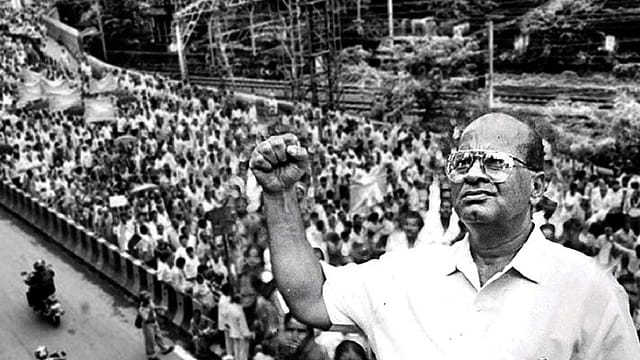
For a moment, I thought I had travelled back 40 years. For me, it was a sense of déjà vu. I had seen one too many strikes in Mumbai in the 1960s, 1970s and 1980s. Those decades witnessed considerable industrial unrest, with Dr Datta Samant emerging as one of the most powerful and confrontational trade-union leaders through organisations such as the Association of Engineering Workers, Mumbai General Kamgar Union and Maharashtra Girni Kamgar Union.
Mumbai really was a trade-union city. According to the Maharashtra Gazetteer, there were 1,079 registered trade unions in Greater Bombay in 1976.
Besides Dr Samant, other well-known labour leaders who wielded considerable influence in Mumbai included R J Mehta, George Fernandes and S Y Kolhatkar, alongside organisations linked to INTUC, AITUC and CITU. R J Mehta’s Engineering Mazdoor Sabha was an important independent union covering engineering, chemicals, printing and allied industries. S Y Kolhatkar was a founder of the CPI(M) in Maharashtra and the founding president of CITU in the state; he was particularly influential among newspaper employees.
Dr Samant represented confrontation; Mehta was identified more with negotiated industrial relations. Dr Datta Samant symbolised an era when an individual trade-union leader could wield enormous power. There are stories galore about how continuous sloganeering, demonstrations and stone pelting outside a company’s office would be used to bargain for better bonuses and higher wages for workers. Militancy was Dr Datta Samant’s middle name.
Industrial unrest had become so serious that even industrialists feared violence. One such episode involved labour unrest at the Godrej plant in Vikhroli in the late 1970s. According to a 1981 Bombay High Court record, on January 8, 1979, Naval Godrej, Phiroza Godrej and Goolbai Dastoor were stabbed at Naval Godrej’s Malabar Hill residence. Naval Godrej told the police that he suspected a connection with labour-union rivalry involving Dr Samant.
But what ultimately broke the back of militant trade unionism in Mumbai is well chronicled by the late Satish Nandgaonkar in a Hindustan Times article in February 2023. He traced the genesis of the textile strike and described how residential projects were coming up in Saat Rasta, or Jacob Circle, where textile mills and organised crime had once flourished.
Mumbai had emerged as a major global textile centre, but workers repeatedly demanded higher wages and better working conditions. Between 1928 and 1938, the city’s mills witnessed hundreds of strikes.
The biggest confrontation came in 1982 following differences over wages and bonuses and growing resentment against the Rashtriya Mill Mazdoor Sangh (RMMS), the recognised union. Dr Samant emerged as the leader of the agitation and spearheaded the January 1982 textile strike, which was supported by an estimated 2.5 lakh workers.
The strike ultimately failed to achieve its objectives and left thousands of mill workers in severe financial distress. The prolonged confrontation also accelerated the decline of Mumbai’s textile industry.
The rest is history. The collapse of the textile mills drove many workers and their extended families into penury. The social and economic dislocation also coincided with the rise of organised crime in several former mill neighbourhoods. Parallelly, Mumbai witnessed the transformation — and eventual gentrification — of vast tracts of mill land.
Against this backdrop, few in Mumbai or Maharashtra would want to see the violent and confrontational trade unionism of that era return.
This is why the news that bank unions have called for an indefinite strike from October 26 is a little unnerving. In this age of AI and automation, the nature of employment itself is rapidly changing. Bank unions’ demands include the immediate implementation of a five-day banking week, resolution of residual issues and opposition to the government’s performance-linked incentive scheme.
I wonder whether some bank union leaders are sufficiently in sync with the reality surrounding them. The days when bank strikes could bring the country to a halt are largely behind us. A simple question to ask is: when was the last time many of us visited a bank branch?
In this age of digital banking, with ATMs, UPI, GPay, credit cards and mobile banking, the dependence on physical branches has declined dramatically. Bank union leaders need to understand this changed reality. Winning public sympathy for prolonged disruption may therefore be considerably harder than it once was.
But strikes by workers associated with platform companies such as Uber, Ola, Swiggy and Amazon, especially if combined with disruptions involving autorickshaws and BEST buses, could cripple a city. So too could strikes by doctors and chemists.
In his column in Times of India titled “Gig work delivers jobs. Let’s cheer, rather than sneer,” Swaminathan S Anklesaria Aiyar argues against regulating the flexibility out of gig employment. His larger point is worth considering: excessively rigid regulation could raise the cost of gig work, reduce employment opportunities and accelerate automation.
And this is no longer a marginal workforce. India’s gig economy already employs millions and is expanding rapidly.
Finally, trade unionism may indeed be returning, but not in the Dr Datta Samant style.
The next powerful labour leader may not stand outside a textile mill or factory gate with thousands of workers booing and shouting slogans. Instead, the leader may organise thousands of delivery riders and drivers through WhatsApp, social media and apps.
And the weapon may no longer be stone-pelting or locking a factory gate. It could simply be thousands of workers logging out simultaneously.