New Rules for a World Without Rules
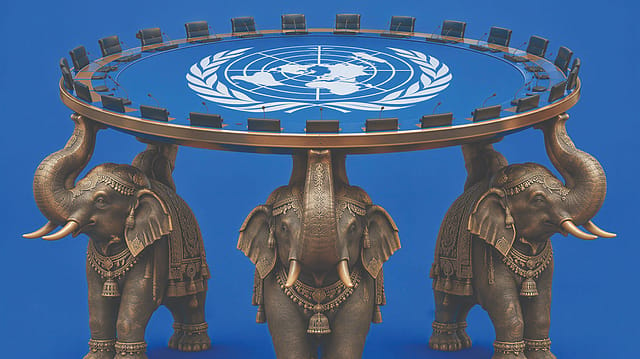
It was on the East River, at the headquarters of the United Nations (UN), that I spent nearly two decades of my working life: as a peacekeeping official grappling with the wreckage of Yugoslavia, as a close aide to that remarkable human being, Secretary-General Kofi Annan, and then as an Under-Secretary-General wrestling with the UN’s own contradictions. Those years taught me that foreign policy is not an abstraction conducted in marble halls; it is, at its heart, the management of human hope and human fear on a planetary scale.
When I returned to India, to stand for Parliament, to serve as a minister, and to chair the Parliamentary Foreign Affairs Committee, which embraces both Houses, and now to represent the people of Thiruvananthapuram in Lok Sabha for the fourth successive term, I carried that lesson with me. India, a civilisation that has absorbed and outlasted empires, has always understood that the world is larger than any one nation’s ambitions, and that our destiny is bound up with the destinies of others. Receiving the Foreign Policy Association’s medal, following honourees who have included heads of state, foreign ministers, and stewards of the global financial system, was a humbling reminder that the causes I have tried to serve, a rules-based order, a more equitable multilateralism, a foreign policy rooted in dialogue rather than domination, are causes that the Association has championed for over a century. I accepted the honour not for myself alone, but on behalf of everyone, in India and beyond, who still believes that diplomacy is a nobler instrument than the sword.
I use “still believes” deliberately, because this is a moment when that belief is under extraordinary strain. The certainties that shaped international life for three-quarters of a century are eroding before our eyes. Alliances once assumed permanent are being spurned or renegotiated overnight. Trade, long celebrated as a force for peace, has become an instrument of coercion. (We can recall Montesquieu’s celebrated notion of doux commerce, the idea that trade softens relations between countries, promoting amicable relations in order to facilitate commerce. He could not have imagined that trade would now be weaponised, with tariffs and supply-chain interruptions proving potent sources of leverage rather than of amity.) Borders are being redrawn by force rather than settled by law. The UN Charter has been ignored, along with its established principles of respect for state sovereignty and territorial integrity, the inviolability of borders, and the inadmissibility of the use of force to settle disputes. Institutions created to prevent catastrophe are being weakened, defunded, or simply disregarded by the very powers that built them. We are living, increasingly, in a world governed less by rules than by power, where the unsettling truth is that the only rule seems to be that there are no rules.
This is precisely the moment when larger vision is required, not less of it. It is fashionable, in turbulent times, to retreat into tactics: to manage the next crisis, win the next negotiation, survive the next news cycle. But tactics without vision is merely motion without direction. And history offers us a powerful lesson in what vision, applied at the right moment, can achieve.
Consider the world we inherited. It was not an accident. It was built deliberately, painstakingly, from the ashes of two World Wars that had claimed tens of millions of lives. The men and women who gathered at Bretton Woods, San Francisco and Dumbarton Oaks did not merely seek to end a war; they sought to address the conditions that had made such wars possible, after 45 years in the first half of the century that had witnessed two World Wars, countless civil wars, the massacres and displacement of millions, and the horrors of the Holocaust and Hiroshima. They knew that if the world continued like this, it was heading for self-destruction. So they consciously created a system that would subordinate power to law, to rules that all countries would honour, whether they were big or small, rich or poor, superpowers or tiny inconsequential states. President Truman memorably declared in San Francisco in 1945, at the conference that created the UN to steward the new global order, that the US and other big countries would honour the rules in the interests of all: “We all have to recognize—no matter how great our strength—that we must deny ourselves the license to do always as we please. No one nation, no regional group, can or should expect, any special privilege which harms any other nation. If any nation would keep security for itself, it must be ready and willing to share security with all. That is the price which each nation will have to pay for world peace.”
And this was a US president whose country commanded 50 per cent of the world economy at the time. Can one imagine any of his recent successors echoing such thoughts? But the leaders of that era had that kind of vision. They asked what kind of world they wanted their grandchildren to inherit, and then had the audacity, and the humility, to build institutions around that vision: the United Nations, the Bretton Woods institutions, and a body of international law that, however imperfectly applied, gave smaller nations a voice they had never before possessed.
It was not a perfect settlement. It bore, unmistakably, the fingerprints of the victors, and countries like my own spent decades contesting its inequities. But it was, for all its flaws, a system oriented towards an idea, that cooperation could triumph over conquest, that law could constrain power, that the strong could be persuaded, or at least pressured, to bind themselves to the same rules as the weak. And whatever its failures, it delivered something no prior era of human history had managed: three-quarters of a century without a war between the major powers. Regional conflicts, proxy wars, immense suffering in specific theatres, yes, undeniably. But no third global conflagration. That is not a small achievement. It is arguably the single greatest achievement of 20th-century statecraft.
That architecture is now being dismantled, not through some coordinated conspiracy, but through the accumulated choices of leaders who have concluded, each in their own capital, that the old rules constrain them more than they protect them. We are watching, in real time, the return of a world where might once again asserts a right of its own, where the strong do as they will and the weak suffer what they must. That old Thucydidean logic, which the postwar order was explicitly built to escape, is reasserting itself in Europe, in the Middle East, in the South China Sea, and in the corridors of international institutions themselves.
So what do we do now? I would argue we do exactly what that generation of statesmen did after 1945: we stop merely reacting, and we start imagining again.
We need, urgently, a new long-term vision of the world we wish to inhabit, and to build towards it with the same patient audacity our predecessors showed. But we cannot simply resurrect the old blueprint. The world of 2026 is not the world of 1945. Any new vision must reckon honestly with forces that generation could not have foreseen: the rise of artificial intelligence (AI) and its power to reshape economies, warfare, and even truth itself; the borderless threats of climate change and pandemic disease, which mock the very idea of sovereign boundaries; the diffusion of power away from a handful of capitals towards a genuinely multipolar world, in which nations like India must be architects of the new order, not merely subjects of it.
This means building institutions fit for an age of algorithms as much as an age of armies: global frameworks for the governance of AI before it governs us; economic arrangements that spread the gains of technology rather than concentrating them; security architectures that account for cyber and space as readily as they once accounted for tanks and troops; and above all, a renewed commitment to multilateralism that is more representative, more equitable, and therefore more legitimate than the one we inherited.
What does this require of a country like India? India can no longer simply ask for a seat at a table designed by others in 1945; we must help design the table itself. That means investing as much in the architecture of ideas as we do in the hardware of national power. It means training a new generation of Indian diplomats, technologists, and scholars who understand that AI governance, climate finance, and pandemic preparedness are as central to national security as any border dispute. And it means recognising that a civilisation of one-and-a-half billion people, home to some of the world’s finest engineers and technologists, has an obligation not merely to consume the rules of this new era, but to help write them.
I think, too, of the generation that will inherit whatever we build, or fail to build, in the coming years. They will judge any new global settlement not by its pedigree, but by its performance: whether it delivers peace, prosperity and dignity, or merely preserves the privileges of the powerful. If we want their faith in multilateralism, we must earn it by building institutions worthy of their scepticism. None of this will be achieved by nostalgia or cynicism, but by people willing to insist that ideas still matter, that public education in world affairs is a necessity, and that informed citizens remain the ultimate check against those who would plunge us back into darkness. I have spent my life between the world of ideas and the world of power, what my former professor, John P Roche, who was Lyndon Johnson’s adviser, referred to as “the world of conclusions and the world of decisions”. And if that journey has taught me anything, it is this: vision without power is idle dreaming, but power without vision is drift, and eventually, disaster. Our task is to fuse the two once more.
(Shashi Tharoor, a former UN under-secretary-general, is a Congress MP. He is the author of, most recently, The Sage Who Reimagined Hinduism: The Life, Lessons & Legacy of Sree Narayana Guru.
This essay draws upon a speech delivered at the Harvard Club of New York City on September 9, 2026 after the author received the Foreign Policy Association Medal)