Venom, Voltage & Volume: Can Ultraviolette’s X-47 Build a Bigger Electric Bike Business?
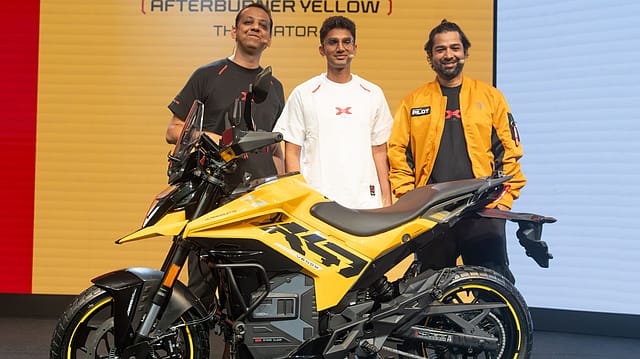
Ultraviolette’s X-47 Venom has shed weight. Underneath it sits a plan to build a much bigger company.
The Bengaluru startup’s latest electric motorcycle introduces the 100V VX-100 architecture, an engineering foundation intended to support a wider family of vehicles. The Venom is its first outing. Scooters and other motorcycles are part of the expansion ahead.
That makes this launch interesting beyond its acceleration figures. Ultraviolette is moving towards a business in which investment in batteries, motors and electronics can serve several kinds of customer.
“VX-100 is the outcome of that approach, establishing a technology foundation for a new generation of products across segments and markets,” underlined Narayan Subramaniam, CEO and cofounder.

Losing Memory
16 Oct 2026 - Vol 05 | Issue 42
The making of a medical and social emergency
The opportunity is to make those systems work harder for the company while making its vehicles more useful to riders.
Ultraviolette’s point of difference is where it has chosen to begin.
Legacy manufacturer Bajaj’s Chetak proposition centres on everyday electric scooter mobility, while Ather’s range spans family and performance scooters. Ultraviolette has built its identity around premium electric motorcycles, with the F77 and X-47 putting design, performance and riding character at the centre of the offer. Its next move takes that motorcycle-led engineering into a broader portfolio, including scooters.
That makes the VX-100 strategically important: it offers a way to widen the customer base while carrying forward a recognisable performance identity.
WHY THE X-47 GOES FIRST
There is a commercial reason for starting here.
Speaking recently to Autocar Professional, cofounder and CTO Niraj Rajmohan said the X-47 had come to account for roughly 90% of Ultraviolette’s volumes. The company is introducing its new architecture through the product already drawing the largest share of its buyers.
That gives the engineering programme a clear direction. Improvements to the X-47 can strengthen an established customer proposition while preparing technology for subsequent launches.
For a young manufacturer, this is a useful connection between product development and market experience. Customer demand helps determine where the next round of engineering goes.
The Venom, therefore, occupies two roles: an upgraded motorcycle for the current customer and the first expression of a broader product strategy.
LESS WEIGHT, MORE ROOM TO RIDE
The changes begin with a familiar electric-vehicle challenge. A larger battery can extend range, but it also adds weight that the rider has to manage.
The Venom’s 7.5 kWh version reportedly weighs 180 kg, down 17 kg from its predecessor. The 11 kWh version weighs 195 kg, a reduction of 13 kg. Both have larger batteries than the corresponding outgoing models. Those are meaningful changes for a motorcycle. Weight enters the riding experience at the parking spot, in slow traffic and whenever the bike needs to be manoeuvred.
“The X-47 Venom reflects our approach to engineering the entire motorcycle as one integrated system,” Rajmohan underlined.
The company says its SRB-11 battery technology offers up to 20% greater energy density, while an improved thermal path is designed to dissipate heat up to 50% faster. A lighter motor and a more compact controller complete the package.
The engineering aim is to carry more usable energy in a lighter motorcycle and manage heat more effectively during sustained riding.
For the buyer, that translates into a more approachable proposition: greater flexibility over how far to travel, with less mass to handle along the way.
The motorcycle’s technology also extends beyond propulsion. Its 77 GHz rear radar supports blind-spot monitoring, lane-change assistance and rear-collision warnings. Battery protection includes a pyro-fuse designed to isolate the electrical circuit within microseconds of detecting a critical fault.
Higher variants reportedly offer equipment including cruise control and camera-assisted parking. Alongside the motorcycle, Ultraviolette introduced B-MAX, a reusable rider safety vest. Together, these additions show how the company is developing the riding experience around the powertrain.
WHAT ₹2.65 LAKH BUYS
The range gives buyers a choice between battery capacity and purchase price.
The introductory ₹2.65 lakh version reportedly has a 7.5 kWh battery and a claimed Indian Driving Cycle range of 227 km. The 11 kWh Recon, with a claimed 343 km IDC range, starts at ₹3.75 lakh. These are ex-showroom Bengaluru prices; introductory pricing applies to the first 5,000 customers, with deliveries scheduled from November 2026.
The smaller battery offers a lower entry point. The larger one gives riders more range flexibility. Actual riding range will vary with speed, conditions and use.
This is also how a common architecture can support different budgets without requiring an entirely separate motorcycle for each buyer. Battery size and equipment create room to serve different preferences within the same product family.
ONE PLATFORM, A WIDER BUSINESS
The larger opportunity lies in extending that approach across distinct vehicles.
Rajmohan reportedly said that four VX-100-based products were planned over the following year. The Tesseract scooter and Shockwave motorcycle are scheduled for commercial introduction in the first quarter of 2027, while an updated F77 is also under development. The precise four-model line-up has not been fully specified.
A shared architecture gives the company scope to reuse development work, purchase components in greater volumes and build manufacturing familiarity across products.
It can also help technical improvements travel through the portfolio. Work on cooling, electronics or charging can become relevant to more than the motorcycle that first introduces it.
For Ultraviolette, this opens an important route to expansion. A performance motorcycle can establish the brand’s engineering identity. A scooter or a motorcycle with a different riding purpose can bring that expertise to another group of buyers.
Those customers need not want the same design, performance or purchase price. The shared foundations allow the company to pursue them through differentiated products.
THE GLOBAL PARALLEL: DESIGNING AROUND ELECTRIC
The broader industry is exploring what a motorcycle can become when its design starts with an electric powertrain.
Honda’s WN7 offers an instructive example. In its technical explanation of the European-market motorcycle, Honda describes how battery placement and a structure using the battery pack as part of the vehicle’s skeleton help achieve its packaging and handling goals. Ease of use in daily riding is central to the development brief.
The relevance to Ultraviolette is the engineering approach. Batteries, chassis layout and riding characteristics are being developed together to shape the complete motorcycle.
That gives Indian manufacturers an opportunity to compete through product development. The questions extend to how a bike carries its weight, fits its rider and works on an ordinary journey.
The Venom’s combination of larger batteries and lower weight belongs within that wider effort to make electric motorcycles more versatile.
CHARGING BECOMES PART OF THE PRODUCT
Ultraviolette says the Venom supports DC fast charging at up to 12 kW. Faster charging can widen the range of journeys a rider is comfortable planning.
The company has also been working on infrastructure. In an earlier public announcement, Subramaniam described a Bolt.Earth partnership targeting 2,000 chargers over 24 months. The programme included 3 kW equipment, with higher-output 6 kW and 12 kW chargers planned.
This is a staged network expansion, with charging speed depending on the equipment available at a particular location.
For a rider with home charging, the everyday benefit may be starting each morning with a charged battery. Public fast charging adds flexibility for longer trips or days when plans change.
The commercial value comes from combining these options into an ownership experience that feels easy to live with.
FROM A FLAGSHIP TO A FAMILY
Ultraviolette’s volume ambitions reflect the breadth of that proposed business.
Rajmohan reportedly said the company was working towards approximately 1,000 vehicles a month and targeting around 10,000 a month by October 2027, supported by new products and manufacturing expansion.
Reaching more buyers will involve showrooms, service capacity, financing and dependable support alongside the motorcycles themselves. At premium prices, customers will also weigh the experience against familiar petrol alternatives.
A broader portfolio gives Ultraviolette more ways to enter that consideration set. The X-47 can appeal to one riding preference, the F77 to another, and a scooter to a different daily routine.
The company is also taking the Venom to Europe, with its launch scheduled for November 3 at EICMA 2026 in Milan. Ultraviolette says it already exports to 20 European countries.
The VX-100 provides a way to connect those ambitions through shared engineering. Its significance lies in how much of the company’s development effort it can carry into future vehicles.
The Venom is the first beneficiary. Ultraviolette’s bigger bet is that the same work can power a whole family.