The Internet Connected Everyone. Now Startups Are Selling the Meet-Up
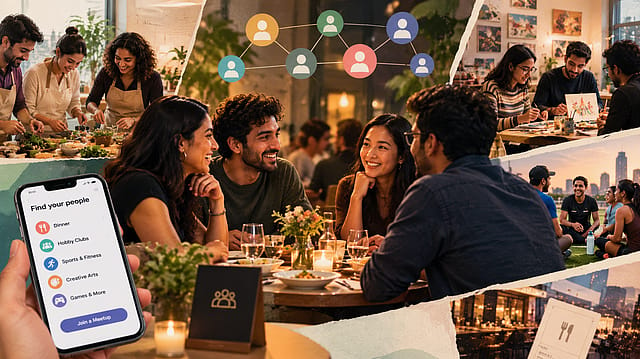
At a Timeleft dinner, customers pay separately for two things: the restaurant’s food and the platform’s arrangement of the company.
Subscribers answer questions about their interests and personality. The service assembles a small group and provides the venue details. Participants then pay for their meals and drinks directly.
The distinction explains the product. Restaurants already provide somewhere to eat. Timeleft organises an occasion on which strangers have agreed to meet.
That coordination has value. It removes some of the uncertainty involved in approaching new people: where to go, whom to invite and whether anyone else wants the same kind of evening.

Losing Memory
16 Oct 2026 - Vol 05 | Issue 42
The making of a medical and social emergency
Across dinners, hobby clubs and activity-based gatherings, startups are building businesses around reducing the effort required to socialise. The commercial challenge begins when a successful introduction becomes an independent friendship.
If customers can arrange the next meeting themselves, what will persuade them to pay again?
A DIFFERENT KIND OF SOCIAL PRODUCT
The opportunity has attracted investors who helped finance earlier generations of consumer businesses.
Pie, led by Bonobos co-founder Andy Dunn, enables people to discover and organise in-person plans. In explaining its investment, Origin Ventures highlighted both the discovery of gatherings and tools that simplify planning with existing friends. Forerunner Ventures led the funding round it joined.
Those functions address related but distinct problems. Meeting someone new requires discovery. Gathering people who already know each other requires coordination.
The latter could prove important to retention. A service that remains useful after an introduction has more opportunities to earn a continuing place in the customer’s life.
Demand for participatory experiences also has supporting evidence. Eventbrite’s 2026 Social Study identifies an interest in low-pressure gatherings, with platform data showing growth in activities including puzzle competitions and flower arranging. These findings describe activity within its marketplace rather than the whole population.
For entrepreneurs, the relevant insight is that an activity gives strangers something to do together. Conversation can develop around a shared task rather than carrying the entire evening.
INDIA HAS ITS OWN FORMATS
Misfits applies that logic through hobby-based communities.
Founded in 2022 by Shashwat Narhatiyar, Chaitanya Dhawan, Saurabh Sharma and Shaswat Kar, the Gurugram-based company raised ₹5 crore in seed funding announced in May 2025, co-led by Info Edge Ventures and Better Capital.
Its model centres on clubs and recurring meetups. The company recruits club leaders and venue partners, while its app helps people discover communities and activities.
Small World offers another version, with memberships covering experiences including dinners with strangers and organised sporting activities. Timeleft also markets dinners in Delhi.
These offerings establish that paid social coordination is already being attempted in India. Their long-term economics depend on more than the willingness to try an unfamiliar evening.
The relevant questions concern attendance, repeat purchases and the cost of delivering an experience people trust.
THE SUCCESS PARADOX
A platform arranging introductions faces an unusual retention problem: a customer’s departure can reflect a good outcome.
People who meet and become friends may move their plans to a group chat. The business has delivered value, but its role in subsequent gatherings can shrink.
That creates several possible strategies.
A service can continue introducing customers to new people. It can provide activities, hosts or venues that remain worth purchasing. It can simplify plans for established groups. Or it can build a recurring club whose value includes continuity.
Each approach needs different evidence.
A large registration count may demonstrate curiosity. Repeat paid attendance would establish more about ongoing value. Event-level revenue must be considered alongside venue costs, hosting, support, refunds and customer acquisition.
The crucial distinction is between people wanting more social connection and people repeatedly choosing a particular company to arrange it.
DENSITY BEATS DISTANCE
Expansion also behaves differently from a purely digital service.
A user can consume online content produced anywhere. An offline gathering requires suitable people to be available within a practical distance, at a compatible time and price.
A citywide audience can therefore conceal weak local availability. Someone seeking a weekday activity close to home may find little value in a large network concentrated across town.
This makes neighbourhood density commercially significant. A smaller local base with frequent, dependable events may offer a better experience than a bigger but dispersed audience.
Expansion requires rebuilding that density: participants, hosts, venues and enough suitable occasions to keep them engaged.
The app can help organise the system. It cannot substitute for the people who make the gathering work.
THE HOST IS PART OF THE PRODUCT
An evening’s quality depends on details that are difficult to automate completely.
Someone must manage late arrivals, include quieter participants and respond when expectations differ. Venue noise, seating and accessibility can affect the experience as much as matching preferences.
Misfits’ recruitment of club leaders and venue partners reflects the importance of this local operating layer. Its venue proposition includes recurring meetups intended to generate footfall.
That relationship can create value for both sides. A venue receives customers; the community receives a place to gather.
It can also introduce tensions. The venue may prefer higher spending, while participants want an affordable experience. Growth must preserve enough consistency that customers know what they are buying.
Trust is particularly important when people attend alone. Clear conduct rules, responsive support and workable complaint handling form part of the service’s value.
WHAT REMAINS WORTH PAYING FOR?
The most durable businesses in this category may earn through continued usefulness rather than endless introductions.
A well-run club can provide a reliable calendar and a familiar community. A dinner service can reduce organisational effort. An activity provider can supply equipment, expertise or access that friends would struggle to arrange independently.
These are concrete services with potential value beyond the first encounter.
Their success should not require treating every unstructured social interaction as a market waiting to be captured. Free communities, informal groups and public spaces remain alternatives—and help establish what a paid service must improve upon.
The opportunity is to make gathering easier and dependable enough that customers return voluntarily.
Timeleft’s separate charge for arranging company makes that proposition unusually clear. The food has an established price. The emerging business is discovering what people will pay for the occasion—and what must be delivered to earn the next booking.