Inside Easy Business Solution's Next Act: Can a 20-Year-Old Bootstrapped Indian Enterprise Software Firm Go Global?
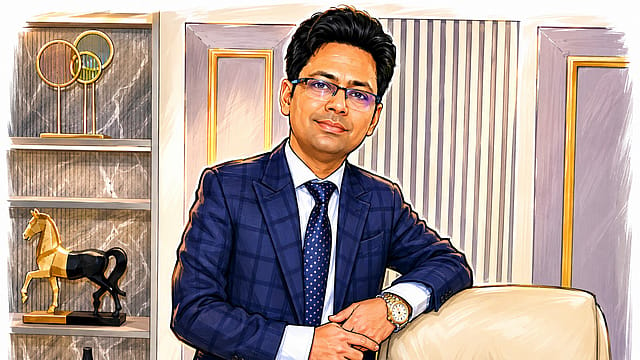
For nearly two decades, Kunal Singhal has had something many startup founders spend years trying to acquire: control.
The Managing Director of Eazy Business Solutions built the enterprise software company without institutional funding, starting in 2007 with an idea that was almost mundane in its simplicity. While auditing manufacturers in Bhiwadi, Rajasthan, Singhal noticed that companies had adopted ERP (enterprise resource planning) systems for operations but continued to rely on Tally for accounting. The result was parallel accounting, duplicated work and disconnected systems.
Singhal happened to understand both sides. He was a Chartered Accountant by qualification and had been programming since school days. “I understood programming, I understood Tally and I understood the perspective of an accountant,” he says in an exclusive conversation with OPEN Digital. The solution was Eazy ERP, a Tally-integrated ERP designed around the way Indian manufacturers actually worked.

Zeroing In on ECI
09 Oct 2026 - Vol 05 | Issue 41
Constitutional legitimacy versus political opportunism
Nearly 20 years later, the company has about 700 customers across FMCG, consumer durables and electricals, construction materials and auto components, among other sectors. It has customers in around seven countries and is expanding in Africa and the Middle East. Its products now extend beyond ERP into distribution management, CRM, sales force automation and other enterprise applications.
Yet Singhal is confronting a paradox that is increasingly common among successful bootstrapped businesses. The independence that helped Eazy survive may now be limiting how quickly it can grow.
“We are contemplating a fundraise now,” he says.
The reason is not survival. It is acceleration.
“We have a beautiful portfolio of products. We have an amazing client set working with us. We are getting traction in international markets. But with my organic capacity, I have limitations to how much I can play at one time.”
That could make the next phase of Eazy's journey more consequential than the first.
The cost of staying bootstrapped
Eazy's financials show a business that is profitable, but not yet operating at the scale Singhal believes it can reach.
According to regulatory filings accessed by Tofler, Eazy ERP Technologies Private Limited reported total revenue of ₹32.4 crore for the financial year ended March 2025, up 11.31% from the previous year. EBITDA stood at ₹3.7 crore, while net profit was ₹2 crore. The filing data also shows net worth at ₹17.1 crore, assets at ₹28.8 crore and borrowings at ₹6.1 crore. EBITDA and net profit declined 46.73% and 61.15%, respectively, even as revenue grew.
The numbers make Singhal's ₹100 crore ambition look less like an imminent milestone and more like a strategic challenge.
“Not even close,” he says when asked whether Eazy has reached the ₹100 crore revenue mark.
There is a reason for the gap. Eazy had begun exploring a fundraise in the previous financial year and had an investor that had almost committed. Had that investment gone through, an acquisition would also have happened, and Singhal believes the company could have reached ₹100 crore this year.
Without that capital, he estimates another two or three years of organic growth.
“Definitely, it matters,” he says when asked whether the absence of funding has slowed the company down. “There have been years when we had such perfect opportunities and just because we did not have the right funds, we could not take those up.”
It is an unusual admission from a founder who spent years defending the logic of staying bootstrapped.
But Singhal's relationship with funding has evolved.
When Eazy was younger, funding simply was not an obvious option. By the time India's startup ecosystem began accelerating around 2014-15, Eazy was already seven or eight years old. Singhal says investors he met were often looking for the familiar startup credentials.
“You have to be an IIM and an IIT. Then you get funding. You don't get funding for being a CA,” he recalls.
The irony is that the rejection may have helped Eazy. Singhal believes outside capital would have meant giving up control much earlier.
His thinking changed after a conversation with investor and mentor Alok Mittal. When Singhal posted about completing 10 years, having 100 employees and ₹5 crore of turnover, he received a call from Mittal.
Singhal was comparing himself with manufacturers who had spent decades building much larger businesses, while looking at startups that seemed to be scaling at extraordinary speed.
Mittal's response became a permanent reference point.
“Kunal, for that, you have to first decide whether you want to be 100% owner of a ₹5 crore company, or you want to be a 50% owner of a ₹100 crore company.”
The sentence forced Singhal to confront a possibility that had been difficult to articulate: perhaps the founder himself had become a constraint on the company's growth.
“I am becoming a limitation to my own growth and I need to think otherwise,” he says.
That is where Eazy's next chapter begins.
From Indian ERP to global challenger
The company's ambition now extends beyond crossing ₹100 crore.
Eazy has already acquired one company called Recibo, Singhal says, and is looking at two more acquisitions over the next year. A fundraise would help finance those acquisitions as well as accelerate international expansion.
The company currently derives around 90% of its revenue from India and 10% internationally. Singhal wants the international contribution to reach 15-20% in the current financial year and increase further.
Eazy has established a team and office in Kenya to serve Africa. A Middle East office, delayed by the regional war situation, is expected to be established by the end of this year or early next year.
Its international expansion has also produced an important lesson in what it means to take Indian enterprise software abroad.
Before entering Africa, Eazy had upgraded its mobile application based on its Indian customer base of around 20,000 users. In India, Singhal says, practically no one was using anything below Android 12. In Africa, the company discovered customers still using Android 8.
“We had to redo the whole application for backward compatibility. It took us about six months,” he says.
Technology localisation was only one lesson. Business culture was another.
In India, an MD is often the owner or promoter. A deal closed by the MD can therefore be considered almost final. In Africa, Singhal discovered that the MD could be an employee, and a seemingly closed deal could still need board approval three months later.
“Every geography has its own learning,” he says.
Yet there is a larger opportunity in Eazy's existing customer base. Singhal says the company has around 20 to 30 multinational customers in India and is trying to use those relationships to enter their global operations.
Philips is the clearest example. Eazy first won the customer in India and was subsequently recommended to its global operations. The company now works across about 18 countries for Philips.
That strategy could allow Eazy to internationalise without having to build every market from scratch.
But getting customers abroad is not the same as building a global technology brand.
And this is where Singhal sees his biggest battle.
“We are not that startup company anymore that we are looking for advertisements or visibility to acquire customers,” he says. “Customer acquisition now today happens within the referral framework. But we're struggling by creating that brand perception.”
The problem is the company Eazy now keeps in the same competitive frame.
SAP. Salesforce.
“How do I go to a prospect and say, ‘Sir, my Salesforce solution?’” Singhal asks.
For him, this is not simply a marketing problem. It is an Indian technology problem.
India has successfully built global credibility in IT services and outsourcing. Singhal believes the next challenge is convincing customers that Indian companies can also build enterprise technology products capable of competing with global incumbents.
“There are enough tech product companies in India who have proven their mark,” he says. “There are enough companies who are doing HR solutions, CRM solutions, ERP solutions.”
His argument is that India needs to move from “business outsourcing or BPO” to technology products that can be built in India and sold to the world.
The question Eazy now faces is whether it can become one of those companies.
The AI test
Ironically, the technology that could help close that perception gap is also changing the enterprise software industry itself.
Singhal says Eazy once spent roughly ₹1 crore trying to develop AI at a time when the underlying technology was far less capable. Eventually, the company had to abandon that development.
The lesson has shaped its current AI strategy.
“We don't want to add AI simply because it is a buzzword,” he says.
Instead, the company wants AI applications that produce measurable operational value, whether that means saving money, improving efficiency or reducing costs.
That philosophy is also being applied internally. Singhal says Eazy has spent months pushing employees to become AI-driven. The company does not intend to replace employees simply because of AI, but resistance to using it is becoming unacceptable.
His own experience illustrates why.
A programmer since childhood, Singhal says he had moved away from coding as the company grew. He did not know newer technologies such as React or Node. AI changed that.
“I don't need to know the language. I need to know what I want. I need to know what direction to be given to it.”
But he is equally wary of the idea that AI makes expertise irrelevant.
“AI is like a Ferrari in everyone's hands, but you still need a driver sitting on it.”
For an enterprise software company, that distinction matters. A prototype can be built quickly with AI. An enterprise-ready product that customers trust with critical business processes is another matter.
That returns Eazy to the principle that has underpinned its business from the beginning: trust takes time.
Singhal recalls buying a Kia and being asked to compare it with Honda and Toyota. His response was that a new car might be good, but Honda and Toyota have accumulated something that cannot be manufactured overnight.
“Trust comes with time. You cannot fast-track it.”
The same, he argues, applies to startups.
“I have seen quite a few startups within my sector who have raised like $100 million, spent those $100 million to acquire customers and still not been able to reach wherever we reached organically.”
Money can accelerate a business, he believes. It cannot compress years of customer experience into months.
“If something was supposed to be done in two years, we'll fast-track it to one year. But you cannot fast-track five years into five months. It won't work.”
That may also explain why Singhal is approaching his own fundraise differently.
Eazy is not raising money to discover whether its business works. It is raising money because it believes the model already works and wants to multiply it.
The company wants more countries, more customers, more acquisitions and eventually, potentially, an IPO. Singhal says a public listing could come three or four years after a fundraise, although it is not an immediate plan.
The harder task, however, may not be capital.
It may be changing how the market sees the company.
For 19 years, Eazy's advantage has been that it understood Indian businesses intimately. It began because a CA-programmer saw manufacturers running two systems when one should have been enough. Its first customers came through family reputation and referrals. Its growth came without the venture capital cheques that powered much of India's startup boom.
Now it wants to compete beyond that ecosystem.
Singhal's philosophy has remained remarkably consistent even as the ambition has changed. Eazy will not sell something it does not have. It will not make promises it cannot fulfil. It will not attack competitors to win customers.
“No mis-selling, no overselling,” he says. “We will never sell anything we don't have. We will never make promises that we don't have.”
For a company that spent almost two decades proving it could survive without outside capital, the next test is very different.
Can it use outside capital without losing what made it valuable in the first place?
And can a software company born from the quirks of Indian manufacturing convince the world that it does not need to imitate SAP or Salesforce to compete with them?
That is the real bet behind Eazy's next phase.