India Post Says It Loses ₹68 Crore a Day. Can Its Assets Change the Equation?
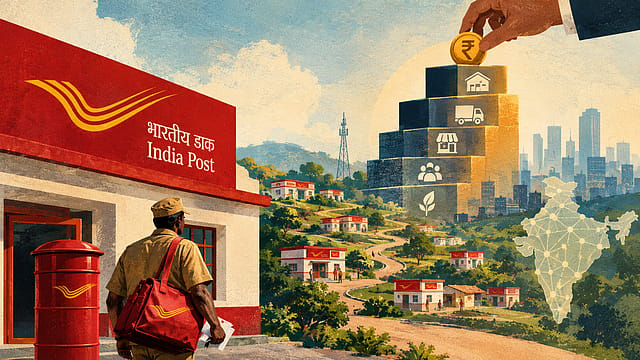
Every day, India Post delivers mail, moves parcels, handles savings and insurance transactions, and provides access to government services across a country where private businesses do not always find it profitable to operate. It is also sitting on something that most businesses spend years trying to build: a nationwide physical network, a recognised public identity and a presence that extends well beyond the major cities.
Yet the scale that makes India Post indispensable is also a source of financial strain. A new independent study by Prequate Advisory puts the cost of its current operating model at approximately ₹68 crore a day. The report’s central argument is that the Department of Posts should be assessed not merely as a government department that requires expenditure, but as a network whose property, infrastructure and reach may be capable of generating considerably more income.

Zeroing In on ECI
09 Oct 2026 - Vol 05 | Issue 41
Constitutional legitimacy versus political opportunism
The report, India Post: The Latent Report 2026, estimates an enterprise value of ₹1,93,767 crore. It arrives at this figure using discounted cash flow and sum-of-the-parts approaches, drawing on valuation methods used for listed businesses such as HDFC Bank, DMart, Delhivery, BLS International, Awfis and Vakrangee. The authors argue that the value lies in assets and capabilities that conventional accounting does not fully capture.
That is a striking proposition. It is also a model-based estimate, not a market price, an audited valuation or a figure endorsed by the Department of Posts. The distinction matters because the report is not saying that India Post could sell itself for nearly ₹2 lakh crore tomorrow. It is making a case for what the organisation might be worth if its existing resources were converted into viable commercial activity.
The difference between those two propositions is where the real story begins.
A network that private businesses would struggle to replicate
India Post’s physical footprint is extraordinary. The report puts its landholding at 121 lakh square metres, or 12.1 square kilometres, and describes a network of more than 1.64 lakh post offices. The value of such infrastructure is not simply the sum of the plots on which its buildings stand. It also lies in their distribution: the locations are already embedded in communities, including places where the economics of setting up a private retail, logistics or financial-services outlet may be less attractive.
For a conventional company, building a comparable network would require years of investment in property, staffing, technology and local relationships. India Post has already made that investment over generations. Its offices, postal workers and established relationships with citizens give it a potential advantage in reaching customers, delivering services and supporting businesses that need a presence beyond the largest markets.
But an existing network is not automatically a productive commercial asset. A building can have a high theoretical value and still generate little income. A location may be useful for delivering letters or providing access to government schemes but unsuitable for a warehouse, a retail kiosk or a flexible office. Commercial value depends on local demand, the condition and accessibility of property, the cost of conversion and the ability to attract paying customers.
The challenge, therefore, is not simply to establish what India Post owns. It is to determine which parts of that network can earn money, what investment they require and whether the resulting returns justify the cost.
Revenue is rising. The cost question remains.
The financial picture is not static. India Post reported revenue of ₹15,296 crore in FY2025-26, a 16 per cent increase over the previous year, according to the Ministry of Communications. The government has also reported strong growth in parcels and other services, signalling an effort to expand beyond the traditional business of letters and stamps. In the first quarter of FY2026-27, revenue reached ₹4,008.95 crore, up 22.2 per cent year on year, the ministry said in July.
These numbers complicate any simple narrative of an organisation in decline. India Post is growing its revenue and attempting to reposition itself as a more commercially responsive service provider. The government’s stated ambition is to turn post offices into profit centres over the coming years.
However, revenue growth is not the same as profitability. A department can collect more money while continuing to spend substantially more than it earns. The latest growth figures do not, by themselves, establish how much of the additional revenue translates into a reduction in the overall deficit.
The Department of Posts’ annual report for FY2023-24 recorded revenue of ₹11,321.35 crore and gross working expenditure of ₹35,645.52 crore. After recoveries, net expenditure stood at ₹34,389.64 crore, producing a reported revenue deficit of ₹23,068.29 crore. These figures belong to an earlier financial year and should not be treated as a measure of the current deficit; they nevertheless illustrate the scale of the historical gap between the cost of running the network and the revenue it generated.
The ₹68-crore-a-day figure in Prequate Advisory’s report should therefore be read in the context of its own methodology. It is a headline description of the cost of the current model, not a substitute for examining the department’s latest audited accounts. The report’s valuation case ultimately depends on whether new business can generate incremental returns after accounting for staffing, technology, maintenance, logistics and the investments required to make underused property commercially functional.
Five ways to make the network earn
Prequate Advisory screens more than 100 possibilities before narrowing its recommendations to five broad opportunities. These include on-demand warehousing, a national hub for consumer and government services, customer-facing kiosks in underused real estate, managed camps in rural post offices and flexible office spaces in locations where demand could support them.
The ideas share a common logic: use what already exists rather than begin by building an entirely new network. But each would require a different operating model.
Warehousing, for instance, could allow India Post to use selected properties and its existing distribution capabilities to serve businesses that need storage and delivery. The opportunity would depend on the location of the facility, available space, transport links, technology and the reliability of fulfilment. Storage space alone does not make a competitive logistics business. Customers need predictable service, inventory management and the ability to move goods efficiently.
A hub for consumer and government services would use the post office as a point of access for services that may otherwise require citizens to travel or navigate multiple providers. This could build on the department’s existing public-facing role. Yet the economics would depend on which services are offered, who pays for them, how transactions are processed and whether the model produces enough income to justify the additional work.
Kiosks offer another route. Underused areas within suitable post offices could potentially host consumer services or retail offerings. Such arrangements might generate rental income or a share of transactions without requiring India Post to operate every business itself. But the value of a kiosk would depend on footfall, the relevance of the service to local customers and the terms of the commercial partnership.
Managed camps at rural post offices and flexible office spaces are similarly location-dependent. A rural post office might be a useful base for a periodic service camp, while a property in a commercially active area could support shared workspace. Neither opportunity can be applied uniformly across the network.
The distinction between a nationwide asset and a nationwide business is crucial. India Post may have a presence across thousands of locations, but demand, purchasing power, property suitability and competitive conditions vary widely. A viable strategy would need to identify the right use for eac