Guess, Who is Counting Every Second! How Legacy Watch Brands Are Trying To Get Back In The Game
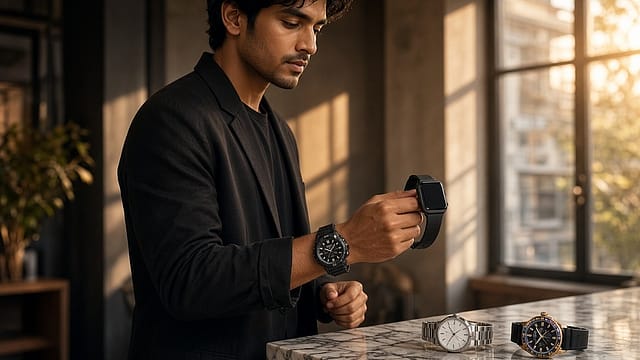
For much of the last decade, the Indian watch industry had a straightforward problem: the smartphone had made the watch less necessary, and the smartwatch appeared to make it obsolete. The latter, however, has not quite happened. India's smartwatch market is now shrinking, particularly at the mass end, even as traditional watch brands find new reasons to sell an object whose basic function has long been replaced by the phone.
The shift is visible in where brands are putting their money. G-SHOCK has Vicky Kaushal fronting its Luxe Black collection. GUESS Watches has appointed Tamannaah Bhatia as its India brand ambassador. Daniel Wellington has brought in Sharvari. These campaigns are not selling watches primarily as instruments. They are selling them as extensions of personal style.“People wear watches because they express personality. That is why Timex has remained focused on fashion watches while participating selectively in smartwatches. I believe the next breakthrough will not be another screen on the wrist but hybrid watches that quietly combine health tracking with traditional design. Technology should disappear into the product, not dominate it," Deepak Chhabra, Managing Director, Timex India said in an earlier interview with Open Digital.

Zeroing In on ECI
09 Oct 2026 - Vol 05 | Issue 41
Constitutional legitimacy versus political opportunism
That matters because the smartwatch boom changed what consumers expected from something worn on the wrist. A smartwatch has to justify itself through features, sensors and connectivity. An analogue watch can justify itself through design, brand, material and cultural relevance. For brands trying to attract younger consumers, that distinction is becoming commercially useful.
Why are smartwatch sales falling in India?
India's smartwatch correction is now difficult to dismiss as a temporary slowdown. Shipments fell 9% year-on-year in the fourth quarter of 2025, following declines of 22% in the third quarter, 27% in the second and 33% in the first, according to Counterpoint Research.
The weakness has been concentrated in the affordable segment, which drove much of the category's initial expansion. Once basic features such as notifications, step tracking and heart-rate monitoring became standard across a large number of inexpensive devices, there was less incentive for consumers to replace them frequently.
The premium end tells a different story. Counterpoint found that India's ₹15,000-₹30,000 smartwatch segment doubled in the fourth quarter, while the ₹20,000-₹30,000 segment grew 1.5 times year-on-year in the third quarter. The market, in other words, is not rejecting smartwatches so much as becoming less interested in undifferentiated ones.
For traditional watchmakers, this creates an opening, but not necessarily because consumers are moving from smartwatches back to analogue watches. The more significant change is that the wrist is no longer being judged only on utility.
What does Gen Z want from a watch?
There is little evidence to support the simplistic idea that Gen Z is abandoning smartwatches for analogue watches. Younger consumers are still important buyers of connected devices, and the premium smartwatch segment is growing.
What has changed is the basis on which a traditional watch can compete.
Timex Group India's annual report identifies Millennials and Gen Z as an important consumer base and points to the continued preference for analogue watches among Indian consumers. The opportunity, therefore, is not necessarily to make young consumers choose analogue over digital. It is to give analogue a different role.
A smartwatch is generally evaluated by what it does. An analogue watch is increasingly evaluated by what it looks like and what it says about its wearer.
That makes the category closer to fashion than consumer electronics. The watch becomes part of an outfit, an accessory bought for a particular aesthetic or a marker of taste. It can also be worn alongside a smartwatch rather than instead of one.
For brands, that is a more interesting proposition than trying to win a technological contest they cannot win.
Why are watch brands turning to celebrities?
The recent celebrity appointments are significant because traditional watches are difficult to differentiate on function. Once the basic job is simply to tell time, brand meaning does much of the remaining work.
G-SHOCK's Vicky Kaushal campaign illustrates the point. The brand does not need to explain the durability of a G-SHOCK to consumers familiar with the name. Its Luxe Black collection instead takes the familiar 2100 silhouette into a more fashion-led space. Kaushal becomes part of that repositioning, bringing the product closer to contemporary menswear and lifestyle culture.
GUESS Watches is making a similar move through a different identity. Tamannaah Bhatia places the brand within India's celebrity and fashion ecosystem, where a watch can function as an accessory rather than simply a timepiece.
There is also some evidence that this is happening against a backdrop of growth rather than distress. Timex Group India reported revenue of ₹800 crore in FY26, up 48% from the previous year, while profit before tax increased 151% to ₹107.4 crore. GUESS Watches grew 51% during the year and the company's e-commerce business grew 90%.
The celebrity strategy, therefore, is not necessarily a rescue operation. It is a way of expanding the addressable audience for brands that already have traction.
Daniel Wellington's Sharvari association operates in the same territory, albeit with a different aesthetic. Its minimalist positioning gives it a more understated route into the same conversation: the watch as a visible part of personal style.
The choice of celebrity matters because each brand is effectively selling a different version of the same proposition. G-SHOCK sells attitude and toughness. GUESS sells fashion and glamour. Daniel Wellington sells minimalism.
The watch is the product. The identity around it is the pitch.
Is the traditional watch becoming a fashion product?
It never stopped being one. But the smartwatch has made that aspect of the category more commercially important.
There is little point for an analogue watch brand to compete with a smartwatch on notifications, health tracking or connectivity. Its defensible territory is physical and emotional: design, craftsmanship, materials, heritage, brand recognition and the pleasure of owning something that does not need an operating system.
Market estimates point to the continued scale of the category. Mordor Intelligence estimates that quartz and analogue watches accounted for 56.45% of India's watch market in 2025, with premium models expected to grow at an 8.53% CAGR through 2031. PS Market Research puts the share of quartz and analogue watches at around 60% of market revenue.
Titan's performance also offers a useful indication of where demand is moving. Mint reported that analogue revenue in Titan's watches and wearables division grew 20% in FY25, while the company's management said its mainline analogue business remained strong even as smartwatch demand weakened following the boom of 2022 and 2023.
This is less a story of analogue defeating digital than of the two categories settling into different roles.
What are watch brands actually selling to young Indians?
Increasingly, they are selling distinction.
The smartwatch market made the wrist highly functional and relatively standardised. The traditional watch has an opportunity to move in the opposite direction. Its value can come from being recognisable, distinctive or aesthetically specific.
That explains the industry's growing interest in collaborations across fashion, music, art, gaming and popular culture. G-SHOCK, for instance, has spent years extending itself beyond its original proposition of rugged utility into lifestyle and cultural collaborations.
Casio India's FY25 revenue of ₹907.64 crore, up 15% year-on-year, also shows that the broader business remains substantial in India. The figure covers Casio's overall portfolio and is not a G-SHOCK-specific number, but it underlines the scale of the market the company is building around its brands.
The strategy is particularly relevant for younger consumers because the traditional watch does not have to compete for the same reason as a smartwatch. One can be worn to track a run; the other can be worn because it works with a particular outfit.
That is a subtle but important change in the industry's pitch.
Can celebrity marketing actually make young Indians buy watches?
This is where the strategy has its limits.
Celebrity association can generate attention, search interest and cultural relevance. It can make an otherwise familiar product feel current. But none of those things guarantees purchase.
A consumer may like the way Vicky Kaushal wears a G-SHOCK and still find the price too high. Someone drawn to Tamannaah Bhatia's GUESS campaign may still choose a smartwatch because health tracking matters more. Sharvari can make Daniel Wellington relevant to a younger audience without necessarily changing how often that audience wears an analogue watch.
The product therefore has to carry the campaign. Design, price, distribution and brand credibility still determine whether attention converts into sales.
For watchmakers, the challenge is particularly acute because celebrity marketing can create relevance quickly, but it can also make brands look interchangeable if everyone adopts the same playbook.
The distinction will ultimately have to come from the product itself.
Are smartwatches and analogue watches still competing?
Not as directly as they once were.
The smartwatch is evolving into a more premium, health and ecosystem-led product with brands like Garmin, Indian brands like Gabbit and more mass brands like Noise, Boat etc. The analogue watch is moving further into fashion, design and lifestyle. Their functions overlap only at the most basic level.
That leaves room for consumers to own both. A smartwatch can serve as a practical device during the day or during exercise, while an analogue watch can be chosen for a meeting, an evening out or simply because it looks better.
For traditional watch brands, that is the opportunity. They do not need to persuade young Indians that analogue technology is superior. They need to persuade them that a device whose technology has barely changed can still have cultural value.
The smartwatch made the wrist functional. The traditional watch is now trying to make the wrist personal again.