Ex-Zepto CXO Shashank Shekhar Sharma Launches Solgram to Bring Quality Back to Online Grocery
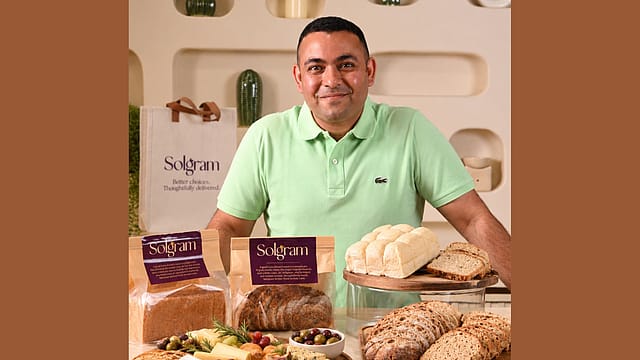
A packet of milk delivered in ten minutes is convenient. But how it was stored before it reached the delivery executive is a different question. The same applies to a box of chocolates, a packet of paneer, a bunch of blueberries or a carton of ice cream. The delivery may be quick, but the quality of the product depends on what happens much earlier in the journey.
It is a question that India's quick-commerce industry has increasingly been forced to confront. In October, food-safety inspections at quick-commerce dark stores in Hyderabad uncovered expired products, spoiled vegetables, pest infestations, poor storage conditions and inadequate cold-room maintenance. Four facilities had their licences suspended. In Uttar Pradesh, a separate inspection drive across 218 establishments resulted in 154 improvement notices and six licence suspensions. Earlier, in July, the Food Safety and Standards Authority of India (FSSAI) had issued nine notices to Swiggy Instamart following consumer complaints about expired, spoiled and contaminated products.

The Era of Forever Wars
30 Oct 2026 - Vol 05 | Issue 44
Coping with an explosive Middle East
These findings do not mean that every quick-commerce operation compromises food quality. But they expose a vulnerability in a business model whose most visible promise is speed: the infrastructure behind the delivery matters as much as the delivery itself.
For Shashank Shekhar Sharma, who has spent time inside the quick-commerce business as a former CXO at Zepto, this is an opportunity. His new venture, Solgram- a premium, quality-led grocery platform built around an end-to-end temperature-controlled cold supply chain, wants to build an online grocery platform where the selling point is not how quickly an order arrives, but the quality of what arrives.
The company has raised over $1 million in a pre-seed funding round led by DSG Consumer Partners and Saama Capital, with serial hospitality entrepreneur Kapil Chopra participating as an angel investor. The round closed within a quarter of Solgram's launch in Gurugram.
"Having worked in quick commerce, I understood the internal mechanics of the business. I could clearly identify a gap that needed to be addressed," Sharma told OPEN Digital.
He believes that gap exists at two levels. The first is the cold supply chain, where product quality can deteriorate between sourcing, storage and delivery. The second is the evolution of online grocery shopping. Quick commerce has made ordering everyday groceries easier, but he believes consumers looking for better-quality, specialised and health-conscious products are still underserved.
"A manufacturer may do its best to produce a high-quality product, but what happens when it leaves the factory? What happens when it moves from the store to the customer and eventually reaches the kitchen table? That is where the breakdown happens," he says.
The quality premium
The timing of Solgram's entry is interesting. India's quick-commerce market is no longer a small experiment in urban convenience. According to a Google and Redseer report released in October 2026, the market is estimated at approximately $13 billion in FY26 and could grow to $70-90 billion by FY31. Its next phase of growth will depend partly on getting consumers to move beyond small, immediate purchases towards larger, planned household grocery baskets.
But getting consumers to buy more online involves addressing concerns beyond convenience. In its research, Redseer identifies assortment, pricing, and quality and hygiene as important barriers to increasing planned grocery purchases. Nearly one-third of surveyed metro users expressed concerns about the freshness and handling of products.
This is where Sharma sees an opening. He is not trying to persuade consumers that quick commerce is a bad way to shop. Rather, he wants to build a specialised alternative for people who are willing to pay attention to what goes into their shopping baskets.
"Most quick-commerce platforms started with the biggest possible consumer base. They began with products such as chips, Maggi and Coca-Cola because these are products that everyone buys. But there is another consumer who wants something slightly more premium and is willing to pay for better quality. Nobody was really solving for that consumer," he says.
The distinction is not merely between expensive and inexpensive groceries. It is also about the range of products available and whether consumers can understand what makes one product different from another.
Sharma points to brands such as Epigamia, whose Turbo range focuses on high-protein products, and differentiated dairy offerings from Milky Mist Dairy and Himalayan Cream. He also mentions brands such as Mr Dairy Pro and Black Highland Farms. On a mass-market platform, he argues, specialised products can get lost among thousands of listings, making it difficult for the brands to reach the consumers they are trying to attract.
"Solgram can give that range a more focused audience. We are trying to build a bridge between the consumer and the brand. We understand the consumer, we understand the brand, and we want to make the right products available to the right audience," he says.
There is a brand-side dimension to this problem as well. In an earlier interaction with Stuti Ashok Gupta, co-founder of Ayurvedic wellness brand Amrutam, she had explained why the company was cautious about entering quick-commerce channels. Her concern was that if the handling and delivery of a product compromised the experience it was designed to offer, the brand could end up losing the very customer experience it had worked to build.
For a brand that invests in its ingredients, formulation, manufacturing and packaging, the consumer's experience does not end when the product leaves its facility. A poor experience at the last mile can damage the brand's reputation even if the problem originated elsewhere in the distribution chain.
That concern is particularly relevant for specialised food and wellness brands. A marketplace may offer distribution and visibility, but it also assumes responsibility for how products are stored, presented and delivered. For Solgram, convincing such brands to come aboard could be as important as acquiring consumers.
Building a cold chain, not just a catalogue
Solgram's proposition is built around controlling more of this journey. Its operations include temperature-controlled storage, dedicated zones for different product categories, quality checks at receiving and fulfilment, and insulated thermal packaging for delivery. It is also investing in shelf-life testing and product traceability, with barcodes assigned to products to track them through the supply chain.
The company says it is already working directly with producers. Sharma cites Tijara Farms, which supplies organic vegetables to the platform. Its founder, a woman farmer named Ms Yadav, has been practising organic farming for around 15 years and sends produce to Delhi and Gurugram on specific days, depending on availability.
"We want to work with producers who have built their businesses over time and have a genuine commitment to quality, rather than simply make claims about it," he says.
The proposition, however, is not limited to fresh produce. Solgram wants to bring together dairy, meat and seafood, bakery, gourmet pantry products and emerging food brands. Its Mindful Mode is designed as a health-first layer for consumers seeking cleaner labels, nutritional transparency and clearer product provenance.
Customers can choose between scheduled, batched deliveries and an express option. This is significant because Solgram is not attempting to replicate the ten-minute promise across its entire catalogue. Different products and shopping occasions may require different fulfilment models.
The question is whether consumers will notice enough of a difference to make this model commercially viable. Temperature-controlled infrastructure is expensive to establish and operate. Perishables bring inventory and wastage risks, while specialised products may have a narrower customer base than mass-market staples. A better supply chain does not automatically translate into better margins.
The young premium consumer
Sharma's understanding of the consumer is also worth examining. Solgram is targeting people broadly between 25 and 55 years, including young professionals, bachelors, families with children and multigenerational households. He believes the willingness to spend on food quality is no longer confined to older, affluent households.
Some of Solgram's largest orders in Gurugram, he says, come from young consumers living in paying guest accommodation. These customers may be away from their families, but are ordering blueberries and other premium products.
"They may be living in a PG, but they are ordering blueberries and other premium products. Spending on quality is not necessarily a barrier for this consumer," he says.
It is an interesting observation, although a few large orders cannot establish the size of a sustainable consumer segment. The real test will be whether such customers continue buying premium products and gradually move their regular grocery purchases to the platform.
Sharma believes this is already beginning to happen. In a typical grocery order, the number of units is generally around four to six, he says. Solgram has crossed eight units per order. His explanation is that consumers initially arrive for one product, such as blueberries, but once they trust the platform, they begin adding milk, bread and cheese.
"As their confidence grows, their basket size increases. That is where the opportunity lies. The average order value also improves as consumers begin ordering more products in a single transaction," he says.
This is an important part of the business model. A consumer buying one premium product occasionally may not justify the cost of operating a specialised grocery platform. A consumer who eventually shifts a substantial portion of the weekly grocery basket to it is a different proposition.
Can premium grocery make money without quick-commerce volumes?
Solgram's most interesting business claim concerns profitability. It does not believe it needs the enormous order volumes associated with conventional quick-commerce operators to make its model work.
The company currently has one warehouse and one store in Gurugram. Sharma says the model does not depend on opening a store every two kilometres or promising delivery in ten minutes. Instead, the plan is to service a larger geographical area from a store, build throughput and then divide the market into smaller service clusters as demand increases.
He believes a store handling approximately 200-250 orders a day could potentially become profitable, depending on its economics, with an average order value in the four-digit range.
"We do not need to match those volumes. Even if our store handles 200 to 250 orders a day, it can potentially become profitable, depending on the economics of the operation. The idea is to build a model where profitability does not depend on chasing massive order volumes," he says.
This is an attractive proposition, but it needs to be tested against the costs of maintaining cold storage, sourcing specialised inventory, managing perishables, fulfilling orders and handling last-mile delivery. A four-digit average order value can improve contribution margins, but it does not by itself establish profitability.
Sharma also says Solgram has been growing at over 100 per cent every 15 days. He acknowledges that this is on a small base, and says the company's immediate focus is on demonstrating product-market fit.
The funding will go towards expanding its cold-chain infrastructure, strengthening technology, deepening sourcing relationships and scaling across NCR before entering other Tier-I cities, including Mumbai, Bengaluru and Hyderabad.
A middle ground for premium products
Another element of Solgram's strategy is its intention to launch private-label products. The company has already introduced offerings in dry fruits and bakery, including croissants and bread.
Sharma believes the premium food market has room between products that are mass-produced and those priced beyond the reach of regular consumers. He cites premium breads selling for ₹350-400 a loaf, arguing that a good-quality alternative need not necessarily cost that much.
"If you sell a good-quality product for ₹250-270 while maintaining your margins, you can reach a much larger audience. We want to create that middle ground through our private labels," he says.
The company also wants to educate consumers about the products it sells. Its founder-led content will explain differences in ingredients, sourcing and production, from slow-fermented bread to the varieties and origins of avocados. Marketing efforts are being directed towards residential societies, parks, gyms and fitness communities, alongside performance marketing and selective influencer partnerships.
There is a discovery opportunity here. A consumer may want a healthier product but not know which brand to choose, what its ingredients mean or whether its price is justified. Solgram wants to become a platform that helps answer those questions, rather than simply display another catalogue of products.
But discovery, like quality, will need to translate into repeat purchases. Consumers may enjoy learning about the origins of an ingredient, but their shopping habits will ultimately depend on taste, price, availability and reliability.
Solgram is entering a market where established platforms already have significant consumer reach, purchasing power and delivery networks. It will have to persuade consumers to add another grocery app to their phones and brands to trust a relatively new distribution channel. It will also have to demonstrate that its cold-chain investments can be maintained as it expands beyond a single Gurugram facility.
The opportunity is real. So are the execution challenges.
Quick commerce has taught consumers that groceries can arrive almost immediately. Solgram wants them to ask a different question: how good are the groceries that arrive? Whether enough consumers are willing to pay for that difference, and whether the company can deliver it consistently without making its operating costs prohibitive, will determine whether quality becomes a viable business proposition or merely another premium positioning exercise.
For now, Sharma has raised the capital to make that bet. The harder work begins with every order.