Can Dumbphones Bring Nokia Back? The New Flip-Phone Bet
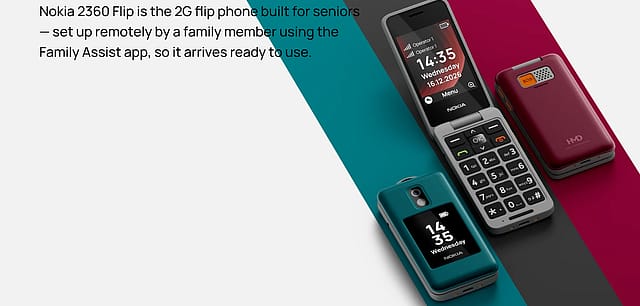
Finnish phone company HMD has unveiled the Nokia 2360 Flip, a basic folding handset aimed at older users and children. The new device gives the familiar name another opportunity to sell the appeal of a simpler phone.
There is a substantial limitation: it supports only 2G networks. As of October 31, its Indian price and launch availability remain unconfirmed.
For Indian buyers, that puts a practical question ahead of nostalgia. Can a simpler phone handle enough of everyday life to become a device you keep using?
What exactly is a dumbphone?
“Dumbphone” is an informal name for a handset with fewer capabilities than a smartphone. The usual industry term is feature phone.
Calls, text messages and physical keys are central to many such devices. Some also offer cameras, music, internet access or payments. The category covers different levels of capability, so the label alone cannot tell you which services a particular model supports. HMD’s Indian range, for example, includes feature phones offering cloud-based online services.

Look Who's Talking Regime Change
23 Oct 2026 - Vol 05 | Issue 43
A flip phone describes the folding design. A smartphone can fold, too. The hinge does not determine whether the device lets you spend hours browsing.
What is different about the Nokia 2360 Flip?
Its most useful idea is that someone else can help manage it remotely.
Family Assist lets a relative change contacts, reminders and settings through SMS. The flip phone needs no data plan for this; SMS charges may apply.
PIN-protected controls let parents restrict contacts and functions. School Mode limits the handset to a clock and emergency calling.
The SOS button calls a preset contact and texts up to five emergency contacts. It does not replace public emergency services.
The hardware includes a 2.8-inch inner screen, a smaller outer display and a removable battery. These are features intended to make basic communication accessible. Their usefulness still depends on the user’s needs and network coverage.
Why would anyone deliberately want fewer features?
Because different users need different things from a phone.
A child’s first handset may need to keep them reachable while limiting what they can access. An older person may value readable controls and help with settings. Someone seeking fewer distractions may want to remove the ability to open social media whenever there is an idle moment.
Those are distinct uses. A phone designed for family supervision does not automatically solve an adult’s screen-time problem. The useful test is what it enables, what it prevents and whether the person can manage the resulting trade-offs.
Is there evidence that less internet access helps?
There is evidence for reducing constant access, although it does not establish that buying this Nokia improves health.
A randomised study published in PNAS Nexus in February 2025 blocked internet access on participants’ smartphones for two weeks. Calls and texts remained available, as did internet access through other devices. Researchers found improvements in sustained attention, mental health and reported wellbeing.
That experiment changed access on existing smartphones. It did not test the Nokia 2360 Flip, establish benefits for every user or show that a short intervention will produce a permanent change. It does support investigating the value of making online access less immediate.
What is the problem with a 2G-only phone?
It needs a compatible 2G network wherever you use it. Support for 4G or 5G elsewhere does not make the handset capable of connecting to those networks.
Before considering the 2360 Flip, an Indian buyer would need to check the operator and local coverage. HMD’s own India guidance points Jio users towards models supporting 4G calling, also called VoLTE. The 2360 Flip’s specifications list no 4G capability.
For comparison, HMD already lists a Nokia 2660 Flip 4G in India. Similar names and shapes can conceal a consequential difference in connectivity.
Can a dumbphone still handle UPI payments?
Some can, through supported services. Giving up a smartphone does not necessarily mean giving up UPI, India’s instant-payment system.
NPCI’s UPI 123PAY framework includes phone-call-based payments and payment apps built for compatible feature phones. The available experience depends on the service, bank and handset.
PhonePe announced its own UPI 123Pay service on August 31, 2026, including plans to pre-install it on devices from Nokia, HMD and other manufacturers. That announcement does not establish that the new 2360 Flip supports it.
Payments are only one requirement. Anyone switching needs to check how they will handle messaging, navigation, tickets and work tasks normally performed on their smartphone. A second device may preserve convenience, but it also changes what the switch actually achieves.
Could this bring Nokia back?
It could help Nokia-branded phones reach additional buyers. A broader comeback requires evidence of sales and sustained use.
The brand’s history needs separating from the company selling this handset. Nokia completed the sale of substantially all its Devices & Services business to Microsoft in April 2014. HMD announced its Nokia-brand licensing arrangement in May 2016. Today’s 2360 Flip is an HMD product carrying the Nokia name.
Nokia-branded feature phones already sell in India. The commercial opportunity is to make them useful to more people, with suitable connectivity, pricing and support. A familiar logo can attract interest; the device still has to earn its place in daily life.
Is the flip-phone revival already proven?
Individual launches establish that companies see an opportunity. They do not demonstrate a mass shift away from smartphones.
HMD made a related pitch with its Barbie flip phone in August 2024. Reuters reported analyst Ben Wood’s scepticism about whether smartphone-dependent buyers would manage more than occasional breaks. That was an assessment of the earlier product, but the durability question remains relevant.
What happens next?
HMD needs to confirm where the 2360 Flip will sell and at what price. For India, operator compatibility and supported services will be essential checks.
The larger test comes after purchase: whether customers keep using the phone, which tasks send them back to a smartphone, and whether the simpler device remains useful once the novelty fades.