Amaha Plans to Raise ₹100 Crore for Expansion, But Can Specialist Mental Healthcare Scale?
Mental healthcare has attracted technology entrepreneurs with the promise of reaching patients without building a clinic on every corner. Amaha is preparing to spend ₹100 crore on a proposition that is rather less virtual: more hospitals, more clinics and more specialists. The fundraise, which includes ₹10 crore in debt financing, will help the company expand its physical network and strengthen the clinical infrastructure behind its services. Amaha reported a total revenue of ₹23.1 crore and a net loss of ₹25.3 crore in FY25, as per regulatory filings accessed from business intelligence firm Tofler.
The round brings together existing investors Lightbox Ventures and Fireside Ventures, alongside Sandbox International Holdings Limited, Nithin Kamath through Rainmatter, and the family offices of Shreyas Shibulal, Ashish Bharat Ram and Adarsh Jalan. The mix of venture investors, entrepreneurs and family offices gives Amaha a pool of backers as it moves into its next phase of expansion. The company has not disclosed the valuation attached to the fundraise or the individual contributions of the equity investors.

Losing Memory
16 Oct 2026 - Vol 05 | Issue 42
The making of a medical and social emergency
For Amaha, founded in 2016 by psychiatrist and healthcare entrepreneur Dr Amit Malik, the capital is intended to support a model that combines digital self-care, online consultations, outpatient services and hospital-based treatment. The business is built around the premise that mental healthcare cannot always be delivered through a screen, particularly for people living with moderate to severe mental illness who may need sustained specialist intervention.
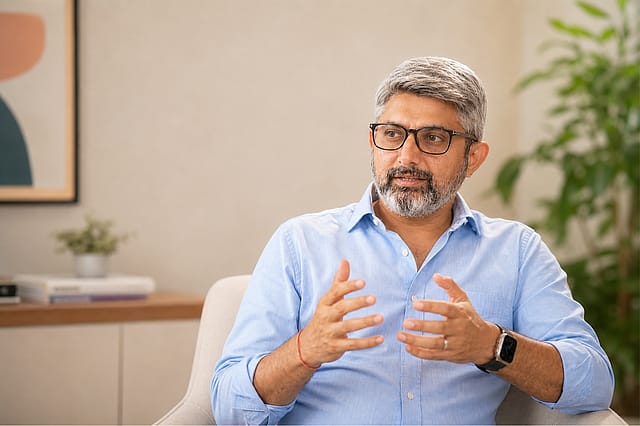
“Over the years, working with lakhs of individuals and families, we have seen how important it is for people living with mental illness to get the right care at the right time, with their families supported along the way,” says Malik, founder and chief executive of Amaha.
“At Amaha, we have built an integrated model that brings together specialised online consultations, outpatient care and hospital-based treatment, delivered by our in-house team of expert psychiatrists and psychologists, to make mental healthcare more accessible.”
Capital for a more intensive model
The fundraise will finance new hospitals and clinics in key Indian cities, alongside investment in clinical teams, training and technology. Amaha also plans to develop AI-enabled tools for triage and clinician support, and data analytics to help teams coordinate treatment and track outcomes.
The emphasis on physical infrastructure distinguishes the company from mental-health services built primarily around digital consultations. Hospitals require substantial operating capacity, specialist staffing and sustained investment. They also create a different financial equation: growth depends not merely on acquiring more users, but on building facilities that can deliver consistent care while managing their costs.
Amaha already operates nine centres across Bengaluru, Delhi NCR and Mumbai. In 2025, it opened a 27-bed super-specialty mental-health hospital in Bengaluru. A second hospital, with 55 beds, is scheduled to begin services in South Bengaluru at the end of December 2026, according to the company.
The expansion gives Amaha a larger physical platform from which to provide intensive psychiatric care. But it also makes execution important. New facilities must attract qualified professionals, establish clinical systems and build patient volumes. The company has not disclosed how much of the ₹100 crore will be allocated to individual projects, or the timelines and financial targets attached to its expansion plans.
The case for investment
Amaha says it has delivered more than 450,000 therapy and psychiatry sessions to over 100,000 clients. Its network comprises more than 270 mental-health professionals, and its peer-support communities have over 65,000 members. It also works with more than 150 organisations on workplace and institutional mental-health programmes.
The scale of these operations provides a base for expansion, though the company has not disclosed revenue, profitability or the contribution of its different services to its business. Without those figures, it is difficult to assess the financial performance of the existing network or how quickly the new capital might translate into sustainable growth.
The need for specialist care offers a compelling social rationale for investment. Amaha's Mental Health Report 2026, based on responses from 13,825 people, found that 53% of respondents had lived with mental-health concerns for more than a year before seeking professional help. A further 94.9% reported experiencing two or more concerns simultaneously. The survey is not a nationally representative estimate, but it illustrates the complexity of needs that providers must address.
Malik says the company's priority is to deepen its clinical expertise while building the infrastructure required to extend access. “Our focus now is on deepening our clinical expertise and further building the infrastructure and systems needed to make evidence-based specialist mental healthcare accessible to more individuals and families across India, while maintaining high quality of treatment,” he says.
The ₹100 crore round will give Amaha additional resources to pursue that ambition. Its challenge will be to turn capital into a network that can grow without diluting clinical standards or making care unaffordable. In mental healthcare, adding capacity is only the beginning; the harder business is ensuring that patients can find the right treatment, continue receiving it and afford to do so.