Why Dunkin’ Never Cracked India: A 15-Year Case of Cultural Mismatch
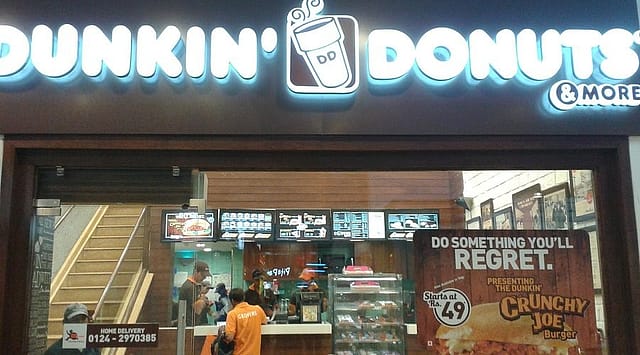
On February 24, 2011, at a signing ceremony at Hotel Oberoi in Delhi, Dunkin' Brands CEO Nigel Travis officially welcomed Jubilant FoodWorks (JFL) as its newest international master franchisee. The agreement called for JFL to develop, sub-franchise, and operate more than 500 Dunkin' Donuts restaurants throughout India over the next 15 years — described at the time as the largest international store development commitment in Dunkin' Donuts' history.
Cut to 15 years later: from a 500-store promise to just 27 by Q3FY26 — now on their way out.
In FY2024-25, the Dunkin network was unchanged at 31 restaurants — zero net additions, compared to +10 in FY2023-24. For context from the FY2024-25 JFL’s store table: Domino's India had 2,179 stores; Popeyes had 61; Hong's Kitchen had 33; Dunkin' had 31. Dunkin' is clearly the smallest brand in the portfolio.
The Modi Years
02 Oct 2026 - Vol 05 | Issue 40
A Nation Rebuilt
A Big Promise, A Small Outcome (2012–2014)
Dunkin' Donuts officially launched its flagship store at Connaught Place, New Delhi in May 2012, branded as 'Dunkin' Donuts & More.' The brand planned to open 10 outlets in the current financial year and aspired to open 80–100 in five years.
The "&More" suffix was telling from day one. Rather than positioning itself as primarily a coffee and donut destination, Dunkin' Brands cast the India launch as an all-day eatery selling items for every daypart — donuts, sandwiches, milkshakes, smoothies, snacks and more.
That early deviation reflected a deeper strategic tension. As Ashita Aggarwal, Professor of Marketing at SP Jain Institute of Management & Research, said, “Issues with Dunkin’ in India largely stemmed from its lack of a clear, focused positioning.”
The plan was to get ahead of Starbucks, which was entering India that same summer.
The India-specific marketing strategy departed completely from the US playbook. Unlike the American slogan "America runs on Dunkin'", which targets the average American commuter, Dunkin' Donuts in India reached out to young adults with the slogan "Get Your Mojo Back!" — premised on the insight that there are enough moments in a young person's life when things go terribly wrong, and Dunkin' was positioning itself as the remedy. More than 60% of the India menu was altered to suit local tastes.
They launched as 'Dunkin' Donuts and more' with a menu going beyond their traditional donuts and coffee, with Indianised flavors — mango, litchi, grated coconut — and priced it targeting the middle class. They followed a fast-paced extensive expansion strategy.
By early 2014, Dunkin' Donuts had set up 21 stores in northern India and aimed to set up around 100 stores by 2017.
Trying to Be Everything (2014–2018)
The brand kept expanding despite early warning signs that the core proposition wasn't landing. It reached a peak of 77 stores — the closest it ever got to scale.
Then the collapse came fast. Jubilant FoodWorks opened the first Dunkin' Donuts in India in 2012 and eventually expanded to 77 stores across the country. By end of June 2018, however, the company brought down the number of stores to 37 — shutting more than half its stores in roughly two years.
JFL's CEO at the time framed it as a cost discipline exercise. "We have shut our most unprofitable stores, cut back on restaurant operating costs and overheads, focused on core categories, and launched innovations including tea, to drive growth," a spokesperson said. JFL's CEO Pratik Pota said the company was "on its way to breakeven" and had reduced losses through disciplined cost cutting and tightening of manpower.
Why Dunkin' Failed: The Cultural Mismatch Diagnosis
The reasons are now well-documented and consistent across every analyst, operator, and case study.
The breakfast problem. Indians were used to their usual breakfast food, which tends to be savory — paratha in the north, dosa or idli in the south. A donut — a big pile of fried, sugar-coated spongy substance — didn't fit the Indian morning ritual.
Harish Bijoor, a brand consultant, framed this as a fundamental contextualisation gap. “A product needs to be contextualised for the market it wants to succeed in,” he said, noting that the idea of making donuts a daily breakfast habit alongside coffee was somewhat alien in India.
Aggarwal similarly pointed out that Dunkin’ assumed its global positioning would translate directly. In reality, India is not a breakfast-on-the-go market, and consumers do not typically prefer sweet items in the morning — making the core use occasion fundamentally misaligned.
Dunkin' is constitutionally a breakfast brand in America. That identity had no natural host in India.
The chai vs. espresso problem. Unlike the West, where customers love coffee, Indians prefer chai. But Dunkin' went to the Indian market with its espressos and iced teas, something most Indian customers weren't used to.
In markets like the US, there is a strong bagel-and-coffee or donut-and-coffee culture — a behavioural foundation Dunkin’ was built on. When that model was replicated in India, it failed to resonate with consumers who did not share the same consumption patterns, Bijoor noted.
The irony: when JFL finally introduced chai to remaining Dunkin' stores, it was essentially admitting the original coffee proposition had failed.
The mithai competition problem. Indian cuisine has more sweets than you can count. A donut had to be something really special. Unfortunately, it wasn't.
As a result, the product naturally shifted into the dessert space, where it faced intense competition from well-established Indian sweets. Donuts, unlike staple snacks, are not an everyday purchase, which led to stagnating sales and slower growth compared to global markets.
The identity crisis. The brand was treated no more than a pastry shop initially, where people would visit to consume donuts as a dessert rather than a meal.
In an attempt to drive footfalls and justify high retail investments, Dunkin’ expanded into burgers and other savoury offerings. However, this diluted the brand’s identity. A brand that was inherently associated with donuts began to stand for too many things at once.
Consumers continued to associate Dunkin’ primarily with donuts, but even within that category, stronger recall began shifting to more focused players like Mad Over Donuts. At the same time, Dunkin’ was not top-of-mind for savoury items like burgers.
Multiple shifts in marketing strategy — from donuts to burgers to beverages — only added to the confusion rather than addressing the core issue, Bijoor said, pointing to the absence of a clear and distinct positioning suited to Indian consumers.
Aggarwal noted that the brand expanded horizontally — adding outlets and categories — without first strengthening its core, creating confusion around what Dunkin’ truly stood for. A sharper focus on donuts, localised flavours, and sustained category innovation may have helped build a more differentiated position in India.
A brand, Bijoor added, must be consistently positioned across product, packaging and service. Without that coherence, even expansion and innovation risk diluting the core, making it harder for consumers to understand what the brand truly stands for.
Menus expanded to include vegetarian burgers, spicy sandwiches, and India-specific beverages. Each addition was an implicit admission that the core identity wasn't working.
Phase 3: The "Coffee-First" Pivot (2019–2023) — A Last Attempt
After the global Dunkin' brand dropped "Donuts" from its name in 2019 and repositioned as a beverage company, JFL tried to execute the same playbook in India.
In November 2022, the company announced it would overhaul stores and revamp its menus to attract younger consumers, after citing a lack of profitability and operational inefficiencies. JFL closed 11 Dunkin' stores in the 12 months ended March 2023 and opened four new 'coffee-first' sites. With 21 stores then open, eight locations fully showcased the brand's renewed coffee-focused identity, including a range of cold espresso beverages.
But the pivot came late — and into a far more crowded market.
Domestic coffee chains Nothing Before Coffee, Blue Tokai and Barista had each outlined expansion plans. Tim Hortons and Pret A Manger had entered India. Tata Starbucks ended March 2023 with 333 stores, adding 71 in a single year.
Dunkin' was attempting a repositioning with 21 stores against competitors with hundreds — and growing. The structural disadvantage was insurmountable.
The Numbers: 3–4 Year Financial Reality
Compiled across both JFL annual reports and the February 2026 investor presentation:
The brand contributed about 0.61% of JFL's total revenue and a loss of roughly ₹191 million (₹19.1 crore) in fiscal year 2025. On a revenue of ₹37 crore, that's a loss margin of over 50%. JFL's total revenue in FY25 was ₹6,104 crore. Dunkin' was rounding-error scale with negative returns.
The investor presentation framing from February 2026 labelled Dunkin' and Hong's Kitchen together as "Emerging business units drag on margins — focus on unit economics." Not a growth story. A drag story.
A Forgettable Exit: 2026
The decision, approved by JFL's board on March 30, 2026, ends a relationship that began with the MUDFA signed on February 24, 2011. JFL will evaluate options including rationalisation of certain stores, sale of physical equipment and store infrastructure, and transfer of franchise rights — all in consultation with Dunkin's brand owners.
JFL will not renew its franchise agreement with Dunkin' once the arrangement ends on December 31, 2026.
JFL has clarified that the exit will not have a material operational or financial impact on its overall business. That sentence is itself the final verdict on Dunkin' in India — at the end of a 15-year run, the company's departure is financially immaterial.
In that sense, the failure was not just operational but conceptual. When positioning falters, as Bijoor put it, you risk losing the plot.