What Parachute's ‘Feel Like a Girl Again’ Says About Women and Advertising
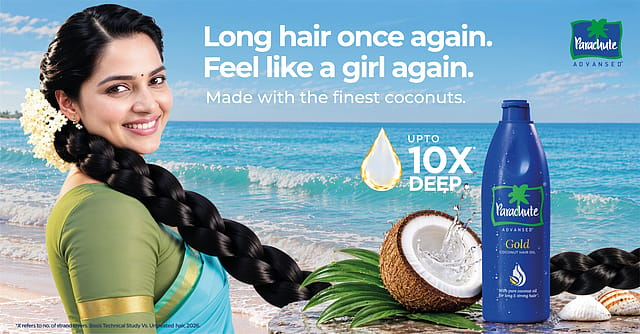
There is something appealing about the idea of meeting old friends after years apart and finding that, for a few hours, nothing much has changed. The responsibilities may have accumulated, the routines may have become more demanding, but the ease of being together remains. It is this feeling that Parachute Advansed Gold's new campaign, Feel Like a Girl Again, seeks to capture.
Directed by Gautham Vasudev Menon, the film follows three friends who reunite after college and rediscover their carefree selves. They run, play and dance by the sea, their long braids swaying as an original soundtrack carries the story forward. Rooted in the cultural traditions of coastal Andhra Pradesh, the campaign brings together music by Karthik, lyrics by Anantha Sriram, vocals by Swetha Mohan and choreography by Brinda Master.

Look Who's Talking Regime Change
23 Oct 2026 - Vol 05 | Issue 43
For Marico, the company behind the brand, the idea is to connect the promise of beautiful long hair with something more evocative than a beauty benefit. Hair becomes a link to memories of girlhood, friendship and freedom. The original track and hook step are intended to carry that feeling beyond the film and into popular culture.
Yet the campaign raises a question that goes beyond hair care. When does nostalgia become a way of reinforcing the very social expectations that brands claim to understand? And when an advertisement draws on women's experiences of growing up, marrying and taking on domestic responsibilities, does it have a responsibility to examine the assumptions embedded in that story?
The issue is not that women should not want to feel carefree again. It is the suggestion, implicit or otherwise, that the freedom they enjoyed as girls is something adulthood takes away.
When girlhood becomes the ideal
The agency behind the campaign, Kakkoii Entertainment, offers a revealing explanation of its thinking. Its founder, Yousuf Rangoonwala, says the agency's research suggested that, for many Indian women, particularly at the mass-market level, the biggest loss is not opportunity but innocence. He points to maturity, domesticity and patriarchal environments as forces that take away years women might otherwise have enjoyed as girls.
It is a provocative proposition, but the campaign material does not provide the research methodology or findings needed to establish how widely this experience applies. More importantly, it raises a question about the way the experience is framed.
For many women, marriage, work, caregiving and household responsibilities can alter the amount of time available for friendships and leisure. But the problem is not that they have grown up. Nor is domesticity necessarily the opposite of freedom. It is the unequal distribution of responsibilities and the expectations attached to women's roles that can constrain their choices.
A woman in a saree who manages a household is no less capable of spontaneity than a woman who has just graduated from college. A homemaker does not necessarily need to recover a former identity to find fulfilment, just as a working woman does not automatically enjoy greater freedom.
The distinction matters because advertising often relies on recognisable shorthand to communicate quickly. Girlhood becomes synonymous with innocence; adulthood with responsibility; and the return to one's younger self with liberation. These associations are easy to understand, but they can also make social expectations appear inevitable.
Parachute's campaign may simply be inviting women to spend time with friends and rediscover the pleasure of being unselfconscious. That is a perfectly reasonable proposition. But the idea becomes less convincing if it implies that the carefree woman belongs to the past, before adult life intervened.
There is a more contemporary way to frame the same thought: women do not need to become girls again to reclaim their time, friendships or freedom.
When advertising challenges the script
The history of advertising offers examples of brands using their reach to question, rather than merely reproduce, familiar social assumptions.
Consider Ariel's Share the Load campaign. Laundry advertising has long drawn on the image of women managing the household, often presenting their work as a natural extension of their role. Ariel turned that expectation into the subject of the advertisement itself, asking why domestic chores should be treated as women's responsibility alone.
Over successive campaigns, the brand encouraged men to participate in household work and challenged the example fathers set for their children. Ariel reported a decline in agreement with the statement that housework was women's work, from 79% of men in its 2014 survey to 52% in 2018. These figures do not establish that the campaign alone changed attitudes, but they illustrate how a brand can make an accepted social convention open to discussion.
The distinction is instructive. Rather than telling women how to cope better with the domestic burden, Ariel questioned why that burden should fall disproportionately on them in the first place.
Always took a similar approach with #LikeAGirl. The feminine-care brand challenged the use of the phrase as an insult, exposing how an everyday expression could associate being a girl with weakness or incompetence. Instead of asking girls to grow out of the label, the campaign attempted to change what the label meant.
Both campaigns started with familiar cultural ideas, but their creative propositions depended on questioning them. That is a different exercise from using an existing association to evoke an emotion.
Dove's Campaign for Real Beauty offers another useful comparison. By featuring women with different body types and challenging narrow ideals of attractiveness, it attempted to broaden the representation of beauty in advertising. Its history also illustrates a limitation: even campaigns that challenge conventional beauty standards can leave appearance at the centre of how women evaluate themselves.
These examples are not evidence that advertising can single-handedly transform society. Attitudes are shaped by families, institutions, popular culture and lived experience. But brands have considerable visibility, and repeated representations can help determine which roles and expectations seem normal, desirable or open to question.
That influence brings responsibility, even when the immediate objective is commercial.
The business of selling a feeling
For an established consumer brand, emotional storytelling is also a way to build distinction in a crowded market. A hair-oil product can communicate nourishment and the promise of beautiful hair, but those benefits may not be enough to make every campaign memorable. Connecting the product with friendship, childhood or personal identity gives the brand a larger narrative to work with.
Parachute Advansed Gold's latest film fits this approach. The braid connects the story to the product, while the reunion, the coastal setting, the soundtrack and the choreography give the brand an emotional world beyond the bottle. The creators also hope the original track and hook step will travel beyond the advertisement, extending its reach through audience participation.
There is a sound commercial logic to this ambition. A story that people remember or choose to share can potentially give a campaign a longer life than a product demonstration alone. But cultural traction cannot be assumed at launch, and a memorable film does not automatically translate into brand preference or sales.
The other risk is that an emotional narrative may be built around a social insight without examining it closely. The agency's claim about women's loss of innocence is the most revealing example. It takes a complicated set of experiences associated with adulthood and domestic responsibilities and turns them into a simple emotional proposition: women have lost something, and girlhood offers a way to recover it.
That may resonate with some viewers. Others may find the premise too narrow, particularly if they do not regard their younger selves as happier or their adult lives as diminished. The campaign's cultural specificity may make the story familiar to its intended audience, but familiarity is not the same as universality.
The more interesting creative opportunity would be to celebrate the enduring relationship between women and their hair without suggesting that a particular hairstyle, age or stage of life represents the ideal version of femininity.
What responsibility should a brand have?
It would be unfair to demand that every advertisement become a manifesto for social change. Brands sell products, and nostalgia, humour, aspiration and beauty are legitimate tools of storytelling. Nor should every portrayal of a traditional household be treated as regressive.
But there is a difference between reflecting a cultural convention and reinforcing it without question. That difference becomes particularly important when a campaign claims to understand the constraints women face.
A brand can acknowledge that adulthood brings responsibilities without implying that women become less free as they mature. It can celebrate the comfort of old friendships without idealising childhood as the last refuge from domestic life. It can draw on traditional hairstyles and regional culture without turning them into standards that define what feminine beauty should look like.
For Parachute Advansed Gold, the challenge is to ensure that the emotional story expands the meaning of its product promise rather than narrowing the idea of who can embody it. Long hair can be a source of pleasure, a cultural marker or a personal choice. It need not stand for lost innocence, just as growing older need not mean leaving freedom behind.
The campaign's central sentiment is easy to understand: women should make room for playfulness, friendship and the parts of themselves that daily routines can obscure. But the strongest version of that message would not ask women to feel like girls again. It would suggest that they never had to stop feeling free in the first place.
That is where the responsibility of brands begins: not in ensuring that every advertisement delivers a social lesson, but in recognising that the stories they choose to tell can either reproduce familiar expectations or give audiences a reason to see them differently.