Ultravolt Has ₹1,800 Crore and SRK. Havells Has Five Words
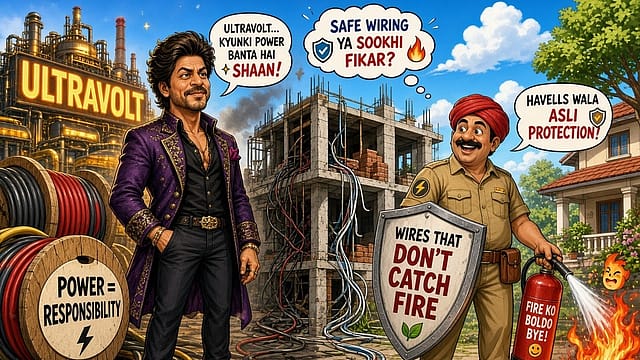
Shah Rukh Khan is standing beside another corporate ambition.
This time, India’s most industrious brand ambassador is not selling a telecom comeback, a luxury watch, a food-delivery app or the idea that a cement company can help the country grow. He is introducing Ultravolt, the Aditya Birla Group’s new wires and cables business, with a line designed to carry the weight of a nation: Power, ek zimmedari.
The full-page newspaper advertisements look less like the arrival of a new brand and more like the declaration of a new institution. That is intentional. Ultravolt may have entered public memory only this week, but it has not entered like a start-up asking permission. It arrives under UltraTech Cement with ₹1,800 crore of planned investment, a 100-acre manufacturing facility at Jhagadia in Gujarat and what the company calls India’s second-largest capacity in the wires segment from the day of launch.

Zeroing In on ECI
09 Oct 2026 - Vol 05 | Issue 41
Constitutional legitimacy versus political opportunism
It wants to become one of the country’s top two players within five years. There is confidence. There is capacity. There is Khan.
There is, as yet, no meaningful market share.
That is what makes Ultravolt such a fascinating brand experiment. An industrial giant has manufactured the ability to produce enormous quantities of wire before the consumer has acquired any reason to ask for its name. The factory may begin as number two by capacity. The brand begins at zero. Capacity can fill warehouses. It cannot fill minds.
India’s Newest Wire is Already Enormous
Ultravolt is not testing one city, launching a few stock-keeping units and waiting for consumer feedback. The Aditya Birla Group says the brand will begin across more than 500 districts and 6,000 pin codes, operate through over 20 warehouses, seek access to more than one lakh retailers and use over 5,000 UltraTech Building Solutions outlets. Its portfolio covers house wires, light-duty and communication cables, solar cables, and power, industrial and specialised cables.
This is the fourth large business the group has created in three years, after Birla Opus in paints, Indriya in jewellery retail and the Birla Pivot business-to-business platform. The playbook is becoming familiar. Find a large category with structural growth, build capacity at intimidating speed, borrow the group’s balance sheet and trust, mobilise distribution, and announce an ambition that makes incumbents study their margins.
The wires and cables market is particularly tempting. India is building homes, electrifying infrastructure, expanding metros, manufacturing electric vehicles and constructing power-hungry data centres. Kumar Mangalam Birla says more than 100 million new homes could be built over the next decade. Every one of them will require kilometres of something the eventual owner may never see.
The market has already taken the newcomer seriously. Shares of established companies including Polycab and KEI fell sharply after Ultravolt’s formal launch, as analysts warned that a well-capitalised entrant could force incumbents to spend more on pricing, distribution and advertising.
Ultravolt frightened investors before it persuaded its first electrician. But the fear is not irrational. Aditya Birla Group is not entering wires from the outside. It is following the homebuilder downstream.
First the Wall. Now the Wire
UltraTech claims that one in every three homes in India is built with its cement. Whether one treats that as a corporate statistic or a declaration of ubiquity, the commercial advantage is clear. UltraTech already meets the individual homebuilder, contractor, architect, developer and dealer while the structure is being imagined and erected. It knows a house is being built before the electrical brands arrive to compete for what will run inside it.
Ultravolt can, therefore, sell an adjacency rather than a stranger.
The company that helped build the wall would now like to supply what disappears behind it. “UltraTech’s strongest advantage is not simply the familiarity of the corporate name,” says Ashita Aggarwal, professor of marketing at SP Jain Institute of Management & Research. "It is the ability to enter the homebuilding journey earlier than a standalone electrical brand," she says. If the group can connect builders, contractors, retailers and electricians across the same ecosystem, cement becomes a route into wires rather than merely an endorsement of them.
That route may matter more than SRK.
Wires are an unusual consumer category. They carry life-and-death consequences but attract almost no daily consumer attention. A buyer may debate the colour of a wall, the shape of a switch and the design of a light fitting. The wire is selected once, buried inside the wall and expected to behave for decades. In many homes, the homeowner does not independently compare insulation technology, current-carrying capacity or smoke toxicity. The electrician, contractor or dealer becomes the interpreter of an invisible risk.
Ultravolt knows this. More than 1,600 electricians had reportedly joined its engagement programme before the launch. The company aims to train more than 40,000 over the coming year through a programme associated with Skill India and the Electronics Sector Skills Council of India. SRK can introduce Ultravolt to the country. The electrician will decide whether it enters the wall.
Ultravolt Has Two Rivals
The newcomer does not confront one incumbent. It confronts two different kinds of ownership.
Polycab owns the market. The company reported ₹25,179 crore in wires-and-cables revenue in FY2025–26 and estimates that its share of the organised Indian market has climbed to approximately 30–31 per cent. KEI Industries reported ₹11,221 crore of wires-and-cables turnover in the same year. Havells generated ₹8,677 crore from its cables division, making cables its largest business segment.
These are not brands waiting politely for disruption. They possess plants, dealers, electricians, institutional relationships, working capital, product breadth and years of accumulated trust.
Yet Havells owns something the balance sheet cannot completely express. It owns five words: Wires that don’t catch fire.
For more than a decade, Havells has turned a technical, hidden and low-interest product into emotional storytelling about safety. Parents, children, friendships and family bonds have changed across its films. The proposition has remained brutally stable. The wire does not catch fire.
The brilliance lies in the compression. A consumer need not understand conductor resistance, copper purity or halogen emissions. Havells gives the category a villain that everybody fears and a benefit that everybody understands.
Ultravolt must therefore fight Polycab on the balance sheet and Havells inside the buyer’s head.
Responsibility Versus Fire
“Power, ek zimmedari” is an elegant corporate platform. It can stretch from a two-bedroom home to a data centre, a metro line, a solar plant and the electrification of a nation. It borrows the moral seriousness of Aditya Birla Group and converts a commercial entry into public duty.
It is also abstract.
What large electrical company would announce that power is not a responsibility? The line makes Ultravolt sound conscientious without immediately telling the buyer what the wire does better. Havells’ promise is narrower but sharper. It takes a physical danger, removes the technical language and lodges the outcome in memory.
One brand is selling a philosophy. The other is telling homeowners what could burn them.
“In a technical category, communication performs an act of translation,” says Aggarwal. The consumer may not understand the engineering, but must understand the consequence. Havells converted flame retardance into a memorable human benefit. Ultravolt’s idea of responsibility is larger and more flexible, but it will eventually need an equally distinctive answer to a simple question: responsibility delivered through what?
The irony is that Ultravolt appears to possess a product answer.
Its NextGen house wire is marketed as toxin-free and flame-retardant, capable of handling temperatures up to 125°C and carrying 90 per cent more current than the benchmark used by the company. Ultravolt also claims additional short-circuit protection and almost no toxic smoke through its HFFR E-Beam construction. Its SafePlus wire is positioned around lower smoke and reduced halogen emissions during a fire.
These are company claims and will require the kind of proof, certification and real-world explanation that serious electrical products demand. But they give Ultravolt something more useful than borrowed grandeur. They give it a possible reason to be chosen.
If a new wire can withstand greater heat, carry substantially higher loads and release less toxic smoke, why allow the superstar to speak mainly about an honourable noun?
Perhaps “responsibility” is the umbrella and the product facts will follow through retail communication. Perhaps Ultravolt wants a platform broad enough to cover industrial cables and national infrastructure rather than trapping the brand inside residential fire safety. That is strategically defensible.
But broad platforms impose a burden: the brand must repeatedly fill them with specific proof. Otherwise, responsibility becomes what advertising calls itself when it has not yet decided which attribute to own.
The Second-Largest Player That Has Not Sold Its Way There
Ultravolt’s most provocative launch claim is also the source of its most useful tension. It says it begins as India’s second-largest player in the wires segment by manufacturing capacity.
The qualifier matters.
Capacity is not sales. It is not utilisation, market share, distribution productivity or dealer recommendation. It measures what the factory can produce, not what the market is willing to absorb.
A new restaurant can build the city’s second-largest kitchen. It does not thereby become the city’s second-favourite restaurant.
Ultravolt’s industrial confidence risks creating a peculiar brand illusion: because the parent is enormous and the factory is enormous, consumer demand may appear like an administrative detail waiting to be completed. In reality, the distance between installed capacity and profitable utilisation is where many corporate adventures discover gravity.
“Capacity gives a company the right to compete at scale; it does not give the brand the right to be preferred,” reckons Aggarwal. For Ultravolt, the real report card will not be how dramatically it entered. It will be how quickly capacity becomes productive demand—through active retailers, electrician recommendation, repeat orders, unaided awareness and ultimately profitable market share.
Aditya Birla Group appears aware of that gap. Its plan is not merely to manufacture and advertise. It is attempting to create national availability immediately, train the trade, use existing construction relationships and bring the UltraTech name into the purchase conversation.
The audacity may be justified. Birla Opus showed that the group is willing to spend heavily, build large capacity and disturb categories long treated as settled. Ultravolt is not a speculative logo invented by the marketing department. It is an operating system being assembled around a logo.
That is the benefit of the doubt this launch deserves.
Shah Rukh Khan, Universal Power Supply
SRK is not an entirely random choice. He has represented UltraTech Cement since 2024, so his presence allows the parent’s communication to flow into the new business. The man beside the cement now stands beside the wire. Familiarity can help a new brand look less new.
He also provides mass awareness at the precise moment Ultravolt needs dealers, contractors and consumers to recognise an unfamiliar name. In a category crowded with established companies and nearly interchangeable technical vocabulary, fame can shorten the introduction.
But SRK is becoming corporate India’s universal power supply.
Within days, he has been asked to embody Vodafone Idea’s comeback and Ultravolt’s birth. His meaning is elastic enough to represent aspiration, resilience, progress, trust, romance, luxury, technology and national development. That versatility makes him commercially irresistible. It also creates the danger that the celebrity becomes the only distinctive element while the brands queue behind him.
The question is not whether people will notice Shah Rukh Khan in an Ultravolt advertisement. They will. The question is what remains when he leaves the frame.
Does the consumer remember “Power, ek zimmedari”? Does that line belong uniquely to Ultravolt? Can the buyer retrieve a product advantage? Will the electrician ask the dealer for the brand? Will a contractor alter an established purchasing relationship because the company has arrived with a bigger parent and a brighter face?
SRK can switch the campaign on. He cannot convert capacity into current demand.
The Battle Behind the Wall
Ultravolt enters at an unusually favourable moment. India’s wires and cables market is growing, infrastructure demand is strong and consumers are gradually moving from unorganised suppliers towards branded products promising greater safety and reliability. A new player does not necessarily need every incumbent to shrink in order to grow.
The category may create room.
But Ultravolt has not announced a modest desire to participate. It wants a top-two position within five years. That ambition requires more than riding market expansion. It requires displacing someone.
The commercial battle will consequently be fought in places consumers rarely see: dealer margins, credit, copper procurement, shelf space, contractor relationships, institutional tenders, electrician incentives, service levels and the speed with which one lakh targeted retailers become productive rather than theoretical outlets.
The advertising battle will be fought over one much smaller territory: a few words in the mind.
Polycab can defend leadership. KEI can defend its scale and institutional strength. Havells can continue making safety emotionally memorable. RR Kabel and Finolex can emphasise their own engineering, distribution and category histories.
Ultravolt must decide what it intends to own beyond the size of the group that owns it.
That is why “Power, ek zimmedari” is both promising and unfinished. Responsibility is a valuable foundation for a product hidden inside walls. It connects engineering with consequence and corporate capability with human safety. But it becomes a brand property only when consumers can explain how Ultravolt behaves more responsibly than the wire beside it.
Five years from now, the most meaningful proof will not be a launch film, a reach figure, an impression count or a photograph of SRK beneath an enormous logo. It will be plant utilisation, retail throughput, electrician advocacy, repeat institutional business, sustainable margins and a genuine place among the category’s leaders.
Aditya Birla Group has the factory, the capital, the distribution ambition and the country’s biggest star. Havells has a sentence homeowners remember when they imagine their house on fire.
Ultravolt can produce enough wire to enter millions of walls. Its harder task is finding one clear promise capable of entering the mind. Because when the electrician finally asks, “Kaunsa wire?”, Shah Rukh Khan will not be in the room. The real victory will come when somebody answers: Ultravolt.