Give CRED Some Credit: From Dravid’s Rage to Rakhi’s Loan Lessons
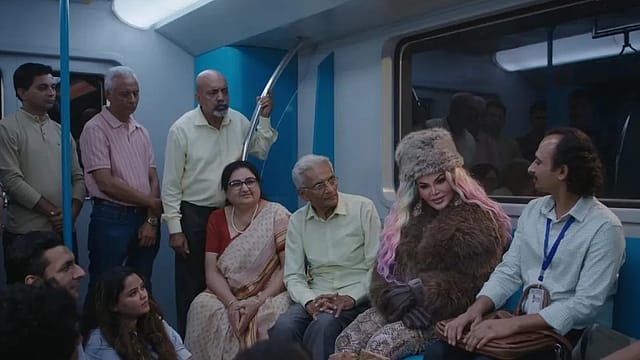
Rahul Dravid has anger issues. Ravi Shastri has happy hours. Rakhi Sawant has a lesson on responsible borrowing.
CRED’s casting department appears to run a particularly entertaining employment exchange. Its latest recruit is seated beside a snowman inside a metro, dressed for a climate the carriage was never designed to provide. The Alps are financially out of reach. Rakhi must make other arrangements. From this improbable classroom comes a warning about taking fresh loans to repay old ones.
A financial-literacy lecture has acquired a snow machine.
Give CRED some credit. Advertising’s first job is to get noticed. Across its best films, the brand has repeatedly given people a reason to watch, laugh and pass the commercial along. Making a credit-card bill interesting is hardly an easy brief. Making the advertisement something people actively seek out is an achievement.
The Modi Years
02 Oct 2026 - Vol 05 | Issue 40
A Nation Rebuilt
The film is part of a financial-awareness campaign by the not-for-profit CRED Foundation. Rakhi explains loan stacking: borrowing again to service existing debt, with the danger of interest and repayments piling up. Another film features Sonam Bajwa distinguishing the desirable bounce in her hair from the expensive bounce of an unpaid EMI.
The entertainment has homework attached.
THE WALL LOSES HIS TEMPER
CRED’s breakthrough trick was understanding that a celebrity arrives with a script already written in the audience’s head.
Dravid’s script contained patience, restraint and dependability. In 2021, CRED handed him a bat and let him attack that reputation in Bengaluru traffic. He shouted, smashed a car mirror and declared himself “Indiranagar ka gunda”.
The joke needed those years of composure. Cast an actor famous for playing thugs and the same scene becomes an ordinary Tuesday.
CRED was spending Dravid’s accumulated public image, with his cheerful cooperation. The pleasure came from watching someone trusted enough to be predictable become magnificently unpredictable.
From a marketing and branding perspective, the cleverness lies in making the audience’s existing knowledge of a celebrity the starting point for the joke.
“Celebrity recognition gives an advertisement a head start. CRED uses what people already believe about the celebrity to create the surprise,” says Ashita Aggarwal, professor of marketing at SP Jain Institute of Management & Research. "The casting becomes part of the idea."
The construction also had discipline. Jim Sarbh explained the bill-payment rewards before introducing Dravid’s improbable anger. The product proposition was present, even if the broken mirror proved considerably more quotable.
THE CELEBRITY HAS FAILED THE AUDITION
The mischief had begun earlier. In the 2020 audition films, stars including Anil Kapoor, Madhuri Dixit and Bappi Lahiri performed for an unimpressed panel. The proposed solution was a simple voiceover.
Imagine paying for celebrities to demonstrate that you can do without celebrities.
The joke took aim at advertising’s own weakness for famous faces. It also depended on those faces being famous enough to survive rejection. Their willingness to play along made the work warmer than a sneer at yesterday’s stars.
CRED then assembled Venkatesh Prasad, Javagal Srinath, Maninder Singh and Saba Karim into the VenkaBoys. The 1990s cricketers returned as a boy band, inviting recognition from viewers old enough to remember their first careers.
Neeraj Chopra’s 2021 film found another route. The Olympic champion played versions of the people scrambling to capitalise on his success: a marketer, a filmmaker, a reporter. A newly minted national hero impersonated the machinery gathering around him.
CRED had hired the celebrity to satirise the celebrity business. The repertoire kept expanding. Kapil Dev channelled Ranveer Singh’s flamboyance. Shastri’s 2022 film converted the motivational “70 minutes” speech from Chak De! India into a warning that happy hours were ending. Some performances reversed an image; others exaggerated it. CRED’s skill lay in knowing which lever to pull.
THE OGs HAVE ENTERED THE CHAT
Nostalgia is one of CRED’s best-used tools.
Much of its memorable work draws on the OGs: people viewers knew long before they knew the app. Madhuri and Anil arrive with memories of cinema; Dravid and Kapil with cricket; Bappi Lahiri with an unmistakable musical personality. For audiences who grew up with them, recognition carries affection. The commercial can begin with a relationship another advertiser would have to spend time building.
But CRED gives that familiarity something fresh to do. The cricketers become a boy band. The stars fail an audition. The famously composed batsman loses his temper. Viewers get the pleasure of recognition followed by the delight of discovering that an old favourite is willing to be ridiculous. The affection helps the joke land without making the performer look like a target.
In 2022, Karisma Kapoor recreated the world of the old Nirma commercial for CRED Bounty. Annu Kapoor and Renuka Shahane brought back Antakshari. CRED was reaching beyond individual celebrities into the television routines people remembered sharing at home.
That is a particularly neat manoeuvre for a financial app. The service belongs to life on a smartphone; its advertising can borrow the warmth of life around the family television. It invites viewers to feel that a new brand understands something about their past. For younger viewers without those first-hand memories, the absurd performance can still provide an entry point, though the nostalgic references will not carry the same charge.
The OGs supply more than a recognisable face. They supply the backstory that makes the new behaviour funny.
There is a trap, of course. Viewers may remember Nirma, Antakshari or their favourite cricketer more readily than CRED’s offer. Nostalgia earns its place when the affection travels forward to the advertiser. Otherwise, CRED has paid for somebody else’s reunion.
THE DEFAULT APP HAS COMPETITION
By 2024, Leander Paes was earning a restaurant discount by dispatching mosquitoes with an electric swatter. Paying through CRED UPI offered a less athletic alternative. The absurdity demonstrated the inconvenience the product promised to remove.
The same year, David Warner and SS Rajamouli turned a discount negotiation into a filmmaker’s nightmare, with the cricketer imagining himself as a movie hero. Again, a payment benefit supplied the excuse for the mayhem.
These payment films point towards a competitive problem in a market containing PhonePe, Google Pay and bank apps. A customer already has ways to pay. CRED must make choosing its route feel worth the trouble.
Its films compete for something more stubborn than a rival’s advertising slot: the app a customer opens without thinking.
Humour can make a financial brand feel approachable and distinctive. "The next task is to connect that feeling to a recognisable benefit, so people remember when they should use the service,” says Aggarwal.
A rival can match a reward or hire another cricketer. Reproducing a recognisable comic sensibility is harder. CRED has built an expectation that its next commercial might be worth watching. That expectation is an asset. It also raises the difficulty of the next joke.
RAKHI HAS SOMETHING TO TEACH
Rakhi’s film makes an interesting adjustment. The celebrity performance carries an explanation of a financial problem through the advertisement. The lesson gets more room than a hurried product line.
Sonam’s hair-versus-EMI comparison similarly gives an abstract consequence a familiar visual reference. Both attempt to make information memorable enough to survive the entertainment.
The Foundation’s wider educational remit also reaches beyond the exclusivity associated with CRED’s members-only commercial platform. Financial understanding has a larger audience than a club for people with strong credit scores.
The comic setting works only if the warning remains clear. Loan stacking needs an explanation viewers can take away; the snowman cannot be the only thing they remember. Rakhi’s extravagance gets them through the door. The lesson has to hold them there.
Here, the familiar CRED question acquires an educational twist: after enjoying the performance, has the viewer learnt anything useful?
Advertising history offers three instructive companions. Snickers’ 2010 Betty White film made unexpected celebrity behaviour serve its hunger proposition. Old Spice’s Isaiah Mustafa extravaganza that year wrapped a body-wash pitch in gloriously impossible theatre. Cadbury’s 2007 drumming gorilla made pleasure itself the experience, with no chocolate demonstration required.
These films allow different distances between the joke and the product. Each nevertheless gives the entertainment a branding job. CRED’s strongest work does the same, whether through the reward promised by the viewing experience or the financial point carried by the gag.
THE OTHER COMMERCIALS
CRED’s financial record has been less consistently entertaining. For FY25, it reported operating revenue of ₹2,735 crore, up 16%, and total losses of ₹1,457 crore, down 11.5%. Operating losses, reported separately, fell 51% to ₹298 crore. In June 2026, the company claimed that the business had reached profitability, citing roughly ₹3,200 crore in revenue, although the statement did not specify the profit measure or reporting period.
The figures show why acclaim for the advertising cannot settle the larger business question. A campaign can attract customers; the company must then earn enough from serving them to cover its costs. Its overall accounts do not establish how much profit or loss a particular commercial produced. An advertisement can succeed at creating attention while the business still has work to do on profitability. "Popularity cannot be treated as proof of commercial success. The two need different evidence,” says Aggarwal.
CRED deserves full marks for making several deeply familiar people surprising again. Its audience has been given performances worth discussing, rather than another celebrity holding a phone and smiling obediently.
For a category that can make a rewards programme sound like tax documentation, that is a considerable creative achievement. The challenge is to make the app as easy to return to as the films.
Dravid earned the laugh. Rakhi has earned the classroom. CRED must keep earning the customer.