Thin Is Back. This Time, It Has a Sponsor
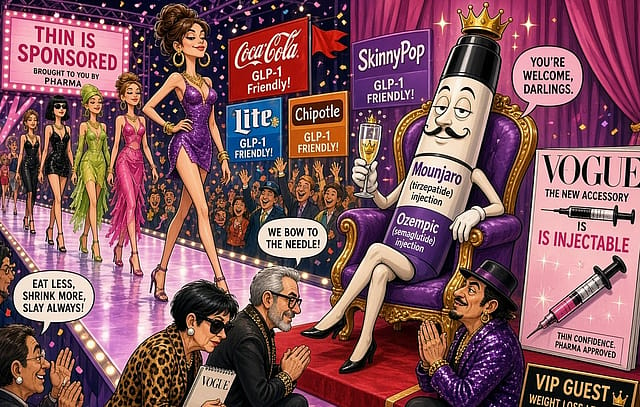
A drug company does not need a model to hold up an injection pen. Sometimes, a place in the credits will do.
At Vogue World in Milan, that place belonged to Eli Lilly, the company behind Mounjaro. The sponsorship promoted the corporate name rather than a particular medicine. A Condé Nast source drew precisely that distinction. Lilly said the association was about health and challenging the stigma faced by people with obesity.
But audiences do not experience sponsorship through the wording of a commercial agreement. They see the company, the clothes and the bodies wearing them.
The association supplies its own message.
That is what makes this partnership worth examining. A pharmaceutical company has entered one of fashion’s most influential showcases, and the pairing can seem almost natural. The ease of that fit is the story.
Losing Memory
16 Oct 2026 - Vol 05 | Issue 42
The making of a medical and social emergency
The Prescription Gets a Wardrobe
Weight-loss medicines have acquired a cultural life far beyond the consulting room. They appear in celebrity conversations, supermarket positioning and the language people use to describe bodies.
A treatment can become familiar long before an individual discusses it with a doctor. It can also become desirable for reasons that have little to do with a clinical assessment.
Fashion accelerates that process. Its business is to arrange people, products and images into a picture of the life we might want. Put a pharmaceutical sponsor into that picture and the association starts working before anyone makes a medical claim.
This does not mean everyone watching a runway will seek a prescription. It means the medicine’s manufacturer becomes part of the scenery of aspiration.
The company gains something a conventional advertisement might struggle to deliver: a sense of belonging.
Glamour Does the Selling
In 1989, anthropologist Grant McCracken described celebrity endorsement through a model of “meaning transfer”. The cultural associations attached to a famous person pass to a product and, through consumption, to its buyer.
A watch acquires some of the champion’s precision. A perfume borrows some of the actor’s allure.
Event sponsorship can work in a similar way. Vogue World offers glamour, taste, access and an influential account of which bodies belong in beautiful clothes. A sponsor can benefit from those associations without putting a product on the runway.
The distinction between corporate promotion and medicine advertising still matters. In Britain, for example, prescription-only medicines cannot be advertised to the general public. A corporate sponsorship is not, by itself, proof of an unlawful medicine advertisement.
But compliance cannot settle the entire editorial question. An association can carry a powerful cultural message without an explicit instruction to buy.
The corporate name sits beside the silhouette. The audience is left to complete the thought.
When the Champion Becomes the Testimonial
Serena Williams’s Super Bowl campaign for telehealth company Ro made the connection more direct.
Ro introduced her as its GLP-1 patient ambassador and placed her at the centre of its “Healthier on Ro” campaign. The company’s rationale drew on the very qualities that had made her a sporting icon: her discipline and willpower could help challenge the idea that using medication was taking a shortcut.
There is a defensible argument there. People should not have to prove that they suffered enough, exercised enough or tried hard enough before accepting medical help. Williams’s achievements do not cancel her right to make decisions about her health.
The commercial question is what happens when that personal decision becomes a mass-market testimonial.
A body celebrated for extraordinary performance is now part of a weight-loss proposition. Viewers can hear a message about access to care. They can also hear an invitation to reassess their own bodies.
Both readings can exist. A campaign’s stated intention does not control which one lands.
The Stigma Changes Its Terms
The strongest argument for these campaigns is also where the tension begins.
Weight stigma causes harm. Treating body size as evidence of laziness or moral weakness has inflicted humiliation for decades. Greater acceptance of medical treatment could help loosen that judgment.
Yet the availability of treatment can create a different pressure: if change is possible, why have you not changed?
That question ignores cost, access, medical suitability, personal choice and the complexity of health. It also gives an old prejudice a new vocabulary. The accusation shifts from insufficient discipline to refusing an available solution.
In his 1980 account of “healthism”, Robert Crawford examined the tendency to locate responsibility for health at the level of the individual. His argument remains useful here: a social expectation can present itself as a private obligation to improve.
Making treatment more acceptable does not automatically make a wider range of bodies more acceptable. Commercial messaging can encourage one while quietly narrowing the other.
The Runway Has Kept Its Rules
Fashion’s casting figures make that concern harder to dismiss.
For its Spring/Summer 2026 size-inclusivity report, Vogue Business examined 9,038 looks across 198 shows and presentations. It found that 97.1 per cent were straight-size, defined as US sizes 0–4. Just 0.9 per cent were plus-size.
After years of body-positive language, the overwhelming majority of runway space still went to a narrow size range.
A few prominent appearances by larger models cannot, on their own, change that distribution. Inclusion has to survive beyond the memorable photograph.
This is why a pharmaceutical partnership carries particular weight in fashion. It enters an industry whose dominant body ideal is already clear.
Thinness also remains entangled with status: the time, money and attention available to spend on the self. Medication may change how some people pursue that ideal without removing the hierarchy around it. The distinction can simply migrate towards appearing effortlessly thin, having discreet access to treatment or being able to afford continuing care.
Even the sneering phrase “Ozempic face” shows how quickly a new route to weight loss can produce another form of judgment.
The Supermarket Spots a Customer
Food companies have moved quickly to serve the emerging market.
Nestlé introduced Vital Pursuit in 2024 for GLP-1 medication users and other consumers focused on weight management. Its proposition included protein, fibre, essential nutrients and portions aligned with reduced appetites.
Conagra introduced an “On Track” badge on 26 Healthy Choice products, identifying them as “GLP-1 friendly”. Smoothie King launched a dedicated GLP-1 Support Menu.
Serving changing nutritional needs is a legitimate business opportunity. But the branding does more than organise a shelf or a menu. It gives a prescription category a consumer identity.
You can now encounter the language while choosing lunch, regardless of whether you take the medicine.
“GLP-1 friendly” can function as a health cue in its own right, much as earlier labels became shorthand for an approved way to eat. The risk is that the association becomes more persuasive than the particulars of the product.
A patient group becomes a market segment. The market segment acquires a lifestyle.
What Fashion Risks Selling
For magazines and fashion platforms, the transaction reaches beyond sponsorship revenue.
Their central asset is the authority to shape desire. They tell audiences what deserves attention, what signals taste and what belongs. A commercial partnership spends some of that authority on the sponsor.
Lilly says it wants to shift the discussion of weight towards health and away from aesthetics. That intention deserves to be recorded. It also makes the choice of fashion as a partner open to scrutiny.
A platform can publish inclusive language while its casting and commercial associations pull in another direction. Readers are entitled to notice the discrepancy.
The question for an editor is therefore larger than whether a drug was mentioned. What does the partnership invite the audience to admire? Which insecurities might it reinforce? How comfortably does it sit beside the publication’s own promises about representation?
Those questions belong before the contract is signed.
The People Watching Closely
Sponsorship often works through a passing impression. Body-related messages can land differently for people already intensely alert to them: teenagers comparing themselves with models, people recovering from eating disorders, readers who have spent years trying to stop treating their bodies as failed projects.
Their response cannot be predicted from a sponsor’s statement of intent.
Nor does every pharmaceutical partnership need to be prohibited. What is needed is disclosure that explains the commercial relationship, editorial independence that holds when money arrives, and serious consideration of who is watching.
Fashion has spent years saying that more bodies belong.
Its sponsorship choices should not leave audiences wondering whether belonging now requires a prescription.
(The writer is professor of marketing at SP Jain Institute of Management & Research. The views expressed are personal)