The Fading Echo: Carl Pei’s Shadow, Robin Liu’s Exit as OnePlus Faces Its Reality Check
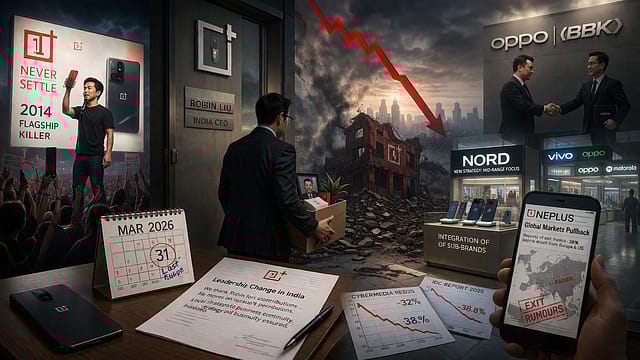
In the unforgiving arithmetic of consumer tech, brands are rarely just hardware. They are myths we buy into—stories of rebellion, value, and the promise that one company can still thumb its nose at the giants. OnePlus sold that myth masterfully in its early years. Then the storyteller walked away, and the myth began to fray. The latest chapter, unfolding in the last week of March 2026, feels less like corporate housekeeping than the final, inevitable unravelling of a personality-driven enterprise.
Robin Liu, the man who steadied OnePlus in India since joining in 2018, has stepped down as India CEO. His last day is March 31. The company’s statement is impeccably courteous: “We thank Robin for his contributions… He moves on to pursue his personal passions.” Operations, it insists, will continue with a “local strategy and business continuity ensured.” Yet the timing is merciless. Only two months earlier, in January, Liu had taken to X to dismiss shutdown rumours as “unverified” and “false,” assuring stakeholders that “OnePlus India’s business operations continue as normal.” Now the executive who denied the whispers is gone—reportedly already back in China after being asked to report to Realme CEO Sky Li, newly elevated to oversee Oppo’s sub-brands. The optics are brutal.
This is not isolated. It arrives amid credible reports of deeper restructuring. On March 23, tipster Yogesh Brar posted (then deleted) that OnePlus was “shutting down in select Global markets.” China would remain untouched; India would pivot almost entirely to budget and mid-range Nord devices. US, UK and EU customers, he warned, faced the worst of it. A source familiar with internal workings told 9to5Google the pullback—potentially beginning as early as April—would include “vast portions of Europe,” with some staff already offered severance. Shipments in India had already collapsed: 32% down in 2025 per Cybermedia Research, 38.8% according to IDC. The brand that once dominated the premium segment now scrapes for share in a brutal mid-premium war against Vivo, Oppo and Motorola. The flagship-killer romance feels like ancient history.

Open Minds 2026
26 Jun 2026 - Vol 05 | Issue 26
The power of ideas and arguments in 50 portraits
To understand the melancholy of this moment, one must return to Carl Pei. He did not design the circuits; Pete Lau did that. Pei’s genius was narrative. In 2014, the lanky co-founder stood on stages in Bengaluru and beyond and declared, “We are not here to settle.” OnePlus was positioned as the anti-corporate insurgency—affordable flagships, unfiltered community engagement, a “Never Settle” covenant that turned buyers into believers. Pei became the human face of defiance in an industry of faceless upgrades. The brand and the man fused so completely that when he left in October 2020—citing new challenges but reportedly uneasy with the deepening Oppo-BBK integration—something irreplaceable departed with him.
What followed was not collapse but dilution. OxygenOS, once lean and community-tuned, absorbed heavier traces of ColorOS. Pricing crept upward. The rebel edge softened into corporate pragmatism. Fans spoke of an identity crisis; the cult following never quite recovered. Pei, meanwhile, founded Nothing—a deliberate counterpoint of transparent minimalism and deliberate refusal to churn. The irony was lost on no one: the man who built the myth had to start again elsewhere to keep it alive.
OnePlus survived because Oppo’s resources propped it up. But survival is not the same as soul. The current contraction—flagships retreating to China, India reduced to safer mid-rangers, global markets scaled back—is the logical endpoint of that drift. The company that once weaponised charisma is now choosing margin protection over myth-making. Liu’s exit is the human punctuation mark on a structural sentence that has been writing itself for years.
For Indian consumers—who embraced OnePlus early, queued for launches, and helped make it a premium success story—the news lands with particular weight. Delhi’s gadget markets and Bengaluru’s tech corridors once buzzed with the brand’s arrival as a challenger. Today there is quiet resignation. Existing owners are assured of updates and service; prospective buyers are told the Nord pipeline continues. Yet the premium flagship dream that defined OnePlus in India feels increasingly like an imported memory rather than a living promise.
This is the perennial hazard of brands built too tightly around one personality. The founder supplies the romance—the defiance, the authenticity, the underdog swagger. Customers do not buy processors alone; they enlist in the story. When the narrator leaves without having institutionalised that spirit into culture and succession, the enterprise risks becoming competent but soulless. Scale can paper over the loss for a while. Markets, however, eventually notice the missing spark. Apple wandered in the wilderness after Steve Jobs’ 1985 exile. OnePlus is learning a similar, smaller-scale lesson.
Brands rarely confess the moment their founding myths expire. They issue statements about “local strategy” and “personal passions,” optimise supply chains, and pivot toward pragmatism. Yet the discerning buyer senses the absence. The ghost of Carl Pei still lingers in the circuitry of every OnePlus device—a reminder that in the age of intelligent machines, the most irreplaceable element remains stubbornly human: the storyteller who once convinced us we were never meant to settle.
In the end, OnePlus is not dying. It is recalibrating under the weight of its own success and the realities of conglomerate logic. But recalibration comes at a cost. The rebel brand that once felt like a movement now feels like just another option on the shelf. And in that quiet shift lies a larger truth about modern capitalism: charisma can launch empires, but only systems can sustain them. When the storyteller walks out the door, the machine must learn to speak for itself—or risk fading into echo.