Seven Languages, One Fight: How Bigg Boss Became India’s Loudest Regional Franchise
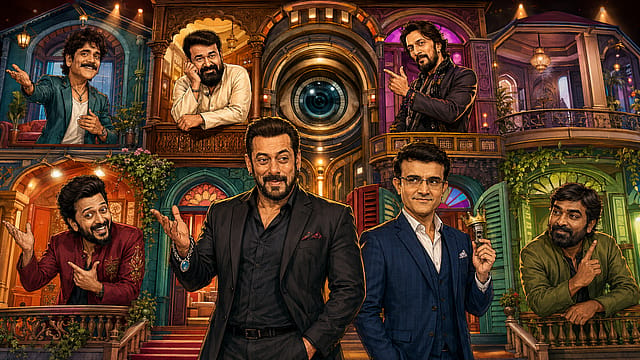
The new head of Bengal’s most argumentative household has never lived there.
Sourav Ganguly has captained India, presided over Indian cricket and taught generations of Bengalis that aggression can remain elegant if the shirt comes off only at Lord’s. He must now supervise a house where people fight over food, friendship, duty, betrayal, beds, bathroom time and the precise tone in which somebody said something three evenings ago.
Bigg Boss Bangla returns on August 30 after a ten-year disappearance. Its first season arrived in 2013 with Mithun Chakraborty. Jeet hosted the second in 2016. Then the cameras went dark. Bengal, a state famous for debate, had somehow failed to make an annual habit of watching professionally organised disagreement.

Zeroing In on ECI
09 Oct 2026 - Vol 05 | Issue 41
Constitutional legitimacy versus political opportunism
JioStar is trying again, this time with Dada at the door and the proposition Durgo Joy Shohoj Noy: conquering the fort is never easy. The metaphor allows Ganguly to carry his entire brand vocabulary into the programme. Pressure becomes a changing pitch. Alliances resemble dressing-room equations. Elimination acquires the smell of selection. The former captain does not merely host a reality show. He lends cricketing strategy, regional pride and family respectability to a format powered by confinement and conflict.
Yet Bigg Boss Bangla is only the newest room in a much larger property.
In 20 years, Bigg Boss has expanded from one Hindi programme into seven language editions, several digital spin-offs, 24-hour livestreams and a social-media industry that keeps working after the television episode ends. JioStar says the franchise reached more than 500 million people and generated over 438 billion viewing minutes across languages in 2025. For the 2026 festive season, the network has assembled six editions across Hindi, Tamil, Telugu, Kannada, Malayalam and Bangla.
India is about to spend the festive season inside six houses at once. Apparently, celebrating togetherness now requires separating several groups of celebrities from civilisation.
A Dutch Eye Learns to Speak Hindi
The house was born in the Netherlands in 1999. Created by John de Mol, Big Brother placed strangers inside a purpose-built home, cut them off from the outside world and watched continuously as privacy, patience and social performance began to erode.
The title carried the shadow of George Orwell’s Nineteen Eighty-Four. The television format removed much of the political terror but retained the all-seeing eye. Surveillance became entertainment. Viewers were invited to observe ordinary behaviour until the pressure made it extraordinary.
India acquired the format in 2006, renamed the invisible authority Bigg Boss and put Arshad Warsi in charge of the Hindi debut. Shilpa Shetty followed. Amitabh Bachchan hosted the third season. Salman Khan arrived for the fourth in 2010 and gradually became so deeply fused with the property that Bigg Boss without Salman began to feel like a house where the owner had misplaced the keys. Sanjay Dutt shared hosting duties during the fifth season, and Farah Khan later stepped in for a special extension.
Streaming created another corridor. Karan Johar hosted the first Hindi OTT edition, Salman Khan the second and Anil Kapoor the third. The house no longer needed to wait for a television slot. It could remain open, live and permanently available to anyone whose own family was behaving too reasonably.
The important expansion, however, began in 2013.
Kannada Bigg Boss launched with Kiccha Sudeep. Bigg Boss Bangla followed with Mithun Chakraborty. Tamil and Telugu editions arrived in 2017. Marathi and Malayalam joined in 2018. A Dutch format that India had first translated nationally was now being translated culturally, one region at a time.
Seven Houses, Many Bosses
The host genealogy explains the franchise better than any ratings presentation.
The Hindi edition began in 2006 with Arshad Warsi and later moved through Shilpa Shetty and Amitabh Bachchan before Salman Khan became its defining host; Sanjay Dutt co-hosted Season 5. When Bigg Boss expanded into Kannada in 2013, Kiccha Sudeep took charge. The Bengali edition, also launched that year, has travelled from Mithun Chakraborty and Jeet to Sourav Ganguly.
Tamil Bigg Boss began in 2017 with Kamal Haasan and later passed to Vijay Sethupathi, while its Telugu counterpart moved from Jr NTR and Nani to Nagarjuna. Marathi Bigg Boss launched in 2018 with Mahesh Manjrekar before Riteish Deshmukh succeeded him, while Mohanlal has remained the face of the Malayalam edition since its debut the same year. The house may be global, but every regional edition has carefully chosen a local superstar to become its voice, referee and moral authority.
Temporary replacements and digital editions enlarged the family. Ramya Krishnan stepped in when Kamal Haasan was unavailable during Bigg Boss Tamil, while Silambarasan took over the Tamil digital spin-off Bigg Boss Ultimate. Samantha Ruth Prabhu briefly handled hosting duties in the Telugu edition. Farah Khan’s Hindi intervention and the rotating OTT hosts showed that the chair could be occupied by somebody else, although the audience often treated the regular host as part of the architecture.
Each casting decision transfers a different kind of authority into the same format.
Salman Khan brings star power, danger and the credibility of somebody contestants may genuinely fear disappointing. Sudeep supplies durability and Kannada intimacy. Kamal Haasan gave the Tamil edition intellectual seriousness and occasionally ideological theatre; Vijay Sethupathi offers a more grounded, conversational directness. Jr NTR brought youthful electricity to Telugu before Nani and then Nagarjuna reshaped the chair. Mohanlal gives Malayalam viewers an institution rather than a presenter. Mahesh Manjrekar carried bluntness into Marathi; Riteish Deshmukh brings warmth, wit and a younger entertainment grammar. Bengal has travelled from Mithun’s mass charisma to Jeet’s star appeal and now to Ganguly’s captaincy.
The host is the local constitution.
He interprets the week, decides which conduct deserves reprimand, translates public anger into a question and restores order without ending the disorder that produces next week’s episode. Contestants may hear Bigg Boss throughout the week. The host arrives to tell them what the world outside heard.
“The physical format can be reproduced almost exactly, but authority cannot be dubbed,” says Ashita Aggarwal, professor of marketing at SP Jain Institute of Management & Research. The host gives the franchise a culturally recognisable moral voice. Audiences are not only watching who wins the task. They are watching somebody they trust interpret behaviour, distribute approval and occasionally articulate the judgement they have already made at home.
That is why the same house needs different guardians. The architecture travels. Legitimacy must be locally sourced.
The Joint Family With Nominations
Bigg Boss may be Dutch by birth, but its emotional machinery adapts almost indecently well to India.
The house resembles a joint family redesigned by a game-show producer. Adults of different ages and temperaments share food, space and labour. Alliances form. Chores acquire moral weight. One person controls the kitchen. Another believes the kitchen has become a dictatorship. Private complaints become public evidence. Every disagreement has witnesses, historians and at least one relative who was not present but has developed a definitive view.
Then comes nomination.
The device gives ordinary social anxiety a visible structure. Who likes whom? Who is pretending? Who contributes? Who manipulates? Who deserves to remain inside the group? Indian family life generally leaves these questions simmering for decades. Bigg Boss installs cameras and requests answers by Tuesday.
This produces a rare combination of recognition and distance. Viewers see familiar power struggles, but they can judge them without suffering their consequences. They choose favourites, form online armies and evict somebody from a house they do not pay to maintain.
The programme turns spectators into remote-control relatives.
It also supplies what scripted television must manufacture at considerable cost: recurring emotional jeopardy. A serial needs writers to create betrayal. Bigg Boss requires a limited food budget, unequal work and two people who have seen each other continuously for 40 days.
An Empty Format With Infinite Appetite
The commercial genius of Bigg Boss lies in how little fixed culture it carries.
A quiz show arrives with questions. A cooking show arrives with recipes, techniques and judging conventions. A singing competition arrives with a performance pipeline. Bigg Boss arrives primarily with rules, cameras, a house and controlled deprivation. The contestants provide the cultural material.
Bengali wit, Tamil cinema, Telugu fandom, Kannada celebrity, Marathi directness and Malayalam social codes do not decorate the format. They become the format.
This emptiness makes localisation unusually deep. A broadcaster can adjust casting, festival celebrations, food, language, humour, tasks and ideas of acceptable behaviour while retaining the central engine: strangers are watched while competing for survival inside a social system.
The format also accommodates changes in celebrity itself. Early seasons relied heavily on film and television personalities. Later editions opened doors to commoners, influencers, digital creators and people famous for becoming controversial in public. Bigg Boss does not need a stable definition of celebrity. It helps manufacture the next one.
For a fading performer, the house can become a rehabilitation centre with cameras. For an influencer, it is a route from the phone screen to mass television. For a controversial figure, it offers an extended appeal hearing. Some contestants repair their reputation. Some acquire one. Others demonstrate, in high definition, why the previous reputation was accurate.
The Conflict Refinery
One quarrel inside Bigg Boss can work harder than an entire scripted episode.
It appears first in the livestream. A clipped version travels across social media. Fan accounts slow it down, subtitle it and identify the villain. The television episode edits it into narrative. Promos turn it into suspense. The weekend host adjudicates it. News sites convert the judgement into headlines. Evicted contestants discuss it in interviews. The disagreement may continue online after everybody has left the house.
This is why Bigg Boss has grown from a television show into a content system.
JioStar says the southern editions collectively attracted more than 2.2 billion votes and over 11 billion minutes of live streaming. Company figures naturally advertise the company’s success, but they reveal the franchise’s real economic advantage. Viewers do not simply watch. They vote, stream, argue, clip, meme and return.
The long season gives advertisers frequency. Daily episodes provide habit. Weekend appearances deliver the host’s star power. Livestreaming creates constant availability. Social media supplies free circulation. Brand integrations can enter tasks, kitchens, bedrooms and conversations rather than remain trapped inside conventional commercial breaks.
The 2026 simultaneous rollout is especially useful during India’s festive-consumption period. Six editions offer JioStar a broad national proposition constructed from intensely regional audiences. Brands can buy scale without pretending that India behaves like one market.
“Bigg Boss combines two things advertisers usually struggle to obtain together: repetition and unpredictability,” says Aggarwal. The property returns daily, but the next emotionally dominant moment cannot be fully scheduled. That uncertainty keeps audiences attentive and gives brands access to a living conversation. "It also creates risk, because the programme’s cultural heat cannot always be controlled as neatly as the media plan,” she adds.
The house is an advertising platform whose inventory occasionally throws a plate.
Is Bigg Boss India’s Most Regional Format?
The tempting answer is yes. The accurate answer is more interesting.
India has built many multilingual television families. Sa Re Ga Ma Pa, born as an Indian singing programme rather than an imported format, has travelled through Hindi and several regional markets. Indian Idol has acquired Tamil, Telugu, Marathi and Bengali versions. Dance India Dance expanded regionally. MasterChef India has appeared beyond Hindi in Tamil, Telugu, Kannada and Malayalam. Quiz and talent properties have also been adapted across languages.
Bigg Boss, therefore, does not own regionalisation by numerical right.
Its distinction lies in what must be regionalised. Talent formats translate aspiration. A great singer provides an immediately legible performance even when the viewer does not understand every word. Cooking formats translate ingredients, dishes and culinary identity. Bigg Boss must translate social friction itself.
What counts as disrespect? How direct may a younger contestant be with an elder? Which joke feels affectionate and which feels insulting? When does confidence become arrogance? How much aggression can a regional superstar excuse before his own credibility becomes involved?
These are culturally unstable questions. Bigg Boss converts that instability into programming.
The contestant mix must feel local without becoming parochial. The host must possess authority without suffocating spontaneity. The arguments must become intense enough to travel but familiar enough to matter. The programme succeeds when viewers recognise their society inside an artificial house.
Other franchises search for the best voice, cook or dancer. Bigg Boss searches for the most productive incompatibility.
The World’s Most Exportable Rooms
India’s seven-language empire sits inside an even larger global property.
Banijay says Big Brother has produced about 70 adaptations and more than 600 seasons since its Dutch launch, and remains active in 27 territories. In 2025, it was broadcast in 27 countries through 35 productions. The central experiment has survived changing television technologies, moral panics, cancellations and revivals because the house can absorb the preoccupations of almost any society willing to watch itself under pressure.
The United Kingdom made Big Brother part of tabloid celebrity culture. The United States placed greater emphasis on gameplay, alliances and strategic competition. Brazil turned Big Brother Brasil into a mass-participation national event whose voting, fandom and sponsorship extend far beyond scheduled television. Big Brother Africa placed contestants from different countries inside one house, making nationality itself part of the social experiment. Nigeria built a powerful entertainment ecosystem around its edition.
India performed another mutation. Instead of using one national edition to contain all its diversity, it constructed parallel cultural houses. The world exported Big Brother across borders. India exported Bigg Boss across cultures without leaving the country.
Yet Big Brother does not dominate the global format business alone.
MasterChef has been commissioned across roughly 70 markets and has exceeded 700 seasons and 16,000 episodes, according to Banijay. The Voice, which also began in the Netherlands, crossed 150 global commissions by 2023. Got Talent earned a Guinness World Records title as the most successful reality television format after spreading across dozens of countries. Survivor, Idol, Who Wants to Be a Millionaire? and Love Island demonstrate the enormous business of selling a repeatable entertainment engine rather than a completed story.
Every great format solves the same problem differently. MasterChef turns local food into universal competition. The Voice turns an unseen singer into revelation. Got Talent promises that anybody may possess a stage-worthy secret. Survivor removes civilisation. Big Brother removes privacy.
India discovered that privacy was only the beginning. The format could also remove linguistic distance.
The House Does Not Win Everywhere
Seven adaptations should not be mistaken for seven uninterrupted victories.
Bangla is returning after only two earlier seasons and a ten-year gap. Marathi has not maintained the clockwork regularity of Hindi or Kannada. Hosts change, channels adjust strategy and individual seasons rise or fall with casting. A technically faithful reproduction can remain culturally lifeless.
The simultaneous expansion creates its own danger. When several editions occupy the same festive window, Bigg Boss gains national scale but also competes with itself for attention, celebrity supply, sponsorship and social oxygen. Audiences may eventually recognise the machinery beneath supposedly spontaneous conflict.
There is a moral limit as well. The programme monetises surveillance, humiliation, isolation and emotional distress while advertising access to the contestants’ “real” selves. But confinement does not necessarily reveal an authentic personality. It reveals how a person behaves while confined, watched, edited, judged and periodically deprived of control.
Humour can become cruelty. Disagreement can be rewarded until performance replaces feeling. Fan communities can convert a television rivalry into targeted online abuse. The host’s cultural authority may legitimise the programme, but it also attaches his personal brand to whatever the format produces.
Sourav Ganguly brings Bigg Boss Bangla credibility. Bigg Boss brings Ganguly unpredictability. The exchange is commercially useful because it is not entirely safe.
The Seventh Door Opens
When Bigg Boss Bangla opens its doors, Bengal will not merely receive a Bengali translation of a Hindi hit. It will test whether an old global machine can once again make Bengali personalities, humour, pride and disagreement feel native inside a deliberately unnatural house.
Sourav will arrive with a captain’s authority. Contestants will enter with biographies, ambitions and carefully prepared versions of themselves. Cameras will begin the patient work of making preparation irrelevant.
Somebody will control the kitchen. Somebody will object. A friendship will become an alliance, an alliance will become evidence and a sentence will survive long after its original context has been evicted.
The Netherlands supplied the eye. India built seven houses beneath it.
The country speaks hundreds of languages. Bigg Boss has so far learnt seven ways to say: the meeting could have been an email, but fortunately everybody has been locked inside until further notice.