Saas, Bahu & Search Bar: How Google AI Entered the Indian Soap Opera
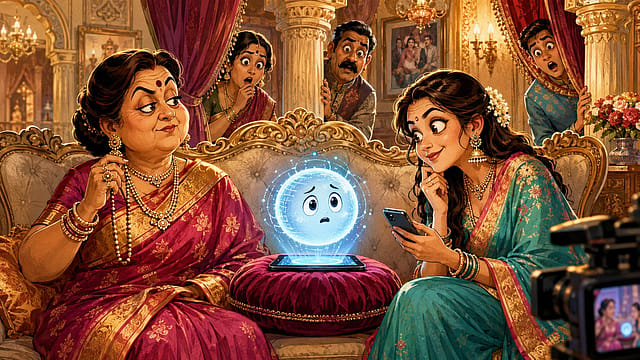
The Indian television serial has survived reincarnation, plastic surgery, memory loss, secret heirs, duplicate husbands and weddings that require approximately the same number of episodes as an actual marriage.
Artificial intelligence should fit right in.
ZEE and Google have placed Google Search’s AI Mode inside the fictional worlds of Ganga Mai Ki Betiyan and Tumm Se Tumm Takk. Characters will use it while confronting everyday questions, ambitions and decisions. ZEE calls its popular characters “Dilfluencers”. Google has now recruited their dil to teach the viewer what to type into the search bar.
The collaboration began around Independence Day with a film featuring Amandeep Sidhu, who plays Sneha in Ganga Mai Ki Betiyan. During a backstage conversation, her makeup artist Aarti reveals that she plans to leave and open a beauty salon. How will she negotiate the questions involved in starting a business?

Zeroing In on ECI
09 Oct 2026 - Vol 05 | Issue 41
Constitutional legitimacy versus political opportunism
Enter Google Search’s AI Mode.
It understands the situation, processes the query and helps show Aarti a possible road ahead. Amandeep eventually breaks the fourth wall and invites the viewer to try the tool. The campaign thought promises an AI Mode that understands, explains and shows the way: Samjhe, Samjhaye aur Raah Dikhaye.
The phrase is warm, reassuring and almost suspiciously qualified for Indian family television. The family elder once understood. The heroine explained. The serial showed the way.
Google would now like all three roles.
Welcome to Prompt Placement
Product placement has traditionally required very little labour from the product. A cola bottle sits on a table. A car carries the hero. A phone displays its logo at the precise angle favoured by the manufacturer. The audience notices the product, the character borrows it and the story moves on.
Artificial intelligence cannot sit quietly in the scenery. Its commercial value appears only when somebody asks it a question, accepts its usefulness and acts upon the response. That is what makes the ZEE-Google collaboration more interesting than another branded object wandering accidentally into the camera.
This is prompt placement. The brand is embedded in a behaviour. The character demonstrates the question, the technology produces an answer and the plot supplies evidence that the answer was useful. Google is not merely purchasing visibility inside the serial. It is purchasing a rehearsal for what it hopes the viewer will do outside it.
The prompt becomes dialogue. The answer becomes screenplay. The adoption tutorial arrives wearing a costume from prime-time television.
For Google, that solves a formidable marketing problem. Millions of people know that artificial intelligence exists. Far fewer know when to use it, how to frame a useful query or why it should replace a familiar search habit. Benchmark scores will not persuade the mass market. Repetition, familiarity and apparent usefulness might.
An advertisement can announce AI Mode. A fictional character can normalise it.
The Soap Has Returned to the Opera
There is a gorgeous historical loop here.
The “soap” in soap opera was never metaphorical. In the 1930s, consumer-goods companies sponsored daytime radio serials to reach homemakers. Procter & Gamble became one of the form’s defining patrons, producing and sponsoring dramas that carried domestic audiences from one cliffhanger to the next while soap and detergent advertising paid the bills. Guiding Light began on radio in 1937 and later moved to television, ultimately becoming one of the longest-running dramas in broadcasting history.
Household fiction was built partly to create household consumption.
Nearly nine decades later, the product has changed. The method has become cleverer.
Soap companies once financed the story surrounding the commercial break. Google wants its technology to participate in the story itself. The old advertiser bought proximity to emotion. The new advertiser asks emotion to demonstrate the product.
The soap opera has completed its upgrade. It once sold soap between scenes. It can now sell AI through the scene.
Google Borrows a Fictional Heart
ZEE’s “Dilfluencer Moments” proposition rests on a sound understanding of television. Regular viewers do not encounter serial characters as strangers hired for a thirty-second endorsement. They meet them daily, understand their histories and become invested in their victories, injuries, marriages and miraculous recoveries.
That relationship carries emotional credit.
When Sneha or another familiar character uses AI Mode to solve a problem, Google borrows some of that accumulated trust. The viewer is not watching an engineer demonstrate software. She is watching somebody she already knows navigate an ambition that may resemble her own.
This is the strategic prize. Google need not persuade the audience to fall in love with a search interface. It needs the audience to watch a loved character find the interface useful.
Ashita Aggarwal, professor of marketing at SP Jain Institute of Management & Research, sees the opportunity in that transfer of trust. “A familiar television character reduces the psychological distance between a new technology and the viewer," she reckons. The character is effectively demonstrating both the prompt and the confidence to use it. The opportunity is enormous, but the integration will work only when AI helps the story move forward. "If the story stops to teach the product, viewers will immediately recognise the advertisement,” she adds.
That last distinction could decide whether prompt placement becomes powerful or painful. The serial must appear to need AI. AI must not appear to have kidnapped the serial.
When the Search Bar Starts Overacting
Indian television audiences possess highly trained advertising detectors. They know when a packet has been placed unnaturally on the kitchen counter. They know why a character suddenly recites three product benefits while the family looks impressed. They know that people in real homes rarely hold labels towards the camera while discussing emotional trauma.
AI integration is even harder to disguise.
A believable prompt is usually messy. People ask incomplete questions, change their minds and misunderstand answers. A sponsored prompt will be tempted to arrive perfectly phrased, followed by a flawless response and the kind of immediate clarity unavailable to humans, algorithms or television writers.
If every dilemma pauses for a software demonstration, the serial could begin resembling a Google tutorial repeatedly interrupted by relatives.
There is also the question of disclosure. Viewers should know when a technology’s appearance is a paid integration. The more naturally it enters the narrative, the more important that transparency becomes.
The stakes increase with the question being asked. Advice about opening a salon can demonstrate research and planning. Health, finance, law and relationships occupy more dangerous territory. Will fictional AI answers carry uncertainty? Will characters verify important information? Or will the machine acquire the unquestioned authority traditionally reserved for the family matriarch?
The characters may be fictional. The trust transferred to the technology will be real.
The New Supporting Actor Never Forgets Its Lines
Brands have entered entertainment before and occasionally become inseparable from it. Reese’s Pieces helped lure an alien in E.T. Apple devices and interfaces carried an entire Modern Family episode. Coca-Cola cups became permanent furniture on American Idol.
Those products enabled action or occupied attention. Generative and conversational AI can shape the decision itself.
That makes it a peculiar new supporting actor. It does not demand a vanity van. It never forgets its lines. It can appear across several programmes without a scheduling conflict. Most importantly, every successful scene teaches a repeatable consumer action: ask this kind of question here.
This is why the battle among AI companies will not be settled only by which model is smartest. It will also be decided by which product becomes ordinary first.
The winning assistant may not be the one most admired by technologists. It may be the one that enters the greatest number of kitchens, classrooms, phones and family conversations without requiring an explanation.
Google Search already owns familiarity. AI Mode must persuade users to alter what they do with it. ZEE supplies something a technical demonstration cannot: a culturally familiar rehearsal space.
The audience watches the character prompt. The character receives help. The viewer learns the ritual. That is advertising, education and behavioural design packed into the same scene.
Who Writes the Next Twist?
ZEE says AI Mode will appear at important moments in upcoming storylines. That gives the partnership room to prove whether it can become genuinely narrative or remain an elaborate commercial cameo.
The best integrations will allow the technology to assist without becoming omniscient. An answer might open a possibility, reveal competing choices or help a character ask a better question. The final judgement must remain human. Drama dies when a machine resolves every uncertainty in seconds.
There is no serial if AI identifies the villain in episode three. There is no family war if it produces the missing property document. There is certainly no 800-episode marriage track if it completes the background check. Google, therefore, faces a charming creative contradiction. Its product must appear useful enough to deserve adoption, but not so useful that it destroys the confusion upon which television drama depends.
The saas needs suspicion. The bahu needs struggle. The search bar needs a successful query. ZEE and Google must give everybody what they need without allowing the advertisement to seize the remote control. The Indian soap opera once taught households what to desire, fear, purchase and discuss. It may now teach them what to prompt.
Welcome to the family, AI Mode. Please remember that nobody receives complete acceptance before episode 500.