One Shoe, Two Histories: How Adidas Forgot the Indian Footprint
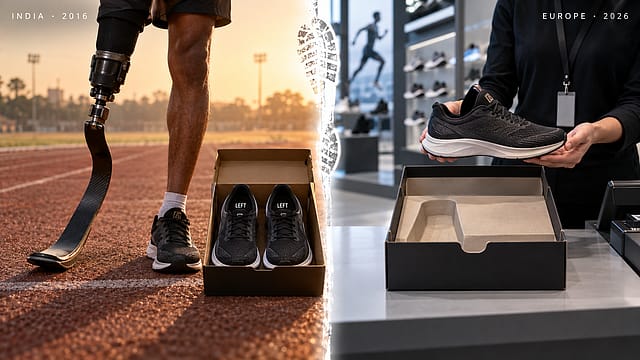
One shoe lay unused in Major DP Singh’s cupboard.
It was new. It was expensive. It was also completely useless to him.
Singh had lost his right leg after suffering severe injuries during the 1999 Kargil War. When he subsequently began running with a blade, he required a conventional shoe only for his left foot. Retail, however, understood human beings as symmetrical customers. Shoes came in pairs. Singh bought two and consigned the untouched right shoe to the cupboard.
“So, why can’t I have two of the same side?” he would later ask.
In 2016, Adidas India and Taproot Dentsu turned that wonderfully obvious question into Odds—a special footwear offering through which para-athletes could order two left shoes or two right shoes.
The Modi Years
02 Oct 2026 - Vol 05 | Issue 40
A Nation Rebuilt
The campaign film followed Singh, India’s first blade runner, across mountains, muddy tracks and punishing terrain. Kabir Bedi’s voice asked whether it was odd for a man to run when he was not expected to walk, to survive one war and begin another, and to achieve with one leg what appeared impossible with two.
Then came the product: an even pair for people who ran against the odds.
Ten years later, Adidas has returned to the same cupboard.
Its new Single Shoe Service, available through Adidas-owned stores across 23 European countries since January 19, 2026, allows customers with a lower-limb difference to buy one shoe for half the price of a complete pair. It covers the footwear available in participating stores and has been designed in consultation with members of the disability community, ParalympicsGB and Harder Than You Think.
It is more extensive than Odds. It is operationally cleaner. Instead of supplying two shoes for the same foot, adidas now sells the customer precisely one shoe.
There is only one peculiar absence: India.
The official Adidas announcement describes the community consultation behind the new service and places it within the company’s wider efforts to make sport more inclusive. It does not mention Odds, Taproot Dentsu or Major DP Singh.
The shoe has travelled. Its history has disappeared somewhere in transit.
An Inclusion Idea With an Exclusion Problem
Santosh Padhi, then co-founder and chief creative officer of Taproot Dentsu, is careful about what he is alleging.
He does not describe the European service as an exact replica. He accepts the material differences in mechanism and scale. Nor does he want adidas to withdraw a service that gives consumers greater choice.
His question is simpler: why could Adidas not acknowledge that the company had addressed essentially the same problem in India ten years earlier?
“The big idea is absolutely the same,” Padhi reportedly said.
The underlying question certainly is. Why should somebody pay for footwear they cannot use merely because the footwear industry packages shoes in pairs?
In 2016, the answer was two lefts or two rights. In 2026, it is one shoe at half price. The retail formulation has improved; the consumer truth remains remarkably familiar.
That is what makes this more interesting than a conventional advertising plagiarism quarrel. There is no established evidence that the present adidas team copied Taproot’s work. A company listening seriously to amputees could independently encounter the same obvious problem. Teams change, agencies move on and institutional memories decay.
But that defence produces another uncomfortable question. How does one of the world’s largest sporting companies forget an idea created, advertised and sold under its own three stripes?
Marketing and branding experts reckon that the issue extends beyond conventional creative credit. Purpose-led work asks a brand to do two things simultaneously: solve a real problem and tell the truth about how that solution evolved. "Scale is progress, but scale without memory can flatten local innovation into a global-origin story," says Ashita Aggarwal, professor of marketing at SP Jain Institute of Management & Research. In an inclusion initiative, acknowledgement is not a ceremonial footnote; it is part of inclusion. Adidas can reasonably argue that the 2026 service is broader and operationally different, but recognising Odds would make the new programme stronger, not smaller.
That is the exquisite contradiction. A service created to recognise consumers whom conventional retail overlooks has overlooked the Indian creators and participant who helped Adidas recognise those consumers a decade earlier. An inclusion initiative has acquired an exclusion problem.
The Global Idea That Began as Local Work
Indian advertising is accustomed to receiving ideas from elsewhere.
A global positioning arrives from London, New York or a European headquarters. The Indian office translates it, localises the joke, adjusts the celebrity and finds a festival on which to hang the message. The genealogy usually travels with the campaign: originating agency, global creative platform, senior leadership and strategic intent.
Odds appears to have travelled in the opposite direction.
An Indian athlete’s lived frustration became an Indian product idea. Taproot developed it for Adidas India. The company altered what it sold rather than merely inserting a para-athlete into an inspirational film. The work was released during the 2016 Rio Paralympics and celebrated by the advertising industry.
Yet when the insight returned at far greater scale, its corporate biography began again in Europe. The Indian idea proved global enough to scale. India apparently was not important enough to remember.
Padhi has suggested that the omission could simply be institutional amnesia. The people responsible for the current service may never have encountered Odds. A decade separates the two initiatives; executives and agency relationships have changed.
That explanation is entirely plausible. It is not particularly comforting. Multinational companies preserve painstaking records of brand colours, sonic signatures, campaign templates and logo dimensions. They build databases to ensure that a shade of blue remains consistent across continents. Yet a product-changing idea can apparently disappear when the people who made it leave the room.
A corporate archive should preserve more than brand guidelines and award entries. It should remember where useful ideas began and whose experience allowed the organisation to discover them.
Otherwise, local markets become laboratories whose successful experiments can later be presented as discoveries made elsewhere.
India has long wanted its advertising ideas to travel. The Adidas episode demonstrates the strange possibility that the work may travel considerably farther than its authorship.
The Two Soldiers in the Story
The debate over Odds resurfaced because another Adidas execution carried the Single Shoe Service into much more combustible territory.
A local Israeli activation featured 11 disabled athletes, including Shalev Biton, a former Israeli soldier who lost his left leg while serving during the May 2021 Israel–Gaza conflict.
Pro-Palestinian activists called for a boycott. They contrasted the campaign’s choice of a former Israeli soldier with the enormous scale of death, injury and amputation among Palestinians in Gaza.
Adidas apologised for the offence caused and described the disputed execution as a local initiative, distinct from the wider Single Shoe Service.
That distinction is crucial.
The European service predates the Israeli controversy. Its functional value does not vanish because one local execution collided with an extraordinary political and humanitarian context. Nor should every athlete with a military background be reduced to the politics surrounding the conflict in which the injury occurred.
But the juxtaposition is impossible to ignore.
The 2016 Indian film also featured a soldier who had lost a leg in war.
Major Singh’s Kargil history helped create a story about resilience, athletic ambition and a retail absurdity that could be corrected. A decade later, another amputee soldier entered the communications around the same fundamental product idea.
The parallels end there. The wars, national contexts and political meanings are profoundly different.
Yet the two executions reveal how rapidly disability advertising can become entangled with military heroism and nationalism. A brand may believe it is presenting an athlete and a practical solution. Audiences also see the uniform, the conflict and the people absent from the frame.
In India, the soldier’s unused shoe unlocked the idea. In Israel, the soldier’s identity overwhelmed it. The product remained functional. The casting made it geopolitical.
Did adidas Improve What India Invented?
The fairest answer is yes. Odds was ingenious, but questions remain about how long consumers could easily access it after the campaign. Singh himself has acknowledged that if the product disappeared with the advertising instead of becoming an enduring retail service, it risked looking like a marketing gimmick.
The Single Shoe Service goes significantly further.
It is available across Adidas-owned stores in 23 European countries. It applies to in-stock footwear rather than one narrowly defined model. Customers purchase one shoe and pay half the price of the pair. The operational system has been constructed for sustained retail use.
This is what inclusion should eventually become: an ordinary service rather than an extraordinary campaign.
A disabled customer should not need to wait for the Paralympics, an award entry or a purpose-marketing calendar before a company notices that conventional retail architecture does not serve everyone.
The 2026 programme therefore deserves applause for making the solution larger and more permanent.
But progress and acknowledgement are compatible.
Adidas could have described Odds as an early initiative that helped illuminate a consumer problem the company is now addressing more comprehensively. That sentence would not diminish the work undertaken with ParalympicsGB or the disability community. It would give the new service a longer, richer and more credible history.
The company would be able to say: we tried this in India, learned from the problem and have now built something better. Instead, the official narrative unintentionally suggests that Adidas encountered the issue for the first time in 2026. The new service improves the product while impoverishing the story.
Who Owns Lived Experience?
Purpose advertising frequently promises to listen to lived experience.
That commitment must extend beyond casting. People cannot supply the insight, emotional legitimacy and narrative, only for the organisation to own the discovery once a more scalable expression becomes possible.
Singh was not a celebrity hired to perform somebody else’s script. The unused shoe in his cupboard was the consumer problem. His running career, his prosthetic blade and his question about two same-side shoes gave Odds its reason to exist.
The brand contributed manufacturing, distribution and enormous cultural reach. Taproot converted the truth into a product and a piece of communication. Together, they made a powerful campaign.
Nobody needs to claim exclusive ownership over the elementary idea that an amputee may require only one shoe. That consumer need belongs to the people who experience it.
Creative credit, however, is not a demand for permanent monopoly. It is an accurate account of contribution.
Acknowledging Odds would not declare that Adidas can never improve the idea. It would demonstrate that the company possesses enough confidence to recognise the earlier Indian chapter.
That may be the final irony. The 2016 campaign ended by asking whether society had done enough to “even out the odds.” Ten years later, Adidas has done substantially more. It has created the stronger retail response that the original insight deserved.
Now it must even out the credit. A single shoe can reveal what conventional retail fails to see. This one has revealed something else: Indian creativity can cross continents, enter 23 countries and return as a global solution without leaving a visible footprint of where the journey began.
Adidas has improved the solution. It should now repair the story.