Kothaye Jaabe Dada? Flipkart Takes a Detour Through Kolkata’s History
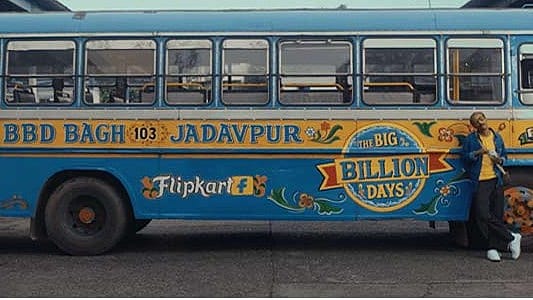
The conductor has been advertising BBD for years. Flipkart has only just boarded.
That is the lovely conceit at the heart of Kothaye Jaabe Dada? A familiar destination, shouted often enough to become part of the city’s soundtrack, turns out to share its initials with a shopping festival. The brand does not have to teach Kolkata three new letters. It has to persuade the city to hear the old ones differently.
BBD. Benoy, Badal, Dinesh.
BBD. Big Billion Days.
The distance between those expansions is considerably greater than the distance between two bus stops.
Flipkart’s latest activation places sale messaging on selected Kolkata buses travelling to and through BBD Bagh. Tickets carry offers and QR codes. A campaign film follows a conductor whose working life has been accompanied by the cry of “BBD! BBD!” The phrase acquires a fresh commercial destination. Conceptualised by Talented and produced by Calm Kaam, the execution turns a route call into a retail invitation.
Zeroing In on ECI
09 Oct 2026 - Vol 05 | Issue 41
Constitutional legitimacy versus political opportunism
It is a neat piece of local observation. It also contains a question that becomes more interesting the longer one stays on the bus.
When a brand borrows a city’s language, how much of the city’s memory comes with it?
Three letters, considerable baggage
BBD Bagh was once Dalhousie Square. Its present name honours Benoy Basu, Badal Gupta and Dinesh Gupta, the revolutionaries associated with the attack on Writers’ Building on December 8, 1930. The initials preserve people and a chapter of the freedom struggle within the address of a busy working district.
For a commuter, however, an address also has an immediate job. It tells you where to go. You can know the history behind a place and still need the conductor to answer a more pressing question: does this bus stop there?
That everyday usefulness is what makes the campaign possible. The same initials can function as commemoration, navigation and, now, promotion.
It would be too easy to declare that Flipkart’s joke proves Kolkata has forgotten its revolutionaries. It proves no such thing. Abbreviation is not a memory test. A passenger can understand both meanings perfectly well and enjoy the collision.
The more defensible argument is also the more revealing one. Advertising has found commercial value in language that already belongs to a place. Its usefulness comes from all the work those letters were doing before the brand arrived.
The conductor is not simply delivering a line written by a copywriter. His familiar call gives the new line its credibility.
The city wrote the first draft
Much local advertising begins with a national campaign and adds recognisable decoration. A landmark appears. A familiar dish makes an entrance. Somebody says something in the local language. The brand waves enthusiastically from the pavement.
Here, the connection is built into the idea. BBD Bagh makes the BBD pun possible. Take away the destination and the campaign loses its organising device.
Baap Ka, Dada Ka, Brands Ka: Has Wasseypur Become Digital India’s Sholay for Pop Culture?
That is a stronger form of localisation because the city supplies a mechanism, not merely a backdrop. The everyday commute becomes the medium through which the sale is encountered. A ticket that normally confirms a journey can prompt a second action on a phone.
There is a satisfying economy to it. A bus conductor repeats destinations because repetition helps passengers. A retailer repeats a sale’s name because repetition helps recall. The activation brings the two functions together without having to invent the first one.
But the arrangement also reveals the value being borrowed. The route call has familiarity earned through ordinary use. The shopping message enters that familiarity and hopes some of it will rub off.
The bus fare buys a journey. The advertising buys an association.
Whether that association produces purchases is a separate question. A clever fit between city and campaign establishes creative relevance; it does not establish commercial effectiveness. Scanning a ticket, remembering a joke and buying something are different outcomes.
Still, as an advertising device, it gives the sale something a generic discount poster cannot: a reason to sound as though it belongs here.
Knowing the address, knowing the story
That sense of belonging is where the historical tension enters.
Benoy, Badal and Dinesh are not simply one possible expansion of a convenient acronym. They explain why the place bears those letters. Big Billion Days is arriving much later, with a different purpose and a shorter stay.
The campaign need not become a history lesson to recognise that distinction. Nor must a bus ticket carry a miniature essay on the freedom struggle. The issue is one of proportion: how confidently can a brand claim local intimacy if it treats the most useful part of a name as the whole of it?
There is room here for affection and opportunism to coexist. An agency may understand a city well and still notice that its vocabulary makes an excellent sales device. Commercial intent does not automatically cancel cultural sensitivity. Cultural familiarity does not automatically guarantee it, either.
The useful editorial question is therefore more precise than whether the campaign has committed an offence. What does it acknowledge about the meaning it borrows? Does the joke leave both expansions visible, or does one become mere preparation for the other’s punchline?
That distinction matters beyond this particular execution. A local reference can make people feel recognised. It can also leave them feeling that something familiar has been mined for a moment of borrowed attention.
The audience, rather than the campaign announcement, gets to decide which encounter it has had.
Another bell rang in America
There is a more outrageous global cousin to this collision between civic meaning and commercial naming.
On April 1, 1996, Taco Bell ran an advertisement announcing that it had bought Philadelphia’s Liberty Bell and renamed it the “Taco Liberty Bell”. It was an April Fools’ prank. In a later StoryCorps account, National Park Service rangers recalled the confusion and reactions it produced.
The provocation came from pretending that a public symbol could become a corporate possession. The joke needed the audience to understand that the bell meant more than an object with a convenient name.
Flipkart’s execution is substantially different. There is no announced purchase of BBD Bagh and no claim to have renamed it. A conductor’s cry is being given a second interpretation. Treating the campaigns as identical would manufacture a scandal the Kolkata activation has not established.
Yet the comparison illuminates why public names can carry unusual advertising power. Their significance has been accumulated beyond the advertiser’s own work. A pun can reach that significance with very little copy.
It can also reach feelings that do not belong to the advertiser to script.
Taco Bell made the imagined transfer of ownership explicit. Flipkart’s device works through a lighter shift in association. In both cases, the commercial name gains something from encountering a public meaning already in circulation.
The creative opportunity and the need for judgment arrive together.
History does not need a velvet rope
There is a strong defence of Flipkart’s approach, and it deserves more than a ceremonial paragraph.
A living city cannot be expected to handle every historical name as though it were behind museum glass. People meet, work, shop, commute and joke in places named after consequential people and events. Ordinary use can keep a name present in daily life, even when nobody recites its origin on every occasion.
BBD Bagh is a particularly unhelpful place to invent a simple opposition between history and commerce. It is a working district. The activities of the present have long occupied the same streets as reminders of the past.
The presence of a sale message is therefore not, by itself, evidence of disrespect. Humour can make a place newly noticeable. Someone who recognises only one expansion of BBD might encounter the other through the campaign and the discussion around it.
That possibility cuts against the easy accusation of erasure. The relevant question is how the encounter is handled, not whether commerce may ever come near memory.
The execution also gives a familiar worker a central role. Its organising figure is a conductor whose repeated call anchors the brand’s entrance. There is creative value in paying attention to a routine that advertising might otherwise pass by.
The strongest reading can hold both ideas at once: this is an observant use of local culture, and the culture contains more than the wordplay needs.
Next stop: whose BBD?
The lasting interest in Kothaye Jaabe Dada? lies in that extra meaning.
For Flipkart, BBD is a commercial property to build. For Kolkata, BBD is also an inherited name to live with. The campaign brings these relationships together but cannot make them interchangeable merely because the letters match.
This is what distinguishes cultural familiarity from cultural depth. Knowing what people say can produce a good line. Knowing why they say it can produce a better judgment about where that line should lead.
The campaign has found an elegant way to get aboard a conversation already taking place. The conductor supplies its rhythm. The route supplies its recognition. The tickets provide somewhere for the commercial invitation to land.
The history supplies the question that makes the whole thing worth a second look.
Kothaye jaabe, dada?
Flipkart would like the answer to be Big Billion Days. Before the sale arrived, those three letters already had three names.