RK-57: Ravi Kishan, Fully Loaded. Brands Follow, My Brother
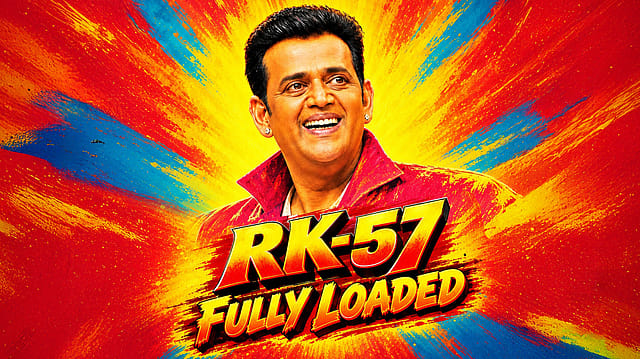
An AK-47 comes with a warning. RK-57 comes with a punchline. Now, he comes with a school of philosophy.
Swiggy Dineout calls it “Ravissance”. Ravi meets Renaissance. In the new campaign, Kishan takes on a sage-like appearance, delivering observations that travel from life and society to food. His familiar mannerisms provide the comic vocabulary. A dining platform has found a philosopher with an audience already waiting for the next pronouncement.
On Instagram, the caption accompanying his post of the film declares: “Forget everything you learned, this is the real jhoot the truth”. Even the contradiction arrives with confidence.
For the man associated with “Money Follows My Brother”, the commercial sequel practically writes itself.
Brands follow, my brother.
Beauty, technology, dining out: the advertising briefs are multiplying around a personality that seems capable of swallowing a script and returning it with a Bhojpuri flourish. The temptation is to call this an overnight transformation. Actor becomes meme. Meme becomes money.

Zeroing In on ECI
09 Oct 2026 - Vol 05 | Issue 41
Constitutional legitimacy versus political opportunism
It is a wonderfully efficient account of a career, provided you are willing to misplace three decades.
Credit: Instagram: ravikishann
To understand what brands are buying, follow the voice beyond the advertisement. Sometimes, it comes with a song for the chief minister.
Ravi Kishan’s Swagger Has a Mother Tongue
At a public meeting in Kushinagar on June 2, Ravi Kishan moved from praising the Uttar Pradesh government to singing in Bhojpuri. “Neta bejod baade ho,” went part of his tribute to Yogi Adityanath: a leader without parallel. Adityanath subsequently supplied his own entertainment, addressing Ravi Kishan Shukla as Ravi Kishan Mishra. The gathering laughed.
Here was an MP who could bring a song into a speech and become part of the joke afterwards. The performer and the politician were sharing a microphone. Bhojpuri made the arrangement sound entirely natural.
The episode helps explain why his appeal travels beyond a collection of viral expressions. The internet has found a wonderfully shareable man. His older audience knows someone who has been addressing it for years.
That distinction carries the story of RK-57. His most durable asset may be the sense that, however far he travels, something recognisably theirs arrives with him.
He can become a Hindi-film policeman, a Telugu villain, a television contestant or a cosmetics guest. The public personality retains the cadences, exuberance and familiarity associated with his Bhojpuri life. He seems capable of turning an interview into a conversation already underway at home.
Home, however, did not immediately know what to do with an actor.
On the television programme Swarna Swar Bharat in 2022, Kishan recalled playing Sita in Ramlila against his father’s wishes. His mother supported the ambition and gave him ₹500 to leave for Mumbai. Years later, he credited her with the career that followed.
A mother had financed an exit. The entrance remained his problem.
Before the Memes: Rejection, Bhojpuri Films and a Makeup Box
His film career began with Pitambar in 1992. Hindi credits accumulated through the following decade, including Army and, later, Tere Naam. He had entered the industry; finding a secure place within it was another matter.
In a 2013 interview, he recalled being without work for four months roughly eleven years earlier. “I would keep smelling my makeup box and cry,” he said. In the same account, he described his mother encouraging him to accept Bhojpuri work for the people of his village. He credited that cinema with giving him money, recognition and respect.
The detail of the makeup box is almost painfully small beside the expansiveness of the man he would become. There was no audience in that recollection, no applause to coax out of a room. There was an actor missing the physical business of being an actor.
Bhojpuri gave that hunger somewhere to go.
Films such as Saiyaan Hamar, Pandit Ji Batai Na Biyah Kab Hoi and Ganga belong to the career that made him a leading man. The familiar description “Amitabh Bachchan of Bhojpuri cinema” conveys the scale of that stature. It also contains an awkward habit of our cultural vocabulary: to explain how large somebody is elsewhere, we reach for a Bollywood measuring tape.
His audience did not need the comparison to know whom it had come to watch.
This is where the easy account of Kishan as a late bloomer begins to wobble. Late to whom? A star can spend years filling one audience’s imagination while remaining peripheral to another. Calling the second audience’s discovery the beginning of his success writes the first one out of the credits.
Credit: Instagram: ravikishann
Yet it would be equally glib to tell him that regional success should have satisfied every ambition. A man can be grateful for what he has earned and still ache for the work he has not been offered.
That ache did not disappear when the money arrived. In an interview in January 2025, Kishan described working on 17 films, doing multiple shifts and sleeping in his car between assignments. He connected the frenzy to his earlier shortage of work. He also acknowledged becoming arrogant, and credited his wife Preeti’s encouragement to enter Bigg Boss in 2006 with helping him reassess himself.
The swagger required some maintenance at home.
That admission makes him more interesting than an indestructible underdog. Scarcity had taught him to grab the next job. Success had not yet taught him when to stop. His mother helped him pursue the actor; his wife, in his telling, helped him recover the person.
Bollywood Recognition and the Regional-Star Label
Nor was the subsequent Hindi career an uninterrupted ascent. Chitkabrey—Shades of Grey, Chaalis Chauraasi, Jeena Hai Toh Thok Daal and Lucky Kabootar were commercially unsuccessful, according to trade records. These were collective productions, not verdicts on one supporting or leading performer. They nevertheless puncture the tidy mythology in which one breakthrough permanently abolishes uncertainty.
Kishan kept working across that uncertainty. The wider history of Indian cinema offers reasons why recognition in another language could remain an unfinished ambition.
Rajinikanth is the illuminating comparison. His Hindi career included the successful Andhaa Kaanoon, ChaalBaaz and Hum. To dismiss it as unmemorable would erase actual films and actual audiences. But those appearances did not reproduce his position at the centre of Tamil stardom. Bollywood could accommodate Rajinikanth without organising itself around him.
Women including Vyjayanthimala and Sridevi built commanding Hindi careers after beginning in southern cinema. Their achievements demonstrate that the borders were permeable; they do not establish that crossing them was easy. Kamal Haasan’s Ek Duuje Ke Liye is an obvious reason to resist any absolute claim about men being shut out.
The useful question is what travels with a star. A name, a performance and an audience do not necessarily arrive with equal bargaining power. Stardom elsewhere can become an intriguing credential rather than a guarantee of centrality in a Hindi film.
Kishan’s route complicates that history further: he began in Hindi cinema, built a much stronger identity in Bhojpuri, and continued seeking room across industries. He was neither a newcomer without a constituency nor a man whose constituency could secure every role he wanted.
“A regional identity can give an actor a powerful audience while also becoming the label through which other filmmakers see him,” says Ashita Aggarwal, professor of marketing at SP Jain Institute of Management & Research. Kishan’s opportunity is to make the qualities associated with that identity valuable across different roles and markets. His journey, she adds, also challenges our hierarchy of recognition: an audience does not become less important because Bollywood discovers its star later.
Kishan’s response has been a career larger than the Hindi–Bhojpuri binary. Race Gurram introduced him to Telugu cinema as Maddali Siva Reddy; Kannada audiences saw him in Hebbuli and Roberrt, while Sangathamizhan belongs to his Tamil work. The range shows professional adaptability alongside the persistence of a recognisable public identity.
Roots, in this career, have supplied a base from which to move.
From Laapataa Ladies to Mirzapur: The Actor Behind the Expressions
The distinction is visible in his recent Hindi work. Aamir Khan auditioned for the policeman in Laapataa Ladies; Kiran Rao ultimately cast Kishan.
Within a popular film history so often narrated through Khans and Kapoors, here was a part whose answer was Ravi Kishan. The significance lies in the specificity of the choice: another actor’s stature could not automatically supply what the role required.
Mirzapur: The Movie has given that specificity a more unruly outlet. His Babban Babua Yadav is a gangster devoted enough to sew clothes for his girlfriend Mumtaz. In a recent interview, the filmmakers reportedly described worrying that sympathy for him would draw viewers away from the established protagonists. They also credited Kishan with improvising “Love you Mumtaz” during a stabbing sequence.
Tenderness has acquired a very alarming tailor.
The performance’s collision of affection and threat makes a useful point about the man now reduced to reaction clips. Producing an unexpected response is an actor’s skill. Decades of work sit behind the face that appears to have wandered accidentally into everybody’s feed.
Bhojpuri, Politics and the Power of Familiarity
His political performances draw on another kind of familiarity. On NDTV’s Poll Curry during the 2024 election campaign, Kishan and Kunal Vijayakar prepared baati chokha in Gorakhpur and discussed home cooking. A companion segment had him talking about sattu as sustenance through rallies. The food supplied a vocabulary of belonging as readily as the speech did.
Such appearances make his son-of-the-soil image tangible. The appeal rests in recognisable things: food, speech, songs, a joke that does not require the audience to adjust itself to the speaker’s sophistication.
Born in Bombay, with family roots in Jaunpur, Kishan complicates the neat division between the metropolis and the provincial outsider. His Bhojpuri identity is something he has continued to practise in public.
It would be foolish to confuse informality with an absence of craft. He is an experienced performer and politician appearing before cameras. The effect is still consequential: viewers are invited to recognise someone familiar within a person who possesses an unfamiliar degree of fame.
There are limits to what that connection proves. Kishan lost his first Lok Sabha contest, for the Congress in Jaunpur in 2014. He joined the BJP in 2017 and won Gorakhpur in 2019 and 2024. Personal appeal operates within parties, constituencies and political choices; it does not make them disappear.
Nor is the man on the stage merely a lovable entertainer. At the same Kushinagar meeting that produced the singing and surname joke, he praised Adityanath’s hardline rhetoric. The warmth and the politics occupy the same platform. Enjoying his delivery need not mean endorsing what he delivers.
His advocacy for Bhojpuri gives the language a place beyond the performance. In July 2024, he introduced a private member’s bill seeking its inclusion in the Constitution’s Eighth Schedule. The campaign for recognition brought a concern associated with his cultural identity into his parliamentary work.
Cricket offers another setting for the same attachment. His Bhojpuri commentary has become part of his public repertoire; the broadcaster’s own archive includes a segment devoted to him discussing it. The ball and the boundary remain the same. The language changes who gets to hear the excitement in a familiar voice.
These are different expressions of an identity that can travel. Parliament, cricket and cinema do not require identical performances. They do allow him to keep making Bhojpuri audible.
How Ravi Kishan Became Part of Gen Z’s Internet
The internet has added an audience with its own listening habits.
At the UP Creator Summit in August, Kishan explained the constrained movement behind his viral sideways walk and demonstrated it again. He also welcomed recreations of his “Koteshwaraye” bhajan, interpreting young people’s participation through his devotion to Shiva.
A bhajan may be prayer to its singer and a remix opportunity to somebody scrolling past. Kishan appears willing to let the encounter contain both. “Gen Z has accepted me as their own,” he said in an interview reported in August.
There is a generosity in joining the joke. The public can repeat the movement, borrow the voice and rearrange the meaning without first undertaking to preserve his dignity. He gives the impression that his dignity can survive a remix.
That is different from claiming he has never felt insulted. We cannot know every private injury from his response to a public trend. What we can see is a veteran who meets this wave of laughter with participation rather than a demand for solemnity.
The distinction matters particularly for a performer associated with a cinema so readily caricatured through its loudness. Exuberance can be treated as a deficiency in one room and become the reason everybody pays attention in the next. Kishan has found ways to let audiences enjoy the excess without making an apology the price of admission.
Dineout, boAt and RENÉE: Brands Follow, My Brother
Commercial interests have noticed. His viral phrase “Money Follows My Brother” has now become a T-Series song. A circulating joke has acquired an official commercial life.
RENÉE Cosmetics, meanwhile, has seated him opposite co-founder Priyank Shah for Beauty Talks and its Lumi Glow range. The casting brings a personality whose appeal was built well beyond the usual beauty conversation into that conversation.
The surprise works because audiences arrive with a Ravi Kishan already in their heads. The company is borrowing a relationship that films, television, politics and public performance helped assemble.
boAt has found another use for that relationship. Its campaign for Crest AI, powered by Google Gemini, draws on “Naam ya Daam” and turns a familiar formulation into “Intelligence follows my brother”. Dineout, meanwhile, places his mock-philosophical persona at the centre of its “Ravissance” conceit.
The distinction between these creative choices matters. A recognisable expression can make somebody stop scrolling. Sustaining their attention requires a situation worth staying for. For a performer with Kishan’s range, there should be room to build characters and scenes beyond another repetition of a popular line.
That is the opportunity suggested by Dineout’s premise. Once a brand establishes a comic world, it can give the performer something to do within it. The audience has a reason to follow the story as well as recognise the star.
There is also a delicious reversal in this casting. A celebrity endorsement usually arrives with the authority of achievement: this person is successful, desirable or admired, so the product acquires some reflected shine. Kishan brings the pleasure of familiarity and the anticipation of mischief. Viewers may be waiting for the next wonderfully improbable thing he will say.
For advertisers, that anticipation is useful. It is also borrowed. The campaign has to turn it into a reason to remember the company paying for the appearance.
That commercial history predates the current attention. Shyam Steel announced him as a brand ambassador in 2024, specifically to strengthen its presence in Bihar, Jharkhand and Uttar Pradesh; OP Pan Masala’s social advertising featured him in 2020.
Steel, pan masala, cosmetics… recognisability can travel farther than category expertise. Whether the affection makes a recommendation persuasive remains a separate question.
“When a celebrity joins the joke, audiences can feel they have a relationship with the person rather than simply permission to admire him,” says Aggarwal. That can make unexpected brand casting work. But affection has to connect with the product: viewers may love Ravi Kishan, share the clip and still have little reason to buy what he is selling.
What Snoop Dogg and Just Eat Can Tell Ravi Kishan’s Advertisers
There is a useful global parallel in Just Eat’s campaign with Snoop Dogg. The food-delivery brand brought his musical identity and humour into its “Did Somebody Say Just Eat” platform. A creative account of the campaign describes the effort to make the brand more confident and playful.
The comparison is useful because it goes beyond the familiar instruction to hire somebody famous. An established entertainer brings a vocabulary, a rhythm and a relationship with the audience. Those qualities can shape the advertisement itself.
There is a practical discipline in the Just Eat example: the brand’s name sits in the refrain. The entertainment repeatedly returns the listener to the advertiser.
Kishan’s campaigns need their own connection. A dining advertisement must leave eating out more tempting or its service more memorable. A technology advertisement needs to communicate something about the technology. Recognition opens the door; the product still needs to walk through it.
The risk becomes sharper when several companies use the same personality at the same time. People could remember Ravi Kishan’s advertising season more clearly than they remember any individual advertiser’s contribution to it. Different logos can end up financing the same memory.
That does not make the casting a mistake. It makes the writing more important. Give the man a situation particular to your product, and his personality can help make it distinctive. Settle for the familiar gesture alone, and the campaign may contribute more to Brand Ravi than to the brand on the invoice.
“Money follows” is an excellent outcome for the endorser. The advertiser needs to know what follows the money.
RK-57, Fully Loaded
At 57, he is consequently more interesting than either a comeback story or a marketing case study can comfortably contain. Born on July 17, 1969, and working in films since 1992, he has lived through enough turns to know that a crowded diary and a lasting place are different things.
There is achievement here, and ambition still pressing against it. There is a regional star enjoying wider recognition, a politician who must answer for his politics, and a man comfortable enough with the public joke to help it along.
The makeup box belongs in this picture too. So do his mother’s ₹500 and his wife’s intervention. They give the exuberance a human cost. He did not simply wake up at 57 with more personality than the internet knew what to do with. He kept finding work, audiences and reasons to return until several of those audiences began looking at him together.
Zindagi jhand ba, phir bhi ghamand ba.
The catchphrase travels because its defiance is easy to recognise. Life has made a mess; the man still intends to introduce himself properly.
For the people newly discovering Ravi Kishan, there is plenty to catch up on. For the people who stayed, there is the pleasure of hearing the wider world join a conversation they began long ago. And when the applause arrives, he still has a language in which to take it home.