Is Your Friendship Worth ₹1.89 Lakh? De Beers Wants a New Diamond Ritual
Your best friend knows why you stopped speaking to the woman from the old office. She remembers the name of the man you should never text after 11 pm. She has sat beside you in hospitals, lied to your mother on your behalf, attended your worst haircut and forgiven several birthdays that WhatsApp remembered before you did.
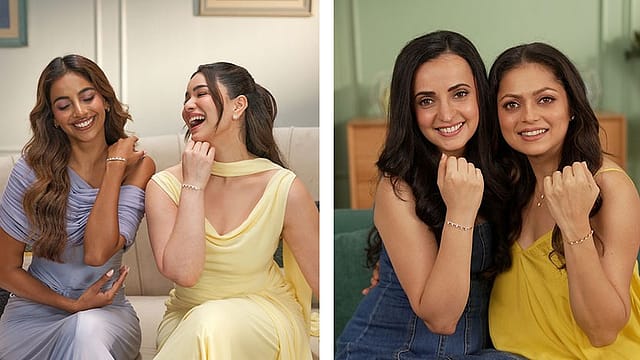
Until recently, none of this required certification. Now, De Beers would like to improve the arrangement. Its “Love, From Bestie” campaign invites female friends to commemorate their relationship with natural-diamond bracelets designed to be worn in pairs. One for you. One for the woman who knows too much to be allowed to leave.

Zeroing In on ECI
09 Oct 2026 - Vol 05 | Issue 41
Constitutional legitimacy versus political opportunism
The collection’s four designs include interlocking and split-circle motifs and a “BFF” rendered in Morse code through baguette and round diamonds. The least expensive design listed on De Beers’ Indian “A Diamond Is Forever” website starts at ₹1.89 lakh. Others begin at ₹2.10 lakh and ₹2.35 lakh.
Friendship has finally received what it was missing: an entry price.
Please Sign the BFF Contract
For Friendship Day this year, De Beers took the second edition of the campaign into 60 natural-diamond retail stores across nine Indian cities. Best-friend duos could receive nail art, make bag charms, pose for professionally shot portraits and sign “BFF Contracts” formalising their status.
The activations reportedly attracted more than 2,000 visitors and produced a 15 per cent conversion rate. Celebrity friendships involving Sara Tendulkar and Banita Sandhu, Mallika Dua and Shweta Tripathi, and Sanaya Irani and Drashti Dhami supplied social-media visibility.
The commercial ambition is unusually candid.
Toranj Mehta, country head for category marketing at De Beers India, reportedly said the first edition gave women a way to celebrate a relationship that rarely receives its own dedicated occasion. In year two, she said, De Beers was evolving the sentiment into a “proper ritual” that consumers could anticipate every Friendship Day.
That phrase deserves admiration for its honesty. Brands usually pretend to discover rituals floating naturally through culture. De Beers openly says it is building one.
“The most powerful brands do not merely sell products. They create rituals that make the product feel necessary,” says Ashita Aggarwal, professor of marketing at SP Jain Institute of Management & Research. De Beers has done this successfully with romantic commitment. It is now testing whether friendship can also be converted into a recurring jewellery occasion.
The machinery is elegant. Identify a relationship rich in emotion but poor in compulsory purchases. Declare that relationship rare and give it a permanent symbol. Sell the symbol in pairs, attach the transaction to an annual occasion and wait for an optional gift to become evidence of love.
This is not product advertising in the ordinary sense. De Beers does not merely want a woman to prefer its bracelet over another bracelet. It wants friendship itself to acquire a jewellery requirement. First came the engagement ring. Now comes friendship’s sparkling entrance fee.
De Beers Has Manufactured “Forever” Before
De Beers did not invent the diamond engagement ring. The custom existed long before modern advertising. Its achievement was more consequential: it helped turn one choice among several into the default proof of serious romantic intent.
The company hired the advertising agency N.W. Ayer in 1938 to increase demand for diamonds. In 1947, copywriter Frances Gerety wrote four words that became one of marketing’s greatest acts of cultural engineering: “A Diamond Is Forever.”
The line first appeared in advertising the following year. It joined a physical property to an emotional aspiration. A diamond was durable. Love was supposed to endure. Buying the former became a way to promise the latter.
According to De Beers’ own account of the campaign, the share of first-time American brides receiving diamond rings rose from roughly 10 per cent in 1939 to about 80 per cent by 1990. Post-war prosperity and the growth of the jewellery industry also mattered, but decades of consistent advertising helped make the diamond ring feel less like a commercial choice and more like a romantic tradition.
That distinction is the summit every marketer wants to reach.
Advertising is visible. Ritual disappears into behaviour. Nobody needs to remember the campaign once the purchase feels compulsory. The consumer begins enforcing the proposition on the brand’s behalf. A proposal without a diamond no longer looks like a different choice. It can look like insufficient commitment. “Love, From Bestie” borrows the same architecture. Friendship is enduring. Natural diamonds are presented as enduring. Therefore, an enduring friendship deserves a natural diamond. The emotional logic sounds complete because advertising quietly removes the cheaper endings.
Why Friendship, Why Now?
Friendship is an excellent market.
It begins earlier than marriage, can last longer and occurs more than once in a life. It survives geographical moves, career changes, childbirth, divorce and bereavement. It offers birthdays, reunions, milestones and an annual Friendship Day. Most importantly for a paired-bracelet collection, it can generate two objects from one emotion.
Romance traditionally gave the diamond industry one purchaser and one recipient. “One for you, one for your bestie” makes reciprocity part of the design.
The category also needs fresh reasons to buy. De Beers’ preliminary results for 2025 described rough-diamond trading conditions as challenging. Its average realised rough price fell 7 per cent to $142 per carat, and parent Anglo American recorded a $2.3-billion impairment to De Beers. The company said the revision reflected lower expected prices, shifting customer preferences between natural and laboratory-grown diamonds, and an excess supply of rough diamonds relative to demand.
De Beers also said one focus of its strategy was to revitalise consumer desire for natural diamonds.
India is an attractive place to attempt it. De Beers calls the country the world’s second-largest market for natural diamonds and reported robust Indian retail growth even while China remained muted. A campaign built around female friendship allows the company to expand beyond the familiar wedding and anniversary calendar without abandoning its strongest claim: geological rarity can express emotional rarity.
The natural-versus-laboratory-grown contest makes that claim urgent.
Lab-grown stones have given consumers a visually similar product at a dramatically lower price. Falling lab-grown prices may weaken their investment mystique, but affordability also lets buyers obtain larger stones without paying natural-diamond prices. De Beers therefore needs natural diamonds to mean something that identical sparkle cannot cheaply reproduce. “Love so natural, only a natural diamond will do,” says the campaign.
That is category defence disguised as affection. If origin alone cannot protect the premium, the industry must make naturalness an emotional credential. The friend was not manufactured. The diamond was not manufactured. The parallel does the selling.
The Best Argument for the Bracelet
There is a generous reading, and it deserves to be taken seriously.
Fine jewellery has historically organised women’s lives around romance, engagement, marriage and family inheritance. Men bought. Women received. The jewellery marked a relationship to a husband or a transition approved by society.
“Love, From Bestie” moves female friendship to the centre. Women can buy meaningful jewellery for themselves and one another without waiting for a proposal, an anniversary or male permission. The campaign recognises the women who perform enormous emotional labour across a lifetime but rarely receive the ceremonial attention given to romantic partners.
Women celebrating friendships through jewellery is a meaningful cultural shift because it moves fine jewellery beyond marriage, romance and male gifting. “The commercial opportunity is genuine. The danger begins when celebration slowly turns into expectation and the price of the gift becomes a measure of the relationship,” reckons Aggarwal.
Friendship deserves commemoration. A bracelet can carry memory. A woman who can afford one may find real pleasure in wearing a symbol shared with someone who stayed through every disaster.
Brands do not always manufacture desire from nothing. Sometimes they notice an emotional shift before society has created the products and ceremonies to express it. Women increasingly earn, spend and define their own milestones. Why should their most durable relationships remain commercially invisible while weddings receive entire industries?
That is De Beers’ strongest defence. It is also the doorway through which the bill enters.
When Celebration Becomes Obligation
Friendship has an unusual dignity because it is chosen and lightly governed. There is no licence, priest, registrar or mandatory anniversary. Friends can disappear for months and resume a conversation in the middle of a sentence. The relationship survives through presence, memory and accumulated acts of care.
De Beers praises this freedom by introducing matching jewellery, a yearly buying occasion and paperwork. The BFF Contract is playful. Nobody mistakes nail art and a store prop for a legal instrument. But the campaign’s deeper project is serious: give an informal relationship the visible proofs associated with formal love.
Once a category succeeds, symbols acquire social force. The question stops being whether anyone needs a diamond bracelet. It becomes why your friendship apparently did not deserve one.
This is how celebration can harden into obligation. Valentine’s Day gifts, engagement rings, wedding photography, baby showers and gender-reveal parties all demonstrate the same commercial progression. A product enters as a charming option. Advertising makes it culturally legible. Social media makes it visible. Comparison makes it anxious. Eventually, abstaining requires an explanation.
At ₹1.89 lakh and above, De Beers is also assigning a luxury price to a supposedly universal emotion.
The campaign does not say richer women have better friends. It does not need to. Luxury marketing works by letting the object perform distinction while the copy speaks about love. The bracelet becomes proof of rarity, permanence and purchasing power at the same time. Your friend may have crossed the city at 2 am when your life collapsed. Unfortunately, she forgot to arrive in natural diamonds.
The Report Card Is Not Yet a Ritual
More than 2,000 visitors and a 15 per cent conversion rate sound impressive. They should also be read carefully.
The figures come from a 60-store promotional weekend. They do not reveal average transaction value, whether one or two bracelets were purchased, how many visitors had registered beforehand, or whether the sales were incremental rather than purchases that would have happened anyway. “A successful activation can demonstrate curiosity and purchase intent. It does not establish a ritual,” says Aggarwal. A ritual exists when consumers begin repeating the behaviour without the brand having to explain or stage it every year.
For “Love, From Bestie” to become a ritual, consumers must repeat it without needing nail-art counters, celebrities and a PR announcement to explain the occasion. Jewellers must stock for it. Friends must anticipate it. Other brands must imitate it. The phrase must enter ordinary conversation.
That is a far higher bar than campaign engagement. De Beers has crossed it before, which is precisely why this experiment matters. Few companies understand better how to wrap a commodity in emotion, attach it to a life event and allow generations of consumers to mistake the commercial script for custom.
But friendship may resist the engagement-ring playbook. An engagement is a singular public transition with a recognisable moment of exchange. Friendship is distributed across thousands of small acts. It rarely has a beginning date, a single best friend or a universally accepted hierarchy. A woman may have several friendships that matter in entirely different ways.
Which one receives the bracelet? Who buys first? Must the friend reciprocate? Does a ₹2.35-lakh friendship outrank the ₹1.89-lakh version? The harder De Beers tries to formalise friendship, the more it exposes what friendship gains from remaining unpriced.
A Friend Is Forever. Must the Diamond Follow?
“Love, From Bestie” is astute marketing. It identifies an under-celebrated relationship, gives women a role as both buyer and recipient, creates a paired sale and opens a new annual occasion for natural diamonds. It also helps De Beers defend geological rarity in a market where lab-grown stones have made sparkle easier to afford.
The campaign may find a wealthy constituency. It may even create a durable gifting niche.
But a niche is not a ritual, and a transaction is not a tradition. De Beers’ historic genius was making the diamond feel like evidence that romantic love was real. Its new ambition is to perform the same conversion on friendship: turn emotional permanence into a purchasable object and make the absence of that object feel incomplete.
The friend who knows your secrets, absorbs your crises and remembers who you were before the promotions and school admissions may indeed deserve ₹1.89 lakh. She may also deserve something rarer: a relationship that does not ask for a receipt.
For now, De Beers has launched the ship of friendship. Whether Indian women climb aboard, or wave cheerfully from the shore while spending the money on a holiday together, will decide if this bracelet becomes a ritual or merely a very expensive Friendship Day campaign.