Virat Kohli Joins LinkedIn. Please Don’t Turn Him into a Leadership Lesson
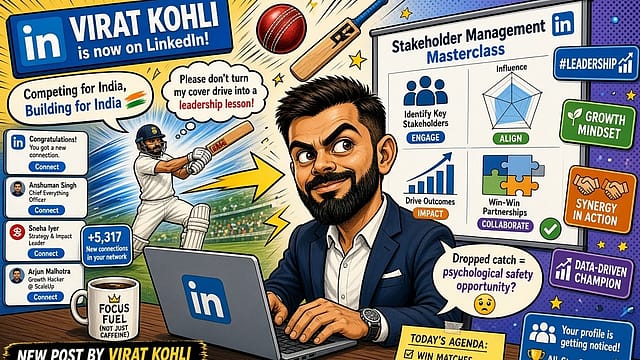
Virat Kohli has joined LinkedIn. Somewhere, a perfectly good cover drive is in danger of becoming a lesson in stakeholder management.
Most people open an account, upload a photograph and wonder whether their job title sounds sufficiently important. Kohli’s arrival comes with a press release, a welcome from the country manager and a statement of national ambition: “Competing for India, Building for India”.
The profile has barely arrived. The mission statement is ready.
There are businesses to discuss. Kohli is joining as co-founder of one8 and an investor in Agilitas Sports, with plans to share perspectives on leadership, performance and building businesses in sport. The announcement places his entrepreneurial interests at the centre of his presence.

Zeroing In on ECI
09 Oct 2026 - Vol 05 | Issue 41
Constitutional legitimacy versus political opportunism
All perfectly reasonable.
The danger begins with what LinkedIn might make of a man whose working life has been unusually difficult to reduce to a motivational caption.
A cover drive becomes execution. Leaving a ball becomes strategic restraint. A dropped catch becomes an opportunity to build a culture of psychological safety.
These are imaginary translations. Kohli has not posted them. The fact that they require so little explanation is the joke.
WELCOME TO THE DEPARTMENT OF TAKEAWAYS
LinkedIn’s most easily parodied literary form is the personal incident that emerges, several short paragraphs later, carrying a management qualification.
A missed flight discovers resilience. A conversation with a child produces a leadership framework. An ordinary purchase becomes a masterclass in customer obsession. Life is apparently running an executive education programme, and everybody has been appointed visiting faculty.
Into this setting comes somebody with experience worth asking about.
Kohli has spent years making decisions under pressure, working with different teammates and dealing with public expectations. His account could offer something valuable: the particular detail that makes an experience his.
What did he misread? Which instinct did he have to unlearn? When did intensity help, and when did somebody else need a different approach?
There is substance in those questions. It disappears when the answer is polished down to perseverance, passion and believing in yourself.
An extraordinary career can produce an entirely ordinary post. The formatting is available to everyone.
That is the risk for LinkedIn as a brand. Bringing distinctive people onto the platform is useful. Encouraging a culture in which they all sound interchangeable would squander part of the attraction.
The platform has secured the name. The interesting test is whether the voice gets through.
THE ACCOUNT IS ALSO A BUSINESS ADDRESS
Kohli has a more practical reason to be there than supplying metaphors for quarterly reviews.
Agilitas describes a business spanning manufacturing, brands and retail. Its public presentation includes Mochiko, Lotto and one8, alongside product development and research capabilities. The launch announcement says Kohli is involved in shaping one8’s products, including their function, design and finish.
That creates a credible reason to talk to a professional audience.
Building a sportswear business can involve recruiting specialists, finding retail partners, developing supplier relationships and explaining the company’s ambitions to people who might work with it. LinkedIn offers a setting in which those conversations make sense.
This is the strategic reading of the move, rather than evidence that any particular partnership has already followed.
The useful distinction is between being recognised and being understood in a new role. People can know Kohli the cricketer without knowing what he contributes to a product decision.
A celebrity’s visibility opens the conversation. Evidence of involvement gives it somewhere to go.
For one8, that evidence could be fascinating: a design rejected after testing, a disagreement about comfort, a feature changed because an athlete noticed something a presentation missed. Those are possible subjects, not disclosed episodes.
They would also tell us more than a photograph of a meeting accompanied by an assurance that something exciting is coming.
Kohli’s statement contains an ambition worth exploring: “Ultimately, I’d like what we build to outgrow all of us.”
That is a demanding proposition for a business associated with a famous founder. Can the product acquire a reputation that holds when the celebrity is out of the frame?
There is a story in answering that. Another paragraph about excellence would be an expensive way of avoiding it.
LINKEDIN GETS SOMETHING OUT OF THIS, TOO
The welcome should also be read from LinkedIn’s side of the desk.
A famous arrival gives existing members another reason to look at the feed and potential members a reason to consider it. Whether that attention becomes sustained use remains to be seen. But the commercial attraction is easy to understand.
LinkedIn has been expanding the ways content and advertising meet on its platform. In April 2025, it announced the expansion of BrandLink, allowing advertisers to align with selected creators and publishers through video, including sponsored shows. In June 2026, it unveiled BrandWorks, a marketing initiative whose activities include a programme connecting advertisers with creators.
Kohli’s announcement does not establish that he participates in either programme, or that his arrival involves a paid agreement.
It does arrive at a platform with a business interest in giving people more to watch.
Here lies the branding tension. LinkedIn competes for attention while offering advertisers a professional setting. Famous personalities can help attract an audience; their business interests help make the appearance feel relevant to that setting.
The familiar mechanics of the celebrity economy acquire a more respectable visitor’s badge.
That need not be a problem. Entertainment and professional usefulness can coexist. The danger is assuming that adding “leadership” to a celebrity announcement automatically supplies the usefulness.
A star can bring people to the room. The conversation must justify keeping them there.
JENNIFER LOPEZ HAS ALREADY MET THE GENERATOR
A global example gets unusually close to the joke.
In Netflix’s promotion for Office Romance, Jennifer Lopez updated her LinkedIn profile using the working lives of her film characters. The Wedding Planner and Maid in Manhattan became material for her résumé. LinkedIn also promoted the exercise.
Then the video turned its attention to the platform’s language.
Lopez described her career as telling love stories before announcing that she would use a LinkedIn generator. The resulting language inflated that simple thought into corporate self-description, including the phrase “high stakes domain of romantic origin stories”.
The joke worked because the gap was immediately recognisable. An intelligible sentence had been promoted beyond its competence.
The campaign understood that LinkedIn itself could be creative material. Its conventions supplied the humour; Lopez’s films supplied the recognisable detail.
Kohli’s announcement takes a more solemn route. That is appropriate to a different purpose. But the comparison raises a useful creative question: how much of a distinctive personality survives the effort to sound professionally impressive?
A new audience should not require a replacement personality.
PLEASE GIVE US THE ACTUAL EXPERIENCE
There is an older marketing argument underneath this newer celebrity arrival. Celebrity gets people to look. What Kohli shares next will determine whether they see him differently.
“For his business identity to grow, the audience needs to see his judgement at work: a product decision, a difficult trade-off, something he had to learn," says Ashita Aggarwal, professor of marketing at SP Jain Institute of Management & Research. If all that emerges is familiar advice about passion and perseverance, LinkedIn gains a famous face while readers gain very little.
The launch can tell us that Kohli intends to discuss leadership. Subsequent posts have the opportunity to show what he means, including where the sporting analogy stops being helpful.
Leading a cricket team and building a footwear business can involve overlapping qualities. They also require different knowledge. Familiarity with pressure does not remove the need to understand a new product, colleague or customer.
That learning process could make the account more interesting.
A famous person admitting that somebody else knew better offers a richer account of leadership than another declaration of the importance of surrounding yourself with great people.
The former has a situation, a choice and a consequence. The latter has excellent compatibility with a stock photograph. The audience deserves enough detail to recognise the difference.
FAME CAN OPEN THE FEED
There is no reason to sneer at Kohli for taking his businesses seriously, or at LinkedIn for welcoming someone people want to hear from.
Nor should every post be expected to reveal confidential decisions or deliver an intimate confession. A useful account can be selective without being empty.
The fair question is whether the material earns attention beyond the name attached to it.
For Kohli, the opportunity is to make his business role more legible. For one8 and Agilitas, it is to give the sporting ambition product-level substance. For LinkedIn, it is to demonstrate that a celebrity presence can enrich a professional conversation.
All three ambitions could work together.
They could also dissolve into an endless exchange of inspiration, gratitude and comments congratulating everyone on the journey. The cricketer would remain famous. The brands would have another channel. The reader might struggle to remember what had been said.
Kohli already has a career people have watched closely. He does not need to make every episode resemble a corporate workshop to justify discussing it.
LinkedIn’s opportunity is to make room for the experience in its specificity: the judgement, the uncertainty, the disagreement, the work.
The most interesting thing Kohli could bring to LinkedIn is something only Kohli could tell us. The least interesting would be something anyone could generate.