Her Hair, Her Heirloom, Her Say: Naturali Finds the ‘I’ in Family Beauty Advice
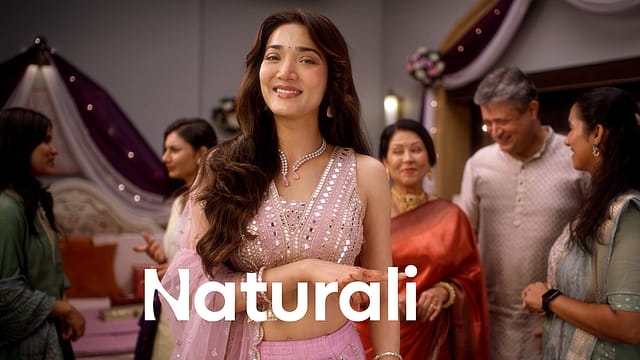
A bride has plenty to carry into her wedding. Sometimes, years of advice come along too.
In Naturali’s new campaign, featuring Medha Shankr, preparations for a sangeet bring a familiar subject into focus: the bride’s hair. There are comments about how it looks. There are extensions. And there is a history behind the moment.
The film moves between the wedding and childhood memories, tracing how remarks about a girl’s hair can follow her into adulthood. What begins as somebody else’s observation gradually becomes something she learns to notice about herself.
Then comes the gesture around which the story turns. Shankr’s character returns to the wedding with visibly fuller-looking hair and hands the extensions back to her Bua.

Zeroing In on ECI
09 Oct 2026 - Vol 05 | Issue 41
Constitutional legitimacy versus political opportunism
A small handover. A larger decision.
The campaign closes with “There is an I in Naturali.” Its accompanying thought moves through three familiar voices: Dadi, Mom and Bua, before bringing the woman herself into the conversation.
That is an emotionally promising place for a haircare brand to begin. In many families, hair is bound up with care, memory and routine. Someone oils it. Someone parts it. Someone knows how to braid it before school. Beauty advice can arrive with the intimacy of a person who has been looking after you for years.
And sometimes, among those rituals, come opinions that stay.
THE VOICES WE GROW UP WITH
The tenderness in this subject lies in how closely affection and expectation can sit together.
A relative may mean well when she suggests adding volume. A mother may be passing on the advice she once received. A grandmother’s idea of beautiful hair may carry the habits and preferences of another generation.
For the girl receiving all this attention, however, the cumulative effect can be different. She is also learning what other people think needs improving.
Marketing and branding experts reckon that beauty advice from family carries the weight of trust. "A girl can absorb it long before she has formed her own preferences,” says Ashita Aggarwal, professor of marketing at SP Jain Institute of Management & Research. The emotional opportunity here is to acknowledge that relationship and make room for her voice within it. "Growing into your own choices can be a very tender story,” she adds.
Naturali builds its narrative around that accumulation. Childhood matters because the bride’s encounter with advice has a past. The wedding gives the story a moment when those old observations become especially present: an occasion devoted to celebration, with considerable attention paid to how a woman looks.
“What I liked about this story is how familiar it feels,” Shankr says in the campaign’s note. “So many women grow up hearing opinions about their hair, often from the people closest to them.”
That familiarity gives the story room for warmth. Readers may recognise a relative, a ritual or an old remark. They may also recognise the gradual process of becoming comfortable with their own preferences.
The most generous reading of the film allows those family relationships to retain their affection while giving the woman space to choose. Returning the extensions becomes a way of expressing that choice.
There is nothing inherently less personal about choosing extensions, either. The emotional idea works because the decision belongs to the person wearing them. In this particular story, she chooses to hand them back.
THE LONG JOURNEY TO ‘I’
Beauty advertising has been exploring a woman’s authority over her own appearance for decades.
In 1971, copywriter Ilon Specht wrote “Because I’m Worth It” for L’Oréal Paris’s Préférence hair colour. The line gave the woman using the product a direct statement of her own worth. More than half a century later, its first-person confidence remains central to the brand’s identity.
Naturali’s “I” enters that broad tradition through a distinctly familiar family setting. The connection is thematic: both lines make room for the woman’s own voice in a category that has often told her how she ought to look.
A closer parallel comes from Dove’s “Love Your Curls” campaign, launched in 2015. Its film explored young girls’ feelings about curly hair and the influence of the women around them. Dove encouraged women to celebrate their curls so that girls could learn to feel proud of theirs.
The family connection is useful. Confidence, like beauty advice, can travel across generations.
Dove’s campaign asked adults to consider what they were passing down. Naturali’s story approaches the relationship from the receiving end: what happens when the girl grows up and begins deciding for herself?
These campaigns belong to different contexts and make different product pitches. Together, they show why hair can support a story much larger than styling. It is visible, personal and closely tied to how people see themselves—and how they are seen by others.
A SMALL GESTURE, A PERSONAL CHOICE
Naturali’s distinctive creative device is the return of the extensions. It gives the campaign’s message an object and an action. The audience can follow the decision through something being handed from one person to another.
The childhood flashbacks give that action its history. The wedding gives it an occasion. The closing line gives it a name.
Returning the extensions gives the idea of choice a gesture people can remember. The family setting makes it recognisable, and the ‘I’ in the brand name gives Naturali a way to connect that personal moment to its identity. "The strength of the idea lies in how naturally those elements come together,” says Aggarwal.
For Naturali, the campaign asks who gets a say in a woman’s haircare choices.
“With this campaign, we wanted to capture something that often gets brushed off as harmless advice: the constant opinions women hear about their hair,” says Anirrban Mukherjii, vice president, personal care, Guilt Free Industries Limited. “For us, ‘There is an I in Naturali’ is about bringing the focus back to the individual and reminding women that their choices should be their own,” he adds.
The campaign promotes Naturali’s Anti-Hairfall range and targets consumers aged 25–35. According to the company, its shampoo, conditioner and hair mask contain rosemary, Korean ginseng and biotin; its scalp serum contains rosemary, Korean ginseng and Redensyl. The film’s fuller-looking hair is part of its advertising narrative.
The broader appeal rests on a recognisable stage of growing up: discovering that you can value the people who helped shape you while developing preferences of your own.
Families give us plenty to carry forward. Their rituals. Their memories. The familiar comfort of someone attending to our hair before an important day.
Eventually, we also get to decide what suits us. At her wedding, Naturali’s bride hands something back. She has a say in what she carries next.