Girlfriend Gives 0%. THECOS Gives 14.40%: Why is Chennai Arguing About the Wrong Interest?
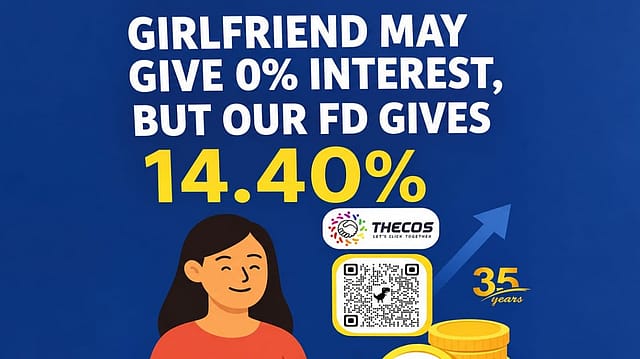
A girlfriend has been converted into a badly performing financial product.
She gives no returns. She shows no interest. She appears to possess neither emotional value nor growth potential.
Fortunately, a Chennai Metro advertisement has discovered a suitable replacement. “Girlfriend may give 0% interest, but our FD gives 14.40%,” announces THECOS, short for Thiruvalluvar Transport Corporation Employees’ Co-operative Credit Society.
Heartbreak now has an alternative asset class.
The line takes approximately three seconds to understand. “Interest” travels from romance to finance. The woman rejects the man. The fixed deposit welcomes his money. The disappointed lover can stop chasing affection and begin chasing yield.
The joke has the intellectual sophistication of something forwarded by an uncle on WhatsApp. As outdoor advertising, however, it is ruthlessly efficient: eleven words, two numbers and one cultural stereotype recognised before the Metro doors close.

Zeroing In on ECI
09 Oct 2026 - Vol 05 | Issue 41
Constitutional legitimacy versus political opportunism
Then the poster escaped the train.
DMK MP Thamizhachi Thangapandian accused it of degrading women, portraying them as objects and violating their dignity. She demanded its removal and asked how Chennai Metro Rail had approved it. AIADMK spokesperson Kovai Sathyan also reportedly condemned the advertisement and called for action.
A cooperative society few Indians outside Tamil Nadu had heard of was suddenly travelling across television, news portals and social media.
THECOS paid for space inside a Metro coach. The outrage bought it the rest of India.
An Advertisement Written for Him—Using Her
Before examining whether the controversy helped the brand, one must ask whom the advertisement imagines as its consumer.
It is plainly speaking to a heterosexual man. He has a girlfriend. She is not interested in him. He controls surplus money large enough to place in a fixed deposit. His disappointment can be redirected from a woman towards wealth creation.
The girlfriend has no financial life of her own. She does not save, invest or compare interest rates. She exists entirely as a measure of the man’s failure. This is where a supposedly harmless pun reveals the machinery beneath it.
The advertisement treats romance as a transaction in which the man invests effort and expects interest from a woman. When she refuses, she resembles an underperforming asset. THECOS promises to appreciate his capital more reliably.
The joke objectifies the woman without needing her body. It converts her attention into a return owed to the male consumer. It also patronises men. Its imagined customer is so emotionally fragile that a fixed deposit must be sold as revenge for romantic rejection. He cannot simply evaluate the product. His bruised ego requires financial compensation.
THECOS has, therefore, achieved a rare feat: it has insulted the person in the advertisement and underestimated the person reading it.
The irony becomes sharper when one considers how desperately the financial-services category is trying to speak to women as investors.
Axis Bank has advertised products designed around women’s financial requirements and used Shefali Shah to ridicule the hollow pink gestures brands perform on Women’s Day. HDFC Bank turned “Vigil Aunty” into an authority on digital fraud. Financial institutions increasingly depict women as entrepreneurs, savers and decision-makers because women represent a vast, insufficiently served market.
Then comes THECOS, dragging the category back to the proposition that the man owns the money and the woman either rewards or rejects him.
This is not an isolated creative accident. Researchers from Mannheim Business School examined financial advertising across seven decades and found that men appeared as the central figure in 84% of the advertisements studied. Male characters were also far more likely to be presented as financially knowledgeable: 36% of male central figures possessed financial expertise, compared with 15% of female figures.
The Chennai Metro poster compresses that history into a single sentence. The man understands interest. The woman merely supplies the pun.
When ‘Just a Joke’ Becomes the Media Plan
The predictable defence will be humour.
Nobody was supposed to read the advertisement literally. “Interest” is a playful double meaning. The girlfriend could have been a boyfriend. Social media contains much harsher jokes. Political outrage has apparently lost its sense of humour.
Humour does deserve room to be mischievous, provocative and occasionally tasteless. Advertising cannot be reduced to a committee-approved collection of virtuous statements. A world in which every joke must pass an ideological purity test would produce remarkably lifeless creative work.
But “it was a joke” cannot end the conversation. It begins another one.
Why was this particular stereotype considered instantly intelligible? Why did the writer assume that the Metro commuter would accept the woman as the unproductive half of the comparison? Why is the person making the investment automatically male?
Jokes work through compressed cultural agreement. The copywriter does not explain that girlfriends are demanding, unreliable or commercially useless. The audience is expected to complete that thought.
The Advertising Standards Council of India’s guidelines say advertisements should not contain gender stereotypes likely to cause harm or serious or widespread offence. The guidance also makes clear that humour, hyperbole and exaggeration do not automatically rescue a harmful stereotype. Whether the THECOS poster formally breaches the code would require adjudication, but “funny” and “harmless” are not synonyms.
The more interesting advertising question is whether the offence was accidental or simply convenient.
Provocation has become one of the cheapest media strategies available to a small brand. A safe FD poster might have been seen by thousands of commuters and forgotten before they reached the escalator. The girlfriend line was photographed, condemned, reposted and debated. Politicians became unpaid media amplifiers.
The brand has received extraordinary earned reach. Yet reach is not the same as advertising success.
How many people remember the name THECOS? How many only remember “that sexist Chennai Metro ad”? Did the controversy increase deposit enquiries, or merely produce ridicule? Did the audience transfer its attention to the advertiser—or leave the brand trapped beneath its own punchline?
For a snack, dating app or youth-fashion label, controversy can create curiosity. A financial institution sells something less forgiving. It sells trust. A consumer may buy chips from a brand that offended him. Handing it ₹5 lakh for five years demands another level of confidence.
That is the strategic danger. The joke makes THECOS appear cheeky when the product requires it to appear dependable. It makes the advertisement famous while potentially making the advertiser look unserious. The campaign used mistrust between lovers to advertise financial trust. That contradiction is far more damaging than the pun.
The Medium Is Part of the Message
The poster did not appear on the society’s social-media handle alone. It was mounted inside Chennai Metro.
That location matters.
Public transport provides a captive, diverse audience. Schoolgirls, working women, families and senior citizens share the same coach. Nobody chose to follow THECOS or opted into its humour. The advertisement entered a civic space and addressed everyone through the presumed worldview of one male consumer.
The Metro also lends the communication a faint institutional glow.
Chennai Metro Rail Limited does not endorse every product advertised on its network. Advertising space is commercial inventory. Yet most commuters do not examine that distinction closely. A professionally mounted financial advertisement inside a state-created transit system can appear to have crossed some threshold of official scrutiny.
The question for CMRL is, therefore, larger than: “Who approved this sexist line?”
What standards govern advertising inside its coaches? Does the approval process examine gender stereotyping? Are advertisements assessed differently when they concern deposits, loans or investments? Does the concessionaire approve the creative, or does CMRL retain final control?
The controversy has created two brands in the consumer’s mind. THECOS wrote the joke. Chennai Metro gave it the wall.
That shared visibility also creates shared reputational risk. When a Metro coach becomes the delivery system for an offensive message, the media owner cannot disappear behind the advertiser.
CMRL carried nearly nine million passengers in April 2026 alone. An advertisement placed within such a system is mass communication, even when the advertiser is relatively obscure.
The politicians are therefore right to question the approval. Removing the poster, however, would only erase the physical evidence. The photograph has already acquired permanent digital tenancy.
Then Comes the 14.40% Until this point, the controversy belongs to advertising and culture. Now the product enters.
THECOS’s website says the advertised 14.40% rate applies to its Long Term Progressive Deposit. The minimum investment is ₹5 lakh. The tenure is five years or longer. Premature withdrawal is not permitted. The website describes the return as “flat interest” and says payout arrangements vary across its schemes.
None of those material conditions appears in the viral line.
THECOS identifies itself as a multi-state cooperative credit society established in 1991. It says it serves more than 10,000 members and holds deposits exceeding ₹500 crore. It also says members of the public can join through its fixed- and recurring-deposit schemes.
A high return does not establish that a product is improper. It does make clarity about regulation, membership, liquidity and deposit protection indispensable—particularly when the headline rate is far above those offered by large commercial banks.
This should have been THECOS’s moment of persuasion. Instead, the sexist creative has encouraged people to inspect the product more closely. The public is now asking who approved the girlfriend line. A diligent depositor may proceed to ask who supervises the society, how the rate is generated and what protection applies to the principal.
The joke has turned the audience into auditors. That may be the campaign’s most expensive unintended consequence.
Did the Advertisement Work?
The answer depends upon what “worked” means.
It attracted attention magnificently. It created recall for the number 14.40%. It turned an inert product category into a live political conversation. It achieved distribution far beyond the media purchased by the advertiser.
On those measures, the creative has outperformed countless respectful advertisements that nobody noticed.
But advertising does not exist to win an argument about advertising. It must move the brand towards a commercial objective.
If the audience remembers the sexism more strongly than THECOS, attribution has failed. If prospective depositors begin questioning the institution rather than trusting it, persuasion has failed. If Chennai Metro removes the creative and tightens its advertising standards, distribution has failed. If the campaign makes women less willing to engage with the brand, market expansion has failed.
An offensive advertisement can be famous and commercially foolish at the same time.
That is the distinction brands routinely erase when they celebrate impressions, reposts and “organic conversations”. Outrage is counted as engagement because the dashboard cannot recognise disgust.
The flip side remains important. THECOS may conclude that national notoriety is worth the criticism. A small regional institution has entered public consciousness. Some consumers may find the line funny. Others may separate a crude advertisement from the deposit product. The noise could still generate enquiries.
Only THECOS’s search volumes, leads, deposit inflows, female-customer response and brand-trust scores can reveal whether the controversy produced value. Views cannot.
The Interest Earned on Sexism
The poster will eventually disappear from the coach.
Perhaps it will be removed. Perhaps the campaign period will end. Perhaps THECOS will replace the girlfriend with a safer comparison and insist that no offence was intended.
The cultural assumption behind the advertisement will be harder to remove.
Indian advertising has spent years attempting to move women from kitchens and beauty mirrors into boardrooms, businesses and financial decisions. Progress remains uneven. ASCI’s analysis of Indian television advertising found men three times more likely than women to be portrayed as authoritative, while women remained disproportionately associated with caregiving.
THECOS demonstrates how quickly one cheap joke can resurrect the old order. 'He' owns the capital. 'She' owes the attention. The brand converts his rejection into a sales proposition and calls the transaction humour.
Yet the campaign also offers a brutal lesson in contemporary advertising. Offence travels faster than persuasion. A line condemned by two political parties can outperform a conventional media budget. The brand gains fame, but loses control of what that fame means.
THECOS promised 14.40% on a fixed deposit. Its sexism generated considerably more interest. Whether that interest compounds into business—or matures into distrust—is the only return that matters now.