From Noodles to Snacks: Inside Chinese Wok’s Next Big Bet
The advertisement opens with a paper bag.
Crack it open and you’ll find fries. But don’t eat them yet. Why? Because first comes the ceremony.
Tear open the Schezwan sachet. Empty the crimson powder over the fries. Fold the bag shut. Now shake it. Hard.

The Modi Years
02 Oct 2026 - Vol 05 | Issue 40
A Nation Rebuilt
The bag rattles like a maraca. Fries collide. Spice dust explodes. Somewhere between the second and third shake, the air fills with garlic, chilli and vinegar. Open the bag again. Now eat—with chopsticks.
Chinese Wok calls this Shake-Shake Schezwan Fries. It’s a snack. It’s a ritual. And it’s a little theatre in a paper bag.
But the real punchline sits elsewhere on the campaign poster. Three letters. WTF. Except here, it doesn’t mean what you think it means.
Chinese Wok cheekily flips the internet’s favourite expletive into “What The Fries.” It’s a sly cultural wink and works precisely because everyone already knows the original phrase. In one stroke, the brand turns an everyday slang acronym into a snack moment.
The message is playful. The strategy behind it is anything but. Why? Because fries are sacred territory in fast food.
For decades, one company has owned that terrain: McDonald's. Its fries—golden, salted and obsessively consistent—have become shorthand for the category itself. Even in India, where spice levels are rarely negotiable, the burger giant has adapted the format with offerings like peri-peri fries.
And now a Desi Chinese giant is stepping into the same arena—with Schezwan.
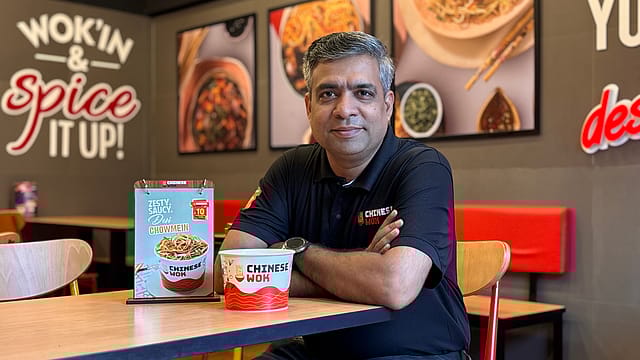
Inside Lenexis Foodworks, the parent company behind Chinese Wok, the framing is more measured. “We are not trying to replicate another brand’s playbook,” reckons Vikas Iyer, who joined the company in 2024 to lead its marketing strategy.
In other words, the move isn’t about competing with McDonald’s. Chinese Wok is trying to own something else entirely: Desi Chinese snacking.
Still, intention and perception rarely travel the same road. Step into the fries category and comparisons are inevitable. When a brand launches a new flavour bomb in a territory long ruled by the Golden Arches, the chopsticks may not be pointed at McDonald’s but the market will look that way anyway.
And this brings us to an unavoidable question: If fries are the battlefield, can Schezwan become the weapon?
The New Snack Wars
Fries may look like a humble side dish. In QSR economics, they are anything but.
They are portable, addictive and infinitely remixable. Sprinkle cheese, dust spices, dunk in sauce—every market finds its own twist. Most importantly, fries are high-frequency snacks. Customers order them between meals, alongside meals, or sometimes instead of them. That makes them incredibly valuable.
Iyer explains. The primary objective of the campaign is to participate more strongly in high-frequency snacking occasions. “Fries allow us to be relevant beyond main meal moments,” he reckons.
In QSR language, that means unlocking new dayparts: afternoon munchies, evening hangouts and late-night delivery cravings. Each moment is another opportunity to enter a customer’s order basket.
The math of fast food is deceptively simple. Meals drive revenue, snacks drive frequency and frequency is where fast-food empires are built.
Chinese Wok’s Schezwan fries—delivered with a DIY shake-shake ritual—are designed precisely for that frequency play. The product is interactive, Instagram-friendly and unmistakably on brand: chilli-heavy, garlic-punchy and unapologetically Desi Chinese.
The chopsticks aren’t accidental either. They transform fries—arguably the most Western of snacks—into something that feels unmistakably Chinese Wok.
Spice up the play
Call it culinary theatre or a strategy served hot, marketing and branding experts are just ‘lovin' it.’ Fries are fries. Salt them, spice them, Schezwan them—it’s still the same potato stick.
“And when someone says fries, the mind goes straight to McDonald’s. Unless, of course, you start saying WTF fries,” reckons Ashita Aggarwal, professor of marketing at SP Jain Institute of Management and Research.
For decades, brands—desi and global alike—have tried to take a bite out of McDonald’s fries turf. Most barely managed a nibble. Almost every QSR chain sells fries, but when someone says fries, the mind still defaults to McDonald’s—the undisputed OG of the category.
“Chinese Wok knows a thing or two about winning crowded food battles,” says Aggarwal.
It has, after all, built a national brand out of one of India’s most commoditised cuisines—Desi Chinese, the kind sizzling at every street corner wok.
Many tried to build a “Chinese” brand here. But what India really eats is Indian Chinese. Chinese Wok simply called it what it was: Desi Chinese. No pretence. No confusion. Just chilli, garlic and truth on a plate.
Calling it Desi Chinese was the insight. Turning that wok-fired chaos into a national fast-food chain—that was the audacity.
The First Audacity
If Chinese Wok’s fries bet looks bold, the company has already pulled off something equally audacious once before.
For decades, India loved Desi Chinese. Nobody thought it could become a national fast-food chain.
The cuisine thrived in chaos. Chowmein carts smoked on street corners. Manchurian balls bobbed in oily gravies. Schezwan sauce splashed across greasy takeaway cartons. Every neighbourhood had its own version. Standardisation—the lifeblood of QSR—looked impossible.
Yet that’s exactly what Lenexis Foodworks attempted when it launched Chinese Wok in 2015.
The idea was simple but radical: organise a cuisine that had never been organised. Build standardised menus, tighten supply chains and create a consistent Desi Chinese experience across cities. One outlet became ten. Ten became fifty. Then the network began to scale.
Today, Chinese Wok operates more than 260 outlets across 45 cities, making it India’s largest Desi Chinese QSR chain.
The financial trajectory mirrors the expansion. Lenexis Foodworks reported ₹347 crore in revenue in FY25, up sharply from ₹179 crore the previous year.
The company is likely to close FY26 at Rs 410 crore. Interestingly, Chinese Wok alone contributes roughly 75% of the company’s business, with sister brands Big Bowl and The Momo Co expanding through cloud-kitchen formats.
But what helped build the scale was a punchy narrative: “Chinese Bole Toh Chinese Wok.” The goal was simple: when Indians crave Chinese food, the brand wants to be the instinctive answer. It’s a mental shortcut in a way. Say Chinese. Think Chinese Wok. This positioning transformed a fragmented cuisine into a brand-owned category.
The Second Bold Bet
Now, let’s come back to fries.
If Chinese Wok’s first act was organising Desi Chinese meals, its next move is to capture the snacking moments around them.
That’s where Schezwan fries enter the wok. The idea is not to replace noodles or fried rice—the core menu anchors.
Instead, it is to extend the flavour identity into a format people can order impulsively. Snackable, shareable and repeatable. “If Schezwan fries resonate strongly,” says Iyer, “it demonstrates our ability to shape consumption behaviour beyond core meal occasions.”
That statement hints at something larger. In fast food, signature snacks often become brand icons. McDonald’s has its fries. Domino’s has its pizza.
Chinese Wok’s bet is that Schezwan—already the most recognisable flavour cue in Desi Chinese cuisine—can travel beyond sauces and gravies into a snacking platform of its own.
The shake-shake ritual makes the product playful. The acronym--WTF--makes it memorable. But beneath it sits a serious ambition. If the bet works, Chinese Wok does more than sell another snack.
It expands its role in consumers’ daily lives. So, lunch becomes noodles, and dinner becomes fried rice. And somewhere in between—during office breaks, movie nights or midnight cravings—comes a packet of Schezwan fries. That’s the real prize. Frequency.
Chopsticks--and profits--on the Battlefield
Of course, none of this happens in a vacuum.
The fries category is one of the most fiercely contested spaces in fast food. Global giants have spent decades perfecting the format—optimising potato cuts, frying temperatures and seasoning profiles to engineer the perfect bite. Against that backdrop, Chinese Wok’s entry may look like a small move. Sometimes, small moves signal bigger ambitions.
But ambition alone doesn’t pay the bills. For Lenexis Foodworks, the next phase of growth must also make the numbers work. The company’s losses have widened sharply—from ₹13.13 crore in FY21 to ₹108.60 crore in FY25.
In other words, the wok is sizzling but the bottom line still needs a dash of sweetness. And this makes Chinese Wok’s latest move more than just a quirky snack launch.
The company has already pulled off one improbable feat—turning Desi Chinese into a national fast-food chain. Now it is attempting something even bolder: turning Schezwan into a snacking habit on turf where McDonald’s built its fries empire.
So, here’s an inevitable question hanging over the entire campaign: What the fries happens next?