Fractional Leadership: How the ‘C-Suite by the Slice’ Is Reshaping Startups, CEOs and the Future of Work
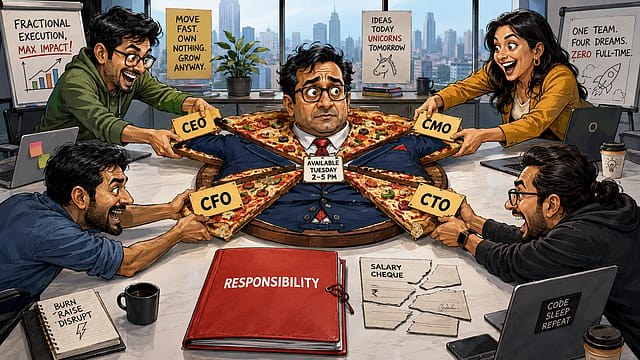
In school, they taught us fractions. One-half. One-third. Three-fourths. Nobody warned us that one day the CEO would become one.
A company needs a marketing strategy but cannot afford a full-time chief marketing officer. It hires a fractional CMO. The finances wobble. A fractional CFO joins for two days a week. Operations begin misbehaving. Enter the fractional COO. Soon, the startup has assembled an entire C-suite. Nobody actually works there full-time.
Welcome to the fractional company, where the designation remains gloriously complete while the executive arrives in convenient instalments.
The visiting card says Chief Marketing Officer. The calendar says Tuesday afternoon. The LinkedIn profile displays the entire alphabet soup. CEO. CMO. CFO. CTO. CHRO. Only the prefix gives the game away: Fractional. One small word has divided the job, the salary, the working week and possibly the blame.

Zeroing In on ECI
09 Oct 2026 - Vol 05 | Issue 41
Constitutional legitimacy versus political opportunism
Please Give Me 25 Years of Experience. I Need It Till Thursday
Fractional leadership allows a company to hire an experienced executive for a fixed part of the week or month. The leader works closely with the business over an extended period but may simultaneously serve several other companies.
A consultant usually studies a problem and recommends a solution. An interim executive occupies a position temporarily. A fractional executive embeds within the company, helps make decisions and carries an operating mandate, without becoming a conventional full-time employee.
Think of leadership sold by the slice. Company A receives Monday and Tuesday. Company B gets Wednesday. Thursday belongs to a startup that has just discovered it urgently needs a chief growth officer. Friday may be reserved for updating LinkedIn.
The economics explain the attraction. Startups need senior judgment long before they can afford senior salaries. A young business may require someone who has launched brands, raised capital, built financial controls or managed rapid expansion.
It may not require that person for 50 hours every week. Or, more accurately, it may require all 50 hours but possess the budget for 10. The fractional model reconciles ambition with the bank balance. The company gets 25 years of experience without paying for all 12 months of it. The executive gets freedom, variety and several clients. The startup gets to say, “Meet our CMO.” Nobody immediately asks how much of the CMO it owns.
The Gig Economy Has Reached the Corner Office
The fractional boom did not appear from nowhere. Remote work made physical presence negotiable. Startups became more cautious about permanent senior hires. Funding tightened, salaries rose and specialist knowledge became more important.
At the same time, experienced executives began questioning whether one employer deserved their entire working life. The gig economy had already divided driving, delivery, design, writing and technology into tasks and assignments. Eventually, it reached the executive floor and asked the CEO whether he would be available by the hour.
Interest has exploded. An Axios search found that LinkedIn profiles mentioning “fractional” had increased from around 2,000 in 2022 to 144,000 by December 2024. Profile descriptions do not equal actual jobs, but they reveal how quickly the label has spread.
A 2025 study of fractional sales leaders in the US and Canada found that average assignments ran for 9.7 months, with weekly commitments averaging 14.6 hours. Nearly nine in 10 worked on retainers. This is becoming a sustained working arrangement rather than an executive dropping in for one motivational PowerPoint.
India has begun adopting the vocabulary too.
Enormous Brands appointed advertising veteran Joy Chauhan as fractional CMO in November 2024, bringing decades of agency experience into a role designed to help the company and its clients solve larger growth problems. Elsewhere, Indian platforms now offer fractional CFOs, sales chiefs and other executives to businesses that need senior expertise without another permanent C-suite salary.
The fraction is gaining flaunt value. Once, executives concealed part-time work because it sounded temporary. Now they announce it because it sounds agile. Complete Designation. Fractional Salary The title remains one of the model’s cleverest features.
Nobody introduces herself as 0.4 CMO
Nobody prints “Chief Financial Officer, available for 96 hours per quarter” on a business card.
The designation arrives whole. The employment relationship does not. This can work beautifully. An early-stage founder gets access to someone who has already made expensive mistakes elsewhere. The fractional leader can install processes, train teams, interrogate assumptions and help the business avoid spending three years discovering what an experienced executive already knows.
The executive also brings knowledge gathered across companies. A full-time leader sees one organisation intimately. A fractional leader may see the same problem unfolding across four businesses.
That cross-pollination can accelerate decisions. It can also produce an impressive collection of confidential calendars.
Marketing professor Ashita Aggarwal locates the promise and the pressure in the same word. Fractional leadership allows a growing company to access experience before it can afford a large leadership structure. The value comes from clarity. The company must know which problem the executive owns, how success will be measured and who will continue the work between visits. "A fractional mandate cannot succeed when the organisation expects full-time ownership from part-time access," she adds.
Her distinction matters. The salary can be fractional. The designation can carry a prefix. The business problem will still arrive complete.
Can Responsibility Be Divided Too?
This is where the arithmetic becomes uncomfortable.
What happens when a crisis erupts on the fractional CMO’s non-marketing day? Who settles a fight between a fractional CFO protecting cash and a fractional CMO demanding investment when both leave the call for different clients? Can an executive absorb the politics, anxieties and unwritten codes of an organisation while serving three others? And what happens to employees below the fractional chief?
They may receive their boss for two days a week, a strategy for the entire quarter and targets that remain aggressively full-time. Leadership depends on judgment, presence and trust. Employees do not always schedule their uncertainty for Wednesday between 2 pm and 4 pm. A senior executive may write the strategy and disappear before the organisation discovers where it breaks. The internal team then owns the implementation, the confusion and the midnight messages.
The fraction can create another problem: everybody has authority, yet nobody has enough proximity. When results arrive, five leaders may claim the numerator. When trouble arrives, responsibility searches for a denominator.
The Chief Inflation Officer
There is also the danger of title inflation.
“Fractional CMO” can describe a veteran embedded in a company, attending leadership meetings and owning measurable outcomes. It can also describe a freelance marketing adviser who has upgraded the title without upgrading the mandate. The same ambiguity applies across functions. A fractional CFO might restructure the company’s finances or merely inspect the spreadsheets once a month. A fractional CEO could lead a transition or become an expensive substitute for a founder who dislikes making difficult decisions.
The model requires precision. How much time will the executive commit? What decisions can the person make? Which outcomes belong to the role? Who executes the strategy? Who answers when it fails? Without clear answers, the company has not hired a fractional leader. It has rented a title.
What if Everything Becomes Fractional?
Today, companies hire fractional CMOs, CFOs, CTOs, COOs and CHROs. Tomorrow, the logic may spread. Fractional founder. Fractional culture. Fractional office. Fractional loyalty. Fractional appraisal. Fractional farewell.
“After considerable thought, I have decided to resign from 40 per cent of my responsibilities. I will continue disappointing the remaining 60 per cent.”
Perhaps marriages will follow. “I am fully committed to this relationship on alternate weekends.” Perhaps politicians will adopt it. “I accept complete credit and fractional responsibility.”
The joke works because the modern workplace is already being broken into smaller pieces. Time, talent and tasks are bought on demand. Fractional leadership extends that logic to the people once expected to own the whole organisation.
And perhaps it will work. Many companies do not need another large salary sitting permanently inside another large cabin. They need sharp expertise at the precise moment a difficult problem appears. The model can save money, widen access to talent and rescue founders from their own blind spots.
But the arithmetic must eventually add up. A company can hire half a CMO, one-third of a CFO and a quarter of a CEO. It cannot build three-fourths of a business. And when the whole thing catches fire, nobody will accept 20 per cent of the blame.