CXO Unplugged: The Restlessness That Took Nishant Arora from a Family Restaurant to Netcore
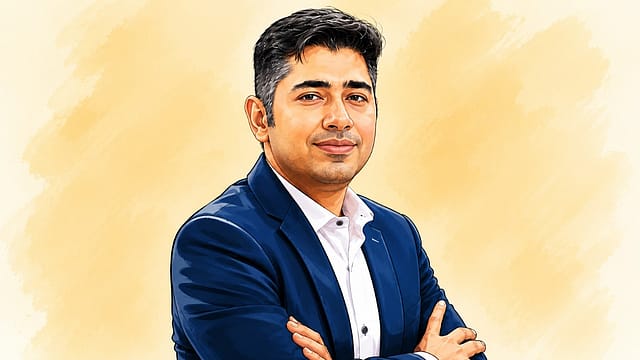
The wholesale vegetable market near Paschim Vihar opens before six. Nishant Arora knew it well — not as a customer, but as the person who ended up there whenever the family restaurant's supply chain broke down, which was often. One week the bakery chef wouldn't show. The next, it was the delivery staff. On the mornings when the vendor didn't turn up either, someone had to buy the vegetables himself. That someone, through most of his early twenties, was Arora.
His father had set up the restaurant for him in 2006, while Arora was still working toward his MBA — a fairly standard move in a traditional north Indian business family, where the assumption is that you finish school and start running something of your own. From the outside it looked like a good life. Arora hated almost all of it. Running it meant days that started at dawn and ended past midnight, consumed by things going wrong. He describes the feeling from that period in a single image: a frog in a pond, comfortable and going nowhere. He was certain his life would stay exactly that size if he let it.
Rise of the Pivotal Power
18 Sep 2026 - Vol 05 | Issue 38
The BRICS declaration is a strategic victory for Modi
When he eventually said he wanted out, his father didn't argue on principle — he ran the numbers. A corporate salary plus the rent he could collect on the restaurant's property came out higher than the restaurant's own profit. The decision made itself.
Twenty years later, Arora is Global Head of Marketing of Netcore Cloud (now Netcore.ai), an Indian martech company whose email and messaging tools sit behind campaigns for many of the country's largest consumer brands — and, more recently, a company he's been trying to rebuild in a bolder image with the fresh identity of Netcore.ai: not a vendor that sends marketing messages on a brand's behalf, but a platform on which AI agents make marketing decisions in real time. The stakes have changed. The discomfort with staying put hasn't.
Life in the Corporate World
Arora graduated from LBSIM in 2008, at the exact moment the global financial system was unravelling. He had built his MBA around commodity pricing, aiming to trade gold and crude oil. Marketing was never the plan. But 2008 didn't care about plans — finance hiring evaporated just as India's global capability centre boom was getting underway, and HP offered him a spot on an analytics team it was standing up in the country. It wasn't the trading floor he'd trained for, but it was close enough to real numbers that he took it.
It turned out to be an education, just not the one he expected. Arora spent his early HP years on the strategic side — modelling which customers were likeliest to buy a new product before launch, running the numbers behind an acquisition target HP was evaluating that eventually went to Oracle instead. What gnawed at him wasn't the work — it was the distance from its outcome. He'd build a strategy, hand it off, and never learn whether it worked. "I wanted to execute the strategy," he says, "and understand what happened after it was implemented." It's the seed of almost everything that follows: a preference, bordering on a compulsion, for staying close enough to a decision to live with what it produces.
The next stretch reads, from the outside, like a fairly conventional SaaS marketing ascent — a decade at IBM leading marketing for its data and AI software, where he picked up a line he now treats as a governing principle: growth and comfort do not coexist. From there to Freshworks, where he ran product marketing for its IT offering and turned it into the fastest-growing line in the portfolio, then to Sprinklr as senior director on the marketing team, before Netcore recruited him roughly eighteen months ago. What connects the stops is less the titles than the restlessness that first sent him out of the restaurant.
That restlessness has a name in Arora's own vocabulary — the three-burner model, his harsher variant of the popular four-burner theory of life. Health is non-negotiable, he argues. Of what's left — friends, family, career — you get to keep two. He chose family and career, and has mostly stopped attending the weddings and reunions that would have kept old friendships alive. He's careful to frame this as a choice rather than a casualty. "It does not hurt as much when you know that you deliberately made a choice," he says.
It's the same logic, scaled up, behind the biggest bet of his career — and he's candid about why Netcore, specifically, is where he finally got to make it. The freedom to take an unconventional swing shrinks the more public and accountable a company becomes, he argues; a listed business grows steadily more risk-averse because every experiment becomes something leadership has to defend. The repositioning he's led at Netcore, he says plainly, wouldn't have been possible at IBM or Sprinklr.
For most of its history, Netcore was synonymous with one thing: email marketing software. It was a genuine category leader there — the kind of dominance that becomes its own trap. Nearly every Indian brand worth having as a customer was already a Netcore customer, so growth increasingly depended on getting those same customers to adopt newer tools — WhatsApp and SMS marketing, a customer data platform built through the acquisition of Unbxd. None of it had dented the market's perception of Netcore as, simply, an email vendor.
Betting on a New Marketing Category
Arora arrived with marketing's centre of gravity visibly shifting from people typing prompts toward AI "agents" acting autonomously on a brand's behalf. He saw two paths: reposition Netcore as a customer engagement platform, a real upgrade but a crowded category where it would still be arriving late — or skip the intermediate step and position Netcore as an agentic marketing platform, infrastructure that lets AI agents actually run marketing decisions for a brand, grounded in that brand's own data and rules.
"I chose the bolder option," Arora says, with the flatness of someone describing a vegetable run. There was no template, so he studied companies that had pulled off something structurally similar — HubSpot's invention of "inbound marketing" as a category, Salesforce's construction of the SaaS narrative, Gong's build-out of "revenue intelligence." He measures Netcore's ambitions against Klaviyo and Insider, and against Salesforce Marketing Cloud, whose own struggles, he notes, have made room for challengers.
The pitch is deliberately narrow: Netcore doesn't build the underlying AI models — that belongs to partners like Google — but sits as the layer between those models and the marketer, supplying business context, governance and workflow. It runs against most marketing instinct: sending more messages doesn't produce more revenue, and a customer who cares about sustainability shouldn't be offered 80 percent off a leather bag. The pitch isn't reaching people more often — it's knowing, in advance, which few messages a customer will actually respond to.
That bet is helped by regulation. India's new Digital Personal Data Protection law has, in Arora's account, pushed brands that once stitched together five or six vendors toward consolidating around fewer partners who can guarantee compliance — a shift that favours a company like Netcore, which owns both the data and the channels. He's unambiguous that he'd support the law regardless: personalisation and privacy, he argues, were never really in conflict, and a brand that keeps messaging people who never consented to it isn't doing good business, whatever the short-term numbers say.
Betting a company's identity on an category that takes up a specific kind of composure, and Arora traces his own back to an unlikely source — a leadership programme at IBM that put him through three days of training with professional theatre actors. The actors ran him through scenarios every executive recognises: a fourth review with an underperforming team, no visible improvement, a meeting with the CEO in two hours to explain why. The point wasn't performance for its own sake. It was learning to manage what a room sees when it needs you not to look rattled. Arora says he can't remember the last time he lost his temper in front of his team.
Ask him what a bad day looks like now, and the answer is revealing for what it excludes. It isn't a campaign that underperforms — he treats unpredictable outcomes as simply the nature of the job. A bad day is a team operating in silos, or a launch built for two months on an assumption nobody tested with an actual customer first.
What Arora wants, ultimately, sits a level above Netcore's quarterly numbers. He wants to be known, he says, as someone who helped Indian SaaS companies find a genuinely global audience — not just global ambition. It's in line with a career built on choosing the harder route over the safer one: leaving a family restaurant for a corporate ladder nobody in his family had climbed, trading friendships for a three-burner life he chose with his eyes open, and now staking a company's identity on a category that, by his own admission, doesn't fully exist yet.
The kid who kept ending up at the wholesale market before sunrise wanted, more than anything, to see his ideas through to the end. Two decades on, he still does. He's just found a much bigger version of the same problem — minus, mercifully, the missing bakery chef.