Brewing a ‘Bubble’ Empire: Inside Boba Bhai
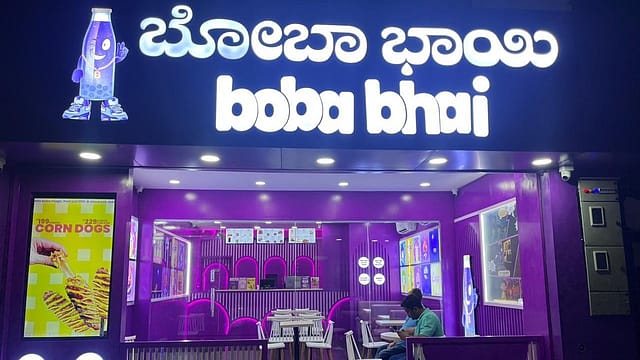
The first thing he heard wasn’t advice. It was a warning.
In 2023, when Dhruv Kohli walked in to pitch investors, he was met with three dreaded words: IT’S A BUBBLE.
The caution came with a smirk. Some dressed it up as concern. Others stated it like fact. Either way, the message didn’t change: IT WILL BURST.
Kohli, a serial entrepreneur and an angel investor, wasn’t bemused. He knew the word and its heft.
In India—and across the financial capitals of the world—‘bubble’ carries weight. Nah, not the weight of excitement. It signals hype running ahead of reality. It is something that looks big—until it suddenly isn’t.
The Vanguard
21 Aug 2026 - Vol 05 | Issue 34
BJP Rearmed for 2029

Back home, Kohli wasn’t the first to hear this gyan—half warning and half threat. Umpteen founders have heard it. Countless investors have repeated it. And markets have always remembered it. Dotcom. Crypto. Edtech. Does it ring a bell? The pattern feels eerily familiar.
So, when Kohli walked into a room and said he wanted to build a business around ‘bubble’ tea-- served alongside Korean-style snacks and fast food under the brand Boba Bhai--the reaction was predictable.
Investors didn’t just question the scale. Some didn’t even understand the product.
He would place the cup on the table before the pitch even began. “Sir, first try this. Then we’ll talk.” Sometimes they did. Sometimes they didn’t. One investor didn’t bother and suggested Kohli a different brew: leave this and do coffee.
The suggestion was bitter. Why? Coffee was proven, predictable and already mapped. And that was the problem. “Everyone is already selling coffee,” Kohli told him. “If I do the same, what’s the difference?”
The scepticism wasn’t just about the product Kohli was trying to build. It was about the category itself. Bubble tea looked like a trend. Something that is imported. Something that is Instagrammable. Many argued that it was built for a moment and not a market.
And how could you blame the naysayers? In a country where food businesses often take a decade to scale meaningfully, business around bubble tea felt too niche, too urban, too young—and too fragile.
Meanwhile, Kohli didn’t disagree with the premise. Bubbles do burst. Whatever be the size: Big, small or entire industries built on them. But somewhere along the way, he had arrived at a different conclusion. Not all bubbles are problems. Some are signals.
Here’s why. “There are markets that didn’t exist until someone built them,” he says, dishing out three examples. Ride-hailing before taxis became apps. Social networks before people knew they needed them. E-commerce in a country that barely trusted the internet. In each case, the early version looked like a bubble: small, uncertain and easy to dismiss.
Until it wasn’t.
Kohli’s answer wasn’t to avoid the bubble. It was to move inside it—faster than doubt could catch up, faster than the narrative could settle.
“Bubbles will come,” he says. “The question is—can you move fast enough to ride them?”
That belief would shape everything that followed—from the name to the pitch to the way the business was built. Because if the bubble was going to burst anyway, you had two choices.
Stand outside and watch or step in and try to build before it does.
Why Dhruv Kohli Says His TAM is Zero
Conviction sounds good in a room. But it gets tested the moment you step out and start asking for money.
When Kohli began raising capital, the questions were immediate and familiar. Not about the product anymore, but about the size of the opportunity. How big is this market? What’s the TAM (total addressable market)?
It’s the question investors use to anchor uncertainty, to turn something abstract into something measurable.
Kohli didn’t resist it. He reframed it. “My TAM is zero.”
The answer wasn’t meant to provoke but to make a point. Two people can sit in a room and stretch that number endlessly—₹100 crore, ₹500 crore or ₹1,000 crore. But it still remains what it is: a projection.
Kohli wasn’t interested in projections. He was building something that didn’t have a defined market yet. In his view, the market would follow the business, not the other way around. “As we grow, the market grows,” he says.
That framing didn’t always land. Rejections came, and then more. By his estimate, 50 to 60 investors passed. Some declined politely. Others were more direct.
For a stretch, the gap between conviction and capital began to tighten uncomfortably. There was a phase when raising ₹4 crore felt within reach. Then there was a phase when even ₹1 crore didn’t.
At some point, the pursuit of capital began to feel like a distraction. So, he pulled back. Instead of chasing investors, he focused on building the business.
The logic was simple: if the product worked, capital would follow. If it didn’t, no pitch deck would fix it.
The early days unfolded far from boardrooms. They played out late into the night—2 AM, 3 AM, sometimes 4 AM—selling, testing, observing what worked, what didn’t, and iterating quickly. It was less about scale at that point, more about signal.
And the signal, when it came was gradual. Orders held, then grew. Customers returned. A category that many believed wouldn’t exist in India began to find shape, one order at a time.
The shift, when it arrived, was almost predictable in hindsight. One investor said yes. Then the narrative began to change. The same people who had passed earlier started calling back.
“That’s when you realise,” Kohli says, “a ‘no’ is not forever.” Capital, in that sense, behaves like momentum. It moves towards what is already moving.
At Boba Bhai, that movement soon began to show up in numbers. Operating revenue scaled from ₹5.2 crore in FY24—when the business ran for just four months—to ₹28.9 crore in FY25, with provisional estimates pointing to ₹70 crore in FY26.
Capital followed a similar curve. The company has raised over ₹82 crore across three rounds, drawing backing from investors such as 8i Ventures, Titan Capital and Global Growth Capital, along with angels including Kunal Shah and Varun Alagh.
Losses, too, have widened—from ₹9.5 crore in FY25 to an estimated ₹12.5 crore in FY26—an expected trade-off in a business prioritising scale.
The direction, however, is clear. The bubble has started to take shape.
Small stores, Big ambition: Scale play behind Boba Bhai’s Growth
Now, the next question is simple: can the momentum hold?
For Kohli, the answer wasn’t going to come from spreadsheets. It would come from the ground—from how people in India actually eat.
“I realised one thing,” he says. “In India, food comes before everything. Celebration comes later.” In a country where meals anchor everything, the opportunity isn’t occasional. It’s constant.
But the structure of the market tells a more complex story. India’s food landscape is vast, but deeply fragmented—unorganised, local and habit-driven.
Even the organised players take years, often decades, to scale meaningfully.
Kohli had seen something else play out overseas. Before returning, he had worked on building cloud kitchens across the UK and Australia, scaling to hundreds of locations.
The experience showed him how quickly food businesses could expand in more structured markets—and how under-penetrated India still was.
“When I looked at the US and China,” he says, “the scale was very different.” India had the population. It had the appetite. What it didn’t yet have was the density.
That gap—between demand and structure—was where he chose to build. At Boba Bhai, that translated into a clear operating logic: small formats, tight costs, and rapid expansion. “This is not a business where you stop at 100 outlets,” Kohli says. “In India, you have to think in hundreds, in thousands.”
That thinking is already visible in the footprint.
Boba Bhai has scaled to over 90 stores across cities including Bangalore, Chennai, Hyderabad, Mumbai, Pune, Delhi-NCR, Lucknow and Jaipur.
Most outlets are compact—between 250 and 400 square feet—designed for throughput, not linger. The model is built for replication.
And the consumer, he believed, was ready. A younger audience—more curious, more experimental, more willing to try something new—was already reshaping how India eats.
That shift, say marketing observers, often follows a familiar pattern. “Trends rarely begin with a market,” says Ashita Aggarwal. “They begin with someone willing to build one.”
Take Mexican food—tacos, burritos, nachos. “Was there really a market for these in India?” she asks. And yet, brands like California Burrito have built scale by staying the course.
The same arc, she suggests, tends to play out with newer formats. What looks niche at first—bubble tea, Korean-style burgers, street food—often just needs a founder willing to persist long enough to make it familiar.
That shift isn’t isolated. It’s part of a broader change in how India is eating.
Industry observers reckon that this is part of a broader shift. “The growth reflects a move towards curiosity-led dining and global flavour exploration, especially among younger audiences,” says Angad Chachra, founder of The Bar Consultants, a F&B advisory based out of New Delhi.
Concepts that combine familiarity with novelty tend to see quick traction, reckons the F&B expert.
That is precisely where Boba Bhai sits—familiar formats and unfamiliar flavours.
On the menu, that shows up as a mix designed to travel easily across tastes: taro lava bubble tea, jamun kala khatta with popping boba, honey sriracha fried chicken, corn dogs and burgers that sit comfortably alongside global QSR staples.
But curiosity can be fleeting. “Whether any brand sustains long-term relevance depends on consistency, adaptability and how well it continues to engage its audience,” Chachra adds.
Kohli knows the trade-off. “In food, you can’t satisfy 100% people,” he says. “We focus on the 98% who like us—and try to take that to 99%.” That pursuit of consistency, however, doesn’t get easier with scale.
Scale, when it comes, brings its own pressures—volume, consistency, expectation. “You’re not a magician,” he says. “If there are 100 people waiting, it will take time.”
But these are problems of growth. And growth, in this case, is evidence.
What began as an unfamiliar product—something that needed explanation—is now being ordered, repeated, and shared. The category is no longer an idea. It is being built in real time. And when that shift begins to show up on the ground, it tends to gather pace.
From Momentum to Moat: Real test for Boba Bhai begins now
Momentum, meanwhile, is a powerful thing. It builds quietly. And then suddenly, it feels inevitable. At Boba Bhai, that shift is already underway.
But momentum has a second nature—it is hard to sustain.
For Kohli, the challenge has evolved. Earlier, the task was to get people to try. Now, it is to make them return—and then, to keep them. Why? Because the very thing that fuels early growth—novelty—can also limit it. Trends spike, attention shifts and consumers move on…Kohli is aware of the drill.
That’s why he doesn’t dismiss that reality. “In the end, you have to keep building,” he says. “You can’t stop.” New products. New formats. Constant iteration. The work doesn’t slow down once the market responds. It accelerates.
Scale introduces pressure, consistency becomes harder and experience becomes uneven. And yet, for the customer, every store is the brand.
It also comes at a cost. Losses have widened as the company has expanded—an indication of the capital required to build ahead of demand, and a reminder that momentum alone doesn’t guarantee operating leverage.
Competition follows visibility. Here’s how it pans out. New entrants rush in, similar formats mushroom, and variations on the same idea becomes the norm. Result? The category that once felt empty begins to fill up.
And when this happens, it shifts the advantage—from being early to staying relevant. So, the long-term test now is about consistency, adaptability, and the ability to keep engaging the customer over time.
And this brings the story back to where it began. Is it a bubble? Will it burst?
Kohli, for his part, bubbles up with conviction—and honesty. “Bubbles will always come,” he reiterates. “The real question is—can you move fast enough to ride them?” That’s the bet.