Beyond the Yorker: How Uniqlo Found Jasprit Bumrah Off the Pitch
You know how a Jasprit Bumrah commercial begins.
You don’t need to see it. You can hear it. This is how action starts: studs on turf. A slow walk back. The run-up gathers. Then—pause and release. And this is how impact lands: seam upright. Batsman beaten.
Now take the same frames, swap the context and add product. A brand trying to borrow Bumrah’s precision. His speed. His control. It could be cement. It could be finance. It could be anything that wants certainty on hire. The script travels well—across categories, across budgets, across years.
The drill is: Change the logo and keep the bowler. And somewhere along the way, Bumrah stops being a person. He turns into a proof point that is reliable, repeatable and replaceable.
So, when you do it the first time, it lands. By tenth, it registers. And by the twentieth, it slips past you. Why? Because now you’re not watching an ad. You’re watching a format—a familiar sequence dressed in new branding. The brand makes the claim, Bumrah delivers it and you’re left to connect the dots. It’s neat, efficient and almost too efficient. It's like a joke you’ve heard before but with a different punchline slapped on.
The Modi Years
02 Oct 2026 - Vol 05 | Issue 40
A Nation Rebuilt
No Run-Up, No Metaphor—Just Bumrah
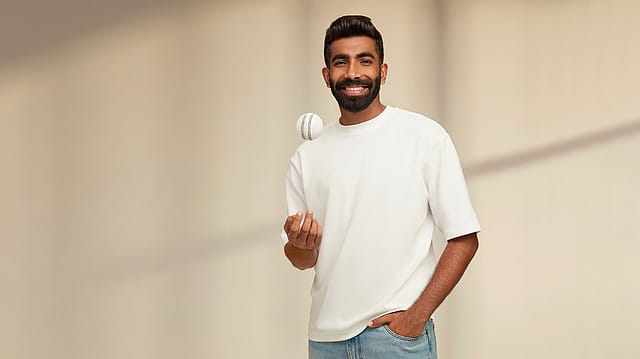
And then Uniqlo walks in. And quietly removes the ball. There is no stadium, no run-up and no slow-motion wrist position analysis. Just Bumrah. Not the bowler. The human. He moves the way he actually does—unhurried, composed, almost indifferent to the idea of performance. There’s no attempt to extract meaning from him. There is no urge to turn him into a metaphor.
The clothes don’t need a demonstration. They just exist on him. And for the first time in a long time, nothing feels borrowed.
This is where it flips. Most brands start with what Bumrah does and build outward. Uniqlo starts with who Bumrah is and strips everything else away. No translation required, no forced parallels and no over-explaining. Just alignment.
This wasn’t accidental.
Inside Uniqlo, the brief was already moving in a different direction. “We didn’t want Bumrah the cricketer,” says Nidhi Rastogi, marketing director at Uniqlo India. “We wanted Bumrah the human.”
That decision changes everything. Once you remove the stadium, you remove the need to perform. What’s left is quieter, more revealing and far closer to how the brand sees itself. “We are a lifewear brand,” she says. “We are about people’s everyday life… whether they are off field, hanging out with family.”
So, the brief became simple and unusually disciplined: No cricket, no bowling and no metaphor to decode. Just a slice of life. “How would Bumrah spend his day?” Rastogi says. “That’s what we wanted to show.”
The choice of Bumrah, then, wasn’t about fame. It was about fit. “He’s very rooted. Very understated,” Rastogi says. “Excellent in what he does.”
That’s exactly how Uniqlo likes to see itself. And that alignment shows up on screen. The calm, the lightness and even the faint humour are seamless. The commercial feels discovered rather than directed.
There’s another layer to it—one most ads never get to. Bumrah wasn’t just cast. He was already wearing the brand. “He actually uses the T-shirt he’s endorsing,” Rastogi says. “He wears it himself.” It’s a small detail but it shifts the energy. Now the commercial isn’t about performance. It becomes an extension. And that’s why the ad doesn’t try too hard to convince you.
It doesn’t need to.
Eat Like No One’s Watching—Including the Brand
And Uniqlo isn’t the only one stepping away from the run-up. Take Sunfeast Yippee!.
In its campaign with Bumrah, the stadium disappears again but this time, the setting is even more disarming. There is a bowl of noodles, the man is off guard, there are no angles to perfect and no image to protect.
The idea is simple: “Eat like no one is watching.” And Bumrah does exactly that—slurping, enjoying, letting go in a way you rarely associate with him on-field. It’s messy, unfiltered and almost playful.
And that’s the point. Here too, the brand resists the obvious. There are no attempts to translate yorkers into product truths. There is no borrowed precision. Just a different side of Bumrah—one that feels closer to everyday life than elite performance. In fact, the film leans into spontaneity, capturing him completely unfiltered in a moment of simple indulgence.
What’s emerging, then, isn’t just a better commercial. It’s a better use of the person. For years, brands asked: What does Bumrah do? Now, a few are starting to ask: Who is Bumrah when he’s not doing it?
And the answers are turning out to be far more interesting.
What Uniqlo—and now even something like Sunfeast Yippee!—are hinting at is a correction.
Rethinking the Celebrity Playbook
For years, celebrity advertising in India has run on a simple equation: take what the person is known for, stretch it, and map it onto the product. Skill becomes shorthand and identity becomes utility.
It worked for years, until it started to look the same everywhere. "When every brand uses the same trait, the trait stops carrying meaning. And the person disappears inside it," reckons Ashita Aggarwal, professor of marketing at SP Jain Institute of Management & Research.
The smarter brands are changing the question. It's no longer 'what can we extract from this celebrity' but 'what already exists here that we don’t need to touch.' "It’s a subtle shift. But it changes the work," says Aggarwal. You stop building ads around the celebrity and you start building them with the person. And this means you stop amplifying performance and start observing presence.
With Bumrah, this matters even more.
He isn’t naturally loud. He doesn’t sell drama on his own. His strength sits in control, in restraint and in the absence of excess. The old template—high energy, high metaphor, high assertion—was always slightly off-key. What Uniqlo—and a few others now—have done is simple. They’ve stopped turning up the volume. And in doing so, they’ve finally made him clearer.
Seen this way, the shift is almost physical.
The ball is still in his hand. But for once, nobody is asking him to bowl. And that might just be the most interesting thing brands have done with Bumrah yet.