Back to the Future for ₹1,500: How KidZania and Big Brands Turn Nostalgia into a Profitable Business
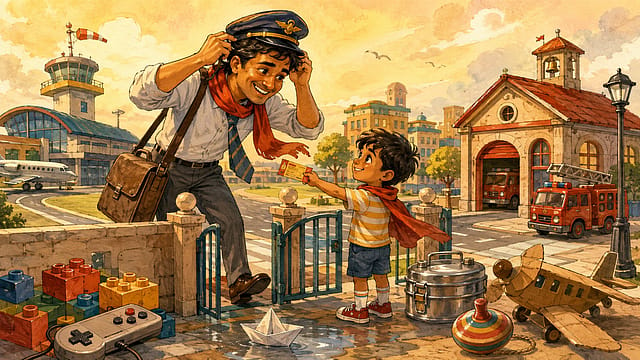
Congratulations. You have been hired as a child.
The salary is zero. The uniform may not fit. The job will last until the ticket expires. Instead of receiving money for turning up, you will pay ₹1,500 plus GST for the privilege.
On August 29, KidZania’s miniature cities in Mumbai and Delhi-NCR are opening their role-plays to adults. No child is required. A 21-year-old can report for duty beside a 45-year-old. Both may become pilots, firefighters, surgeons or television presenters, subject to height, patience and the length of the queue.
KidZania calls the event an Open House.
Marketing might call it a time machine with a payment gateway. The five-hour ticket costs ₹1,200 and a full day costs ₹1,500, excluding 18 per cent GST. Adults reportedly receive access to more than 35 role-plays and ₹400 in game coupons. They can therefore enjoy the thrill of earning imaginary money before returning to an economy that collects real tax.

Zeroing In on ECI
09 Oct 2026 - Vol 05 | Issue 41
Constitutional legitimacy versus political opportunism
The joke is adults paying to perform children’s versions of adult jobs. The business beneath the joke is far bigger. KidZania is selling nostalgia.
Memory Has Entered the Checkout Cart
Nostalgia marketing begins with an old sensory trick.
A tune returns. A packet looks familiar. A retired television character appears. A toy comes back in adult size. The consumer recognises something before the sales pitch has properly begun.
That recognition is commercially useful because memory does half the introduction. The brand does not enter as a stranger. It arrives carrying the smell of a school lunchbox, the sound of a Sunday television show or the small triumph of discovering a toy inside a meal.
The product may be new. The emotional paperwork has already been completed. KidZania takes the mechanism further. It does not sell an object from childhood. It sells temporary re-entry into childhood itself.
Children once visited its city to rehearse adulthood. Adults are now returning for the edited version. The pilot controls the aircraft without delays. The surgeon completes the operation without paperwork. The journalist reads the news without discovering that three more developments have occurred during the first paragraph.
The uniform remains. The institution around it disappears. Real employment pays adults to work. KidZania has removed the salary, retained the queue and renamed the arrangement nostalgia.
Why the Past Opens the Wallet
Nostalgia is often described as affection for earlier times. That definition is too gentle for marketing.
For brands, nostalgia is a form of emotional compression. It can place family, belonging, safety, youth and identity inside one image or sound. A campaign need not explain why an old jingle matters when the audience has spent 25 years storing the explanation.
Research supplies an even more profitable insight. A 2014 study published in the Journal of Consumer Research used six experiments to examine nostalgia and money. It found that nostalgic feeling could reduce the desire for money, increase willingness to pay for products and encourage people to part with more cash. The researchers traced the effect partly to the social connectedness created by nostalgia.
In simpler language, memory can make the wallet feel less important.
That helps explain why nostalgia grows particularly attractive during disruption. Economic anxiety, technological acceleration, political uncertainty and permanent digital noise make the present feel unstable. The past, once edited by memory, appears slower and safer.
The past need not have been better. A favourable memory is enough.
Ashita Aggarwal, professor of marketing at SP Jain Institute of Management & Research, locates the commercial power in that emotional security. “Nostalgia reduces the psychological distance between the brand and the consumer," she reckons. Familiar music, characters, products or rituals can restore a feeling of comfort and belonging before the rational evaluation of the offer begins. That is commercially powerful in periods of rapid change because the brand is not merely promising enjoyment. It is promising emotional continuity.
KidZania’s timing, therefore, makes sense. The adult is not buying the serious reality of becoming a pilot at 35. The adult is buying five hours with the child who once believed becoming one was possible.
India Has Been Drinking Its Memories
Few Indian brands understand nostalgia as completely as Paper Boat.
Its traditional drinks, including aam panna, jaljeera, kokum and aamras, were familiar long before the brand arrived. Paper Boat’s achievement was to package those tastes as memory. Its name, illustrations, pouches and “Drinks and Memories” proposition turned the product into a portable childhood.
The brand did not need to invent longing. It found longing already living inside summer holidays, grandmothers’ kitchens, monsoon games and recipes that urban consumers no longer prepared regularly.
Paper Boat sells the drink. Memory supplies the aftertaste.
Campa represents another branch of the business. Reliance Consumer Products acquired the cola brand in 2022 and brought it back in 2023, decades after Campa had occupied a distinct place in Indian soft-drink history. Its red and purple identity returned with a powerful advantage: older buyers already knew the name.
Yet Campa also demonstrates why nostalgia cannot operate alone. A remembered cola still requires price, distribution, refrigeration and repeated purchase. Reliance has treated the old name as an entry point, then placed industrial scale behind it. Memory may reopen the door. Supply must keep the shelves filled.
Cadbury chose a more intelligent route in 2021. It recreated its famous cricket advertisement from the early 1990s almost frame for frame, but reversed the genders. A woman batter played the decisive shot. A man ran onto the field in celebration.
The campaign avoided photocopying the past. It allowed the audience to recognise the original and then discover what had changed. That is nostalgia with editorial judgment. The old memory provides warmth. The present supplies the correction.
CRED took the more mischievous route during the 2022 IPL. Karisma Kapoor recreated the visual language and mannerisms of a vintage Nirma commercial. Renuka Shahane and Annu Kapoor returned to the world of Antakshari. Familiar faces, television grammar and jingles from the 1980s and 1990s were recruited to sell a credit-card payment platform that did not exist when those memories were formed.
The category mismatch was part of the joke. CRED used familiar faces, rhythms and references to make the new fintech economy less culturally remote.
Nostalgia became a translator between an unfamiliar product and a familiar culture.
Parle-G, Maggi, Amul, Rasna and Doordarshan-era advertising occupy similar reservoirs. Their packs, mascots, songs and rituals carry autobiographical value for consumers. When such brands revive an old line or visual, they are activating more than recall. They are inviting consumers to remember who they were when the brand first entered their lives.
McDonald’s Put Adulthood Inside a Happy Meal
The global nostalgia factory has become even more explicit.
In 2022, McDonald’s launched its Cactus Plant Flea Market Box for adults in the United States. The meal used a redesigned box, familiar menu items and collectible figurines featuring characters such as Grimace, Hamburglar and Birdie.
McDonald’s itself described the offer as repackaging one of its most nostalgic experiences for adult fans. The results made the emotional strategy measurable. In its 2022 earnings commentary, the company said demand exceeded expectations, the promotion sold out nationally and generated what was then its highest-ever weekly digital transactions in the United States.
The adult Happy Meal performed a small act of commercial genius. It preserved the food, restored the surprise and upgraded the buyer’s spending power.
The child once asked a parent for the meal. The child now possessed a salary and ordered through the app.
McDonald’s repeated the logic through later adult boxes and, in 2025, brought back the wider McDonaldland universe and its characters after more than two decades. The meal came with a limited-edition shake and collectible souvenirs designed, in the company’s own phrase, to unlock memories.
The souvenir is crucial. Nostalgia marketing increasingly converts memory into something scarce, collectable and photographable. The consumer revisits the past and acquires proof of the visit before stocks disappear.
LEGO Grew Up With Its Customer
LEGO has built an entire adult business without treating adulthood as the end of play.
Its “Adults Welcome” range includes complex architecture, art, luxury cars, film properties and retro objects. The age marking moves upward. The language shifts from play towards creativity, immersion, display and mindfulness. The brick remains recognisable.
This is nostalgia marketing at its most strategically complete because the product develops with the consumer. LEGO does not simply return the inexpensive childhood set in an old box. It offers a more complex, aesthetically ambitious and expensive version that fits the adult’s home, fandom and disposable income.
The memory creates permission. The new design creates value.
Nintendo has used the same principle. Its miniature NES and SNES consoles reproduced the appearance of older systems while bundling classic games into contemporary hardware. The products allowed adults to recover the ritual without recovering the unreliable cartridges, tangled wires and technological limitations of the original era.
The best nostalgia products do not reproduce every inconvenience. They restore the emotion and quietly repair the experience.
Coca-Cola Resurrected a Failure
Nostalgia can even turn a corporate mistake into an asset.
In 2019, Coca-Cola brought back New Coke in a limited promotional run tied to the third season of Netflix’s Stranger Things, which was set in 1985. New Coke had lasted only 79 days before consumer outrage pushed the company to restore the original formula.
Thirty-four years later, the failure had become cultural material.
Coca-Cola and Netflix used archives, period packaging, television-style advertising and product appearances inside the series to recreate the summer of 1985. A decision once remembered as a marketing disaster returned as a collectible piece of entertainment.
Time had removed the commercial danger and preserved the story.
The revival showed that nostalgia does not require an uncomplicated past. It requires a past with recognisable emotional ownership. Consumers may enjoy revisiting an old failure when they are no longer being forced to drink it permanently.
Gen Z Misses a Past It Never Had
Nostalgia marketing is often lazily described as a millennial business.
Millennials are certainly valuable. They carry strong memories of the 1980s, 1990s and early internet, while possessing more spending power than they did when those memories were created. Gen X and older consumers bring their own archive.
But Gen Z has expanded the market in a strange direction.
Young consumers can feel nostalgia for periods they did not personally experience. Researchers call this historical or vicarious nostalgia. Vinyl records, film cameras, Y2K fashion, old television graphics and 1990s advertising can offer emotional atmosphere without autobiographical memory.
Social media helps compress decades into aesthetics. An era becomes a font, filter, soundtrack, sneaker and colour palette. Gen Z can consume the 1990s without having survived dial-up internet or waited a week for the next television episode.
Nostalgia no longer belongs only to those who lived through the period being revived. Millennials can buy back fragments of their childhood. Gen Z can adopt the music, fashion, design and cultural mood of a past encountered through screens, stories and somebody else’s memories.
The generations enter the nostalgia market through different doors, underlines Ashita Aggarwal, professor of marketing at SP Jain Institute of Management & Research. Gen Z often supplies the cultural visibility, while millennials bring stronger autobiographical memories and, frequently, greater spending power. “Gen Z turns older aesthetics into content, identity and cultural play," she says, adding that millennials are more likely to possess direct memories of the brands and experiences being revived, while older consumers respond to an entirely different archive. Nostalgia marketing cannot treat them as one generational block. "Each generation is buying a different relationship with the past,” she reckons.
KidZania can speak to all three. A young adult may enjoy the absurdity and shareability. A millennial may recover an abandoned career fantasy. An older visitor may respond to the universal ritual of childhood role-play rather than to the brand itself.
The product is one city. The memories enter through different gates.
When the Time Machine Runs Out of Fuel
Nostalgia is powerful precisely because it is borrowed emotional capital.
That also creates its limitations.
First, memory can win attention without winning repeat purchase. The first adult photograph from KidZania’s cockpit is funny. The fifth visit requires a fresh reason. An opening-day crowd may prove that people enjoy novelty, not that KidZania has discovered a durable adult segment.
Second, nostalgia cannot rescue a weak product. Campa must still taste right, reach stores and compete on price. A retro console must work. An adult LEGO set must justify its complexity and cost. The past can secure a trial. The present must earn the second purchase.
Third, a reference can exclude as effectively as it includes. A 1990s jingle delights those who recognise it and leaves everybody else watching strangers laugh at a private joke. Regional, class and generational memories are not interchangeable. India does not possess one childhood.
Fourth, repetition can turn emotional history into creative laziness. Revive the song. Recast the celebrity. Reprint the packet. Add “remember this?” The method becomes mechanical, and the audience begins to see a brand rummaging through the attic because it has nothing new to say.
Fifth, nostalgia beautifies the past. It can erase exclusion, scarcity, gender roles and social realities that deserve no revival. Cadbury’s cricket remake worked because it recognised this danger and changed the memory instead of worshipping it.
Aggarwal’s warning belongs at the centre of the strategy. “Nostalgia is an invitation, not a complete value proposition," she says. The brand must add relevance, utility or a contemporary point of view after recognition has done its work. There is also a saturation risk. When every old song, packet and character returns as branded content, consumers begin to see the machinery behind the memory. "The past stops feeling personal and starts looking like inventory,” she adds.
KidZania faces one additional danger. Its city was designed to help children understand work, money and civic life through imaginative play. Adults carry real wallets, creator reach and commercial attractiveness. If their demand becomes significant, brands may push for activities designed around adult humour, sampling and social sharing.
The child-sized city could slowly become an experiential mall wearing a firefighter’s helmet.
Childhood, Now With GST
KidZania’s Open House is smart because the proposition can be understood before the campaign is explained.
Adults miss childhood. They feel tired of work. They remain curious about the lives they might have chosen.
The ticket compresses those emotions into a day pass. The investment banker can become a firefighter before lunch. The advertising executive can read the news. The journalist can try aviation, although the simulated aircraft may still be easier to escape than the newsroom.
Nobody must make the fantasy permanent. That is the feature. The adult can borrow another life for 20 minutes, take a photograph and surrender the uniform before any part of the job becomes tedious.
This is the deeper genius of nostalgia marketing. It does not actually return the consumer to the past. It removes the boredom, discomfort and helplessness, then sells a polished fragment back in the present.
Paper Boat removes the labour from aam panna. Nintendo removes the troublesome cartridge. LEGO removes the age limit. McDonald’s removes the need to ask a parent. KidZania removes the consequences from work.
The memory remains recognisable. The inconvenience has been edited out. For five hours, grown-ups can become almost anything they dreamed of being as children. Except younger. That remains out of stock.