As OpenAI exits Sora, Google scales Gemini Flow: What creators like Talwiinder signal about AI video economics
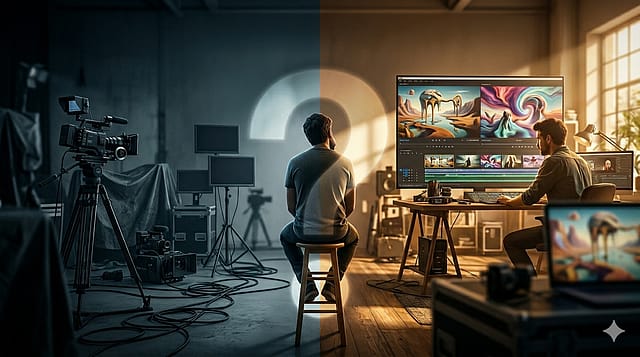
There is a tendency in tech to declare the future too early.
A few months ago, AI video looked like one of those moments. Text to film. Prompt to production. No crew, no set, no waiting.
Now, OpenAI is shutting down Sora, the very product that helped build that narrative.
At almost the same time, Google is leaning in the opposite direction. It is pushing Flow, its own video tool, using creator-led projects to show what the technology can do. One of those is a recent music video by Talwiinder, built with AI-generated visuals instead of a traditional shoot.

Zeroing In on ECI
09 Oct 2026 - Vol 05 | Issue 41
Constitutional legitimacy versus political opportunism
Google describes Flow as an AI creative studio built on its generative models, designed to turn text prompts and reference images into cinematic clips, scenes and narratives. The company says it is working with creators globally to test how such tools can be used across formats including music videos and branded content.
Both things are true at once. That is what makes this moment worth paying attention to.
The technology works, at least in parts. The business around it is still unclear.
Sora’s shutdown is not being framed as a failure. It is being positioned as a shift in focus. But the reasons are not hard to read. Video generation is expensive to run. It is unpredictable at scale. It sits in the middle of ongoing fights around copyright and deepfakes.
None of those problems have easy fixes.
Google, for its part, is being more careful in how it presents Flow. It is not selling the idea that anyone can type a line and get a perfect film. The pitch is subtler. This is a tool you work with. You generate, adjust, redo. Something closer to editing than magic.
Creators involved in early projects echo that learning curve. Filmmaker Bowdhitya, who worked on Talwiinder’s video, described the process as iterative, requiring specific inputs around camera, lens and lighting to get usable results. Talwiinder, too, noted that the system demands time and direction, even as it enables visuals that would otherwise be difficult to produce within typical budgets.
That lowers expectations. It also makes the product easier to place inside existing creative workflows.
But step back, and both companies are circling the same issue.
Cost.
A video like Talwiinder’s would normally require a crew. Camera, lights, set, post-production. All of that costs money because it pays people.
With AI, a chunk of that cost disappears. Or more accurately, it moves. From people to platforms.
That shift is already beginning to show up. The United Nations Conference on Trade and Development has pointed to job losses in parts of the entertainment industry linked to AI adoption. Industry estimates suggest the market for AI-generated content will grow quickly in the next few years. The same estimates also talk about lost income for creators.
Both trends can exist together.
There is another layer to this that no company is answering directly.
These systems are trained on existing films, images and art. Work made by people, over decades. The legal question of who owns what, and who gets paid, is still open. Cases are moving through courts. There is no clear outcome yet.
Which is why it is too early to call this a clean disruption story.
Talwiinder’s video shows what the tools can do when they work well. It also shows how AI is beginning to enter mainstream creative workflows, particularly for artists balancing scale and cost. Sora’s shutdown, on the other hand, shows what happens when the model does not hold up as a product.
Put those together and the picture is less dramatic, more uncertain.
AI video is not the future yet. It is a space being tested in public, by companies that are still figuring out how to make it work.