The Public Life of History: What Romila Thapar and Namit Arora’s book reveals about academics and intellectual trust
“Tell me, Daddy, what is the use of history?” Marc Bloch’s The Historian’s Craft (Apologie pour l’histoire, 1941–42) opens with his son’s question. It would become Bloch’s final work. In many ways, it was also a memoir—written amid deprivation and unquenched hopes of his dark times.
Those dark times clearly got anchored on 14 June 1940, when German forces entered Paris unopposed. The city had been declared an “open city” to spare it destruction. Yet resistance began almost at once. What started in fragments slowly hardened into an organised underground struggle, culminating in the armed uprising of August 1944 and the liberation of Paris on August 25. Apologie is best read alongside Bloch’s other wartime meditation, Strange Defeat (L’Étrange Défaite, 1940), a work equally marked by anguish, lucidity and moral clarity.
Losing Memory
16 Oct 2026 - Vol 05 | Issue 42
The making of a medical and social emergency
At the outset in Apologie, Bloch acknowledged that history remained a “young” science — one that, like modern physics, possessed no immutable laws. The book itself remained unfinished: four completed chapters and a fragment. The reason was brutal.
In March 1944, Bloch was arrested by the Germans and taken to the Gestapo headquarters on Avenue Berthelot, directed by Klaus Barbie, and already notorious for systematic torture. He was later transferred to Montluc prison. On the night of June 16, 1944, Bloch was executed alongside other prisoners in the meadows of La Roussille.
Let us turn to a different, though somewhat similar, question: “What is the use of history?” Unlike the question posed by Bloch’s son, this question appeared as the opening line of AL Rowse’s The Use of History. First published in May 1946—scarcely two years after Bloch was executed for his role in the Resistance—Rowse’s book formed part of the ‘Teach Yourself History’ series. The series rested on a firm conviction: that “there can be no subject of study more important than history.”
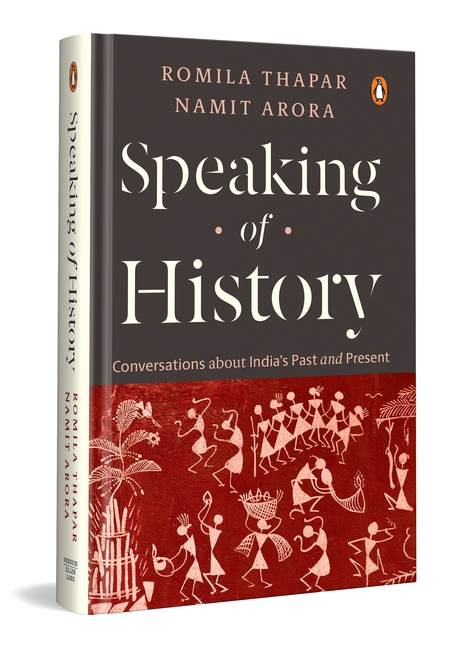
To an intelligent reader it should be clear that Bloch’s question arose from a child’s search for meaning amid civilisational collapse and impending crisis. Rowse’s from a teacher’s confidence in history as a pillar of post-war reconstruction. There can be several other motivations to ask that question. Romila Thapar and Namit Arora’s Speaking of History: Conversations about India’s Past and Present (2025) is one such.
In Conversations and in Silences
Over the last two decades, Romila Thapar has published several anthologies of reflective essays. The themes are unsurprising: they are the very questions that have animated her seven-decade-long professional career. Among them are the use and misuse of history, the myths surrounding the Aryans, the intrusion of religious fundamentalism into the study of society, and both the overt and subtle attempts by right-wing forces to distort Indian culture. She has also engaged in lively conversations with her intellectual interlocutors—whether in The Public Intellectual in India (2015), or in Talking History (2017), her dialogue with Ramin Jahanbegloo, joined at points by Neeladri Bhattacharya. Yet this raises a pertinent question: how is talking history different from merely speaking of history? The distinction matters, especially when Namit Arora is neither Jahanbegloo, nor certainly Bhattacharya.
Speaking of History has its making in two key motivations. Thapar finds the origins of the book in the question about “why history is so misunderstood in some circles.” For Arora, it was about understanding “the dismal state of popular history in India” which he sums up as “evidence-free assertions, a deep suspicion of academic historians, and its troubling infiltration into school textbook.” It seems we are back to the Bloch-Rowse distinction we started with. To seek meaning in history is to confront the human condition; to instrumentalise knowledge is to reduce history to a weapon, a slogan, or a utility.
What readers ultimately encounter is less a revelation of Thapar’s ideas—many of which she has clearly articulated elsewhere over decades—than a revealing map of Arora’s own intellectual trajectory. His assumptions, preoccupations and ideological niche emerge sharply through the framing of his questions and the texture of his interventions.
Across 24 chapters—uneven in length and depth—the book traverses a wide intellectual terrain: the beginnings of historical scholarship in India, historical method, Marxism and historiography, gender, caste, civilisation, the “conservative turn”, the integration of Islam into Indian society, and much more. For our purposes, we will speak of silences in the book.
Who Listens to Historians?
In many of her works, Thapar has drawn upon Max Weber’s ideas of authority and legitimacy to examine how political power in early India sought social sanction beyond mere coercion. Weber’s distinction between different forms of legitimacy, especially traditional and charismatic authority, enabled Thapar to analyse kingship not simply as political domination, but as a negotiated social order sustained through ritual, lineage, Brahmanical endorsement and the production of normative ideals such as dharma.
In a similar vein, in the Weberian sense, the legitimacy of intellectuals may derive from multiple sources: institutional authority (universities, academies, archives), charismatic authority (public stature, moral courage, originality), or even traditional authority (civilisational inheritance, canonical status). Much like kingship in Thapar’s work, intellectual authority is socially produced and historically negotiated. It must be continually performed, defended and renewed.
However, Arora never engages with Thapar in the book on why intellectuals like her has found herself being challenged, both as an individual and as a social class, time and again. After all, there is a truth-claim that the moment intellectuals cease to persuade and begin merely to proclaim, legitimacy weakens and authority hardens into posture. The book is replete with postures and proclamations about the “right-wing,” and in many cases the observations are factually grounded. But where is the persuasion? Chapter after chapter, what Thapar and Arora present as the public controversy over Indian history, the inferiority complex of Hindu nationalists, or the pervasive absence of a “historical temper,” is asserted rather than interrogated. Causes are presumed, not examined through the discipline of doubt.
Would it not have been more pertinent to ask Thapar about the “change and continuity” within the larger Nehruvian project of secular education? A project in which she was not merely a participant but one of its most influential intellectual architects. Did the attempt to create secular citizens through secular histories succeed, fail or transform into something altogether unintended?
Questions and their Incertitude
In one of the chapters, Thapar embarks on an extended discussion of Marxist historiography through the examples of gifts and dāna, yet a lay reader may still be left wondering: what precisely makes some form of history writing “Marxist”? Surely, the writing of economic or social history alone does not make a historian Marxist. How then do Marxists approach the past? Is there even a single Marxist method of history writing? These are questions that demand clarity—especially in our present (anti-)intellectual climate.
But the discussion never quite arrives there because neither Thapar nor Arora ventures beyond zones of intellectual comfort. The probing unease that could have sharpened the conversation remains absent. This was precisely what Talking History (2017) often managed to avoid, thanks to the meticulous and threadbare interventions of Neeladri Bhattacharya.
One more example: In a chapter jocularly titled ‘The Silence of the Academic Lambs’, Arora seems very clear that academic historians do not play a greater role in “resisting and critiquing the appalling quality of popular history.” Thapar think the silence of academics is partly because of sheer public abuse they face, and the state’s repressive measures do the rest. Fair enough. But the alternatives of “right-minded” and not “right-wing” YouTubers that Arora flags as optimism in the present, easily tends to forget interventions like Arvind Narayan Das’ India Invented (1999) or Bipan Chandra’s The Epic Struggle (1992) in the good-old Doordarshan days.
The problem of academic silence on contentious issues is not merely one of “Hum kyu phasen usme? (Why should I get entangled in that?)”, as Thapar puts it. It is something far more unsettling. The university culture that Thapar helped shape once imagined itself as a paradise of praxis. It produced a hybrid figure—the activist-academic—scholars who not only wrote texts but also appeared at the barricades of political movements. How, and why, these activist-academics eventually chose distinctly “bourgeois” disciples to inherit and administer the very departments they had struggled to build remains a kind of gothic mystery of Indian academia.
In the end, let us return to the central concern of public history. Robert Kelley (1925-2003), who is often credited with coining the term, defined it succinctly: “Public History refers to the employment of historians and the historical method outside of academia.” Yet the social and economic realities of Indian academia are far too uneven for such neat formulations.
How am I to expect uniformity, standardisation and the nationalisation of history writing, sitting in sub-national and vernacular Odisha—the very project that Thapar and her intellectual co-travellers championed under the aegis of the New Delhi state in the 1960s and 1970s? And if the making of academic history itself resists a single template, how then can one reasonably expect a one-size-fits-all public history?
In Bloch’s Apologie, the last chapter, on historical causation, ended abruptly: “In history, as elsewhere, the causes cannot be assumed. They are to be looked for…” Perhaps, interventions such as Speaking of History could stop assuming the causes and look for them outside academia. They might find that universities in society have similar battles with social forces, as history has with its publics in India. What do we do about it?