Book Review | Inside “Grammar of the Void”: Stories of Trauma, Dreams, and the Darkness Within
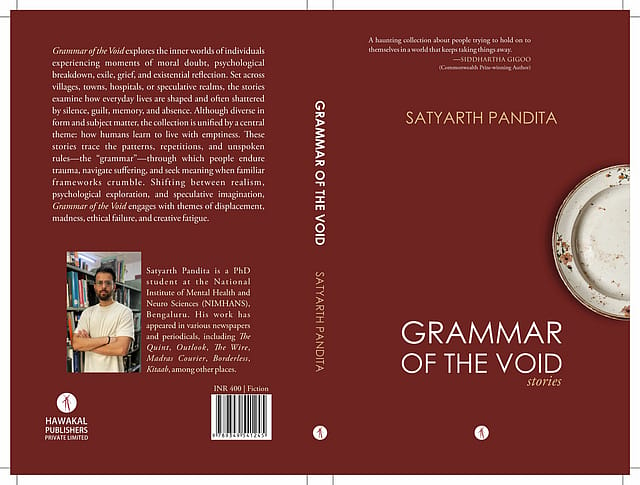
Grammar of the Void is mesmerizing, unsettling collection of short stories that navigates the terrain of existential human condition, of pain, separation, death, fear, memory, exile and the fragile architecture of human psyche.
Satyarth Pandita's writing is conventional but original, feels like a whiff of fresh breeze, not to be ignored, oscillates between parable and allegory, psychiatry and neuroscience, often slipping into the catastrophic and bewildering world of speculative fiction.
The grotesque imagery of Synapse is haunting. I'm reminded of Kafka, Sarmago and Laszlo, some stories read like that.
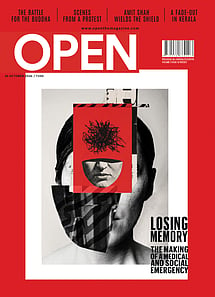
Losing Memory
16 Oct 2026 - Vol 05 | Issue 42
The making of a medical and social emergency
In Sarmagos novel, the entire town is swept by impenetrable white blindness and in Synapse, people are stripped of their ability to dream.
Imagine the consequence! The story begins with a haunting, surreal exchange of a writer and a one-eyed waiter, "What would you like to have, sir?" the one-eyed, bewhiskered waiter asked.
"A cup of coffee," the man replied, looking up and raising his eyebrows. Then almost as an afterthought, he added, "With a platter of dreams, please."
The old waiter looked at the gentleman with an expressionless face. His right eye was brown and milky, while his left eyeball was missing, leaving a void in his left eye socket.
Every time he opened his eyelids wide after blinking, a pale pink tissue became visible."
I'm still thinking of the logic bomb, designed to change the algorithm; targeting the synapses in prefrontal cortex causing a catastrophic failure that will shut the dream pod machine.
I'm thinking of the fate of that writer who was filled with terror after watching the hollow socket that replaced his left eye. What end do humans suffer in stories and in reality!
Denial is frightening, imagine a corpse putrefied, bones, skin, mangled to the bed and the husband tending to the wounds for past one week amidst the stench, the mania surrounding the house, the pitiable human condition, little girl watching the old man watering the wilted roses, all seems horrific, straight from a scene of Scorsese' Shutter Island, some indescribable dream, the body decays, the house stinks, this isn't just horror but a devastating metaphor for the loss of present and past, the psychic trauma of exile and memory.
In Piroutee - mutated flies move in large arcs or circles, then smaller circles, ending in exhaustion, death becomes an existential symbol reminiscent of Albert Camus' Sisyphus.
Professor Kumar contemplates on his own arduous futile life, ensaring him in his own spirals like spiders web, looks back at the years spent in the lab, relates that to his back breaking daily grind, randomness, human condition, fate, finding freedom in the movement of fly, the experience of not being free but the struggle to live, embracing the little demon, finding dignity in the struggle, just like Sisyphus condemned to carry that rolling stone to the heights and bringing it back to climb again, because there's no other way, to think otherwise, you're trapped, you are forced to reconcile with your present condition.
Betrayal exposes the fault lines underneath the forced exodus of the Kashmiri Pandit community when one brother fled the valley without informing the other, mistrust, fear ran amok, complete breakdown of the mental faculties of one brother because of the harbored guilt lying underneath, the brother and family that was left behind is killed by terrorists, the other in the camp goes through terrible dreams, cuts his own tongue, indulges in frenzied monologues, lives a harrowing life.
Other stories The Birthday Gift, Species of Sufferings, A Life for Sale are grounded in stark realism of daily life binding us, they are powerful explorations of the rot that's running deep in the society and the banal cruelty of circumstance, our obsession for longevity, immortality and the consequent encounter with the inevitablity of no escape.
The Bard's return is a story to meditate on, reflect, a moment of rare luminosity where revered poet Lal Ded is reimagined as a radiant young girl ending the arduous wait of devotees, reclaiming her lost verses, reciting them in her unwavering voice for eleven months and fifteen days with the event culminating in her luminous frame fading into the great tree.
Breath with interruptions is so relatable, ordinary yet profound, Aay suffers from belching, ignores the ailment, goes to doctor only to find that he hasn't been breathing correctly, problem is not with the stomach but with the way he breathes, the rhythm, the movement.
Avtar's story at the end closes the collection with profound loneliness, the gaping void, laying bare the tale of thousands of Kashmiri Pandit parents who died in camps, rented places, in their own houses waiting for their children to return from abroad, alien lands, the story itself becoming an emblem of abandonment, not just familial but civilizational.
Pandita's debut book laced with clean eclectic prose is an essential read which doesn't fail to capture the power of written word, conceives a universe of his own, strewn with people/characters/souls battling hope and despair, achieves its aim of keeping the reader glued to the last word.
(Sushant Dhar is a freelance writer based in Jammu)