Death of the Nation-State: What will replace the post-1945 world order?
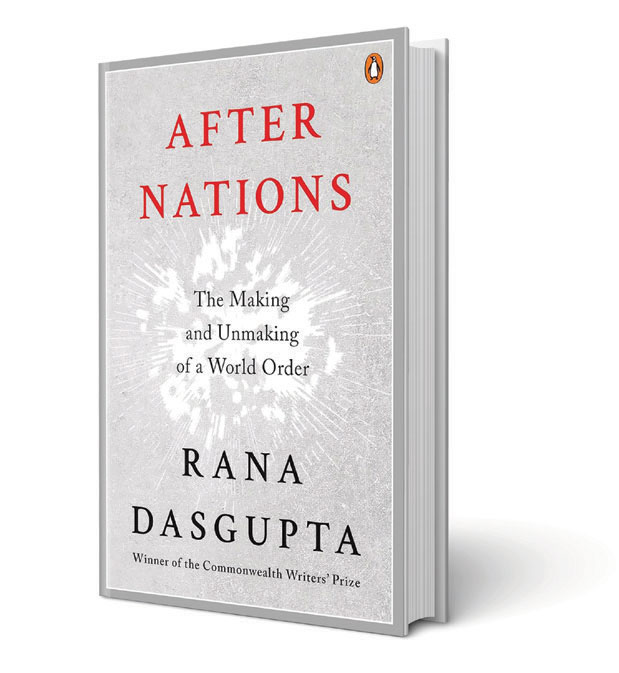
JUST AS META’S employees have no opt-out clause from every keystroke and click being logged to educate AI that will soon make them redundant, we, citizens of nation-states, have no choice either. “Whatever freedoms [the nation-state] offers are founded in [a] primordial unfreedom: we cannot not belong to a nation-state,” writes Rana Dasgupta—novelist, essayist and author of the novels Tokyo Cancelled and Solo and a portrait of Delhi, Capital—in his most ambitious work to date, After Nations, which is a sweeping intellectual history of a soon-to-die subject from medieval Europe to Silicon Valley built around four ideas that once powered and now threaten the world order: God (medieval France), property (England), law (the United States), and nature (China).
The nation-state, with its roots n the Peace of Westphalia (1648), acquired moral prestige after World War II because of the twin imperatives of protecting citizens and preventing another industrial-scale genocide fuelled by nationalism. Unfortunately, this exceptional period in world history “is well and truly at an end.” The system that sustained us through the Cold War and is now convulsed by chaos is incapable of solving the problems of human movement (migration), ecological challenges and wealth inequality, Dasgupta believes, while a few mega-companies with their technological copyright can undermine the system, jeopardising the survival of the species. Does the apocalypse seem nigh? Well, our “nation-state system has lost its Byronic pathos: in a remarkably brief period, its demented extraction from the earth, and from human minds and bodies, has caused the sensation of progress to be replaced with the anxiety of futurelessness.” How do we avert Apocalypse? Dasgupta argues that “we build back, in another form, our shrivelling systems.”
Losing Memory
16 Oct 2026 - Vol 05 | Issue 42
The making of a medical and social emergency
Synthesising theology, colonial property law, commerce, capital, empire, nationalism, climate change, and AI into a political narrative, After Nations impresses with its intellectual range and is written with a trained novelist’s self-confidence. It’s also a book for our time when extreme nationalism and Big Tech are threatening the structure of the state. To regain a future, we must first reconcile ourselves to the fact that the nation-state is contingent and not eternal. Perhaps it was never meant to last. Particularly insightful is Dasgupta’s reading of China—a continental empire whose survival depended on taming its rivers. Shaped by this need to control nature, China exports the philosophy and practice of exploitation. Its power cannot be understood without reverse-engineering ecology into imperialism.
It’s a damning thing to say an author’s heart is in the right place, being as it does a precursor to an admission of disappointment otherwise. Dasgupta acknowledges the ideas are not new and while the book is indeed a brilliant architecture of thought, After Nations stumbles on its prescription. The solution is reduced to a plea for humanity-wide inspiration. To build back and inject a new system with fresh political creativity, unconstrained by the nation-state, we must cooperate with others, respect nature, and be convivial. Given the scale of our crisis, surely we needed a more concrete blueprint? Nor does Dasgupta correctly examine tech-determinism, getting waylaid by the idea that tech giants would try to overthrow the state. That’s not how Mark Zuckerberg, Sam Altman or Elon Musk operates. Musk went inside the system to change it. Silicon Valley has long understood it’s far easier, safer and more economic to capture the state from within. Finally, tagging the four ideas to the four states is reductive. And bringing China into play doesn’t quite help the book escape the Eurocentric, orrather, Anglo-Americantrap.
After Nations is a compelling read, not least because the post-1945 global order, the very picture of post-nationalist yearning, is crumbling and we haven’t thought of a replacement. That’s a terrifying thought.