Uncle Joe’s Best Men: The human cost of the Cambridge Five’s ideological purity
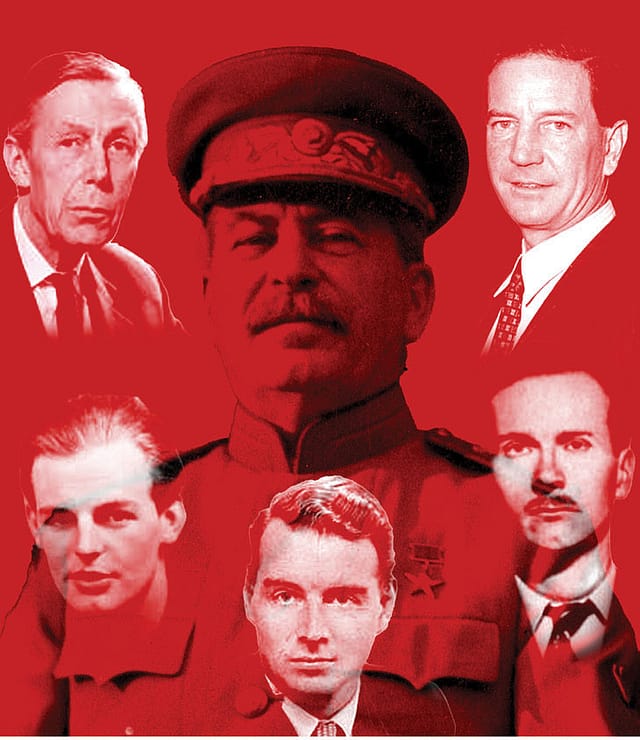
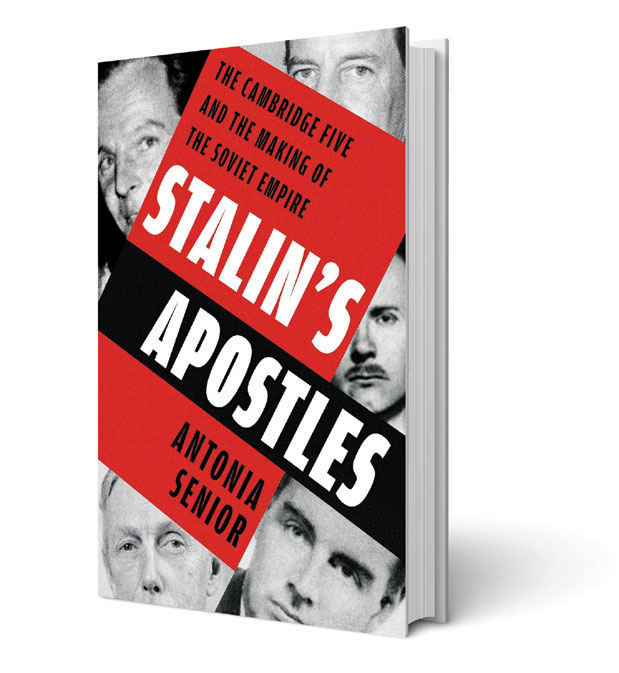
The OBVIOUS QUESTION: Who needed another book on the Cambridge Five? Kim Philby, Donald MacLean, Guy Burgess, Anthony Blunt and John Cairncross had seemingly been exhausted as a subject decades before Antonia Senior began her research on Stalin’s Apostles. Turns out, the book was necessary. The reason is in the subtitle. Without Philby & Co, Stalin might not have managed to build the Soviet empire.
The story of Britain’s most notorious spies—the ‘Magnificent Five’ in the KGB’s words—had been constrained by the framework applied to their lives and lies, what Senior calls the “chapocracy” of clubland intrigue, gin and state secrets, an incompetent but complacent establishment that couldn’t accept Eton or Cambridge could produce traitors, and so on. Senior, a journalist and former student of Christopher Andrew, pioneering historian of Britain’s espionage and counterintelligence services, instead asks why Stalin needed these five men. And what price was paid, and continues to be paid, for their betrayal.
Losing Memory
16 Oct 2026 - Vol 05 | Issue 42
The making of a medical and social emergency
Combining excellent prose with compelling storytelling, Senior scores high in exploring recently declassified material. But inherent in this strength is a weakness: while new files are being made accessible by the National Archives, it’s only a fraction of the thousands of documents the Five passed to the Soviets. This becomes a problem of causal logic as will be seen later. Even more significant is Senior’s placement of Stalin at the centre of the narrative—how his geopolitical need to expand communism prefigured the recruitment of the Five. They helped him win the war too. Cairncross provided intelligence vital to the Red Army’s victory in the Battle of Kursk in 1943. Insight into the disagreements between Churchill and Roosevelt made Yalta a walkover for Stalin.
The immediate human price was paid by anti-Soviet partisans in eastern Europe who suffered torture and death. Senior acknowledges that among such groups were also Nazi collaborators and fascists like Stepan Bandera in Ukraine backed by the British. But without the Five, the post-war history of what Timothy Snyder calls the “Bloodlands” might have been different. Nor would Stalin have pursued the atom bomb had the Five not made the case for a Soviet bomb.
The book is a delight to read simply for passages like (on Burgess): “Throughout his life, those who saw the angel wanted to arrest the fall; those who saw only the devil were repelled.” As for ‘chapocracy’,
there is a course in espionage social science waiting to be unveiled. The fresh disclosures reveal Anthony Eden, foreign secretary, was told in 1952 there was insufficient evidence to prosecute MacLean and Burgess, who had defected in 1951, were they to return. Or that MI5, anxious to avoid embarrassment and earn American ridicule, made Blunt, whose Soviet allegiance would be made public by Margaret Thatcher in 1979, persuade an unhappy Burgess not to come home from Moscow in 1959. Again, the Foreign Office’s Sir William Strang told Whitehall in 1952: “If we want to avoid embarrassment, the best course would be to let him [Philby] slip away.” Philby’s ‘slipping away’ from Beirut in 1963 remains murky.
Unfortunately, such archival novelty runs into an evidentiary wall. Without access to the Russian archives, we can only infer that X or Y died at the hands of Stalin’s executioners because of the Five. Members of Cambridge’s elitist Apostles, the Five were British communists, not Russian. And yet, they were blind to the already growing evidence in the mid-1930s of the ugliness of the first communist state. “The Marxists in the Apostles club just chose not to look. Who would choose to tarnish that radiant vision with facts?” Thus we ask, “What was the human cost of their ideological purity?” when another Russian dictator still dreams of rebuilding the Red Empire. Putin, after all, venerates Philby.