Power Play: Karan Mahajan turns an expansive family drama into a searing political statement

IF KARAN MAHAJAN has a to-do list for his India trip, enduring jetlag doesn’t seem to be on it. Less than a day since flying to Delhi from the US, the novelist is bright-eyed and chatty, and delighted to be back in the city where he grew up and where his parents still live. What features in his list is catching up with old friends. “I studied at Modern School, Vasant Vihar, and my friends do things that are very different. They’re business people—one has a transport business, another has a hotel, someone runs a car parts business,” he says. “To me, it is a window into this part of Delhi that I obviously have nothing to do with any more. So I look forward to hearing their stories.”
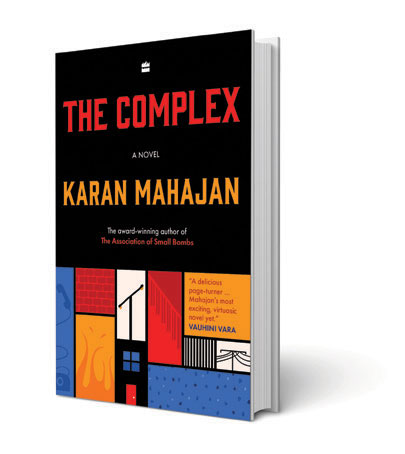
A family and friends reunion isn’t Mahajan’s only goal for this trip. A decade since his second novel, The Association of Small Bombs (2016) found critical acclaim and a place among the finalists of the National Book Awards in the US, he is back with a new novel, The Complex (Fourth Estate, `799). We are sitting, armed with hot and iced coffee, at Delhi’s Kunzum Books, host to the book’s launch in the city followed by a multi-city tour across Mumbai, Bengaluru and Chandigarh. If The Complex arrives 10 years after Mahajan’s last novel, its plot time-travels approximately the same amount of time into the past. Set in the 1980s, it follows a joint family in Delhi whose members—descendants of a grand patriarch who was one of India’s foremost political architects—wrestle for influence and validation.

Losing Memory
16 Oct 2026 - Vol 05 | Issue 42
The making of a medical and social emergency
“When I was writing The Association of Small Bombs, which was set in Lajpat Nagar and surrounding areas, I was already writing obliquely about bourgeois Punjabi Delhiites,” Mahajan says. “I realised that I wanted to explore that world in greater depth.” The thought mingled with the idea for another story—a woman living in the US who wants to return to India but isn’t able to. It soon became clear to him that this was destined to be one novel—a multi-generational family drama set in the fictional address of A-19, Modern Colony in Delhi.
Much like joint families, The Complex is teeming with characters. SP Chopra, one of the minds behind the Constitution and a former Reserve Bank of India governor, has left his children a sprawling home in Delhi and a legacy so looming that everyone falls short of living up to it. As others come and go, the novel revolves around a few key characters. Gita, married to Sachin (SP’s grandson from one of his nine children), suffers the family’s worst behaviour; as newlyweds, she and her husband see US as their key to a better future but life tosses them back inside the complex. Sachin’s brother Brij is a romantic with a vicious temper, toxic traits that propel his wife, Karishma, on a self-destructive streak. Vibha, one of SP’s daughters, has her own questionable means to maintaining family equilibrium. And then, there is Laxman, SP’s youngest son, married to Archana and father to two girls who exerts a damaging power at home to compensate for his failures outside it. Their stories are narrated by Mohit, Brij and Karishma’s oldest son. “He brings together all the threads of the novel at the end. He is the next generation of Chopra who is reacting against the sins of the previous generation, but doesn’t know how to do it through communication,” Mahajan says. “In fact, no one in the novel knows how to communicate with anyone else. That’s the central problem and so he does it through this political action. He’s only dimly aware of the consequences and that leads to a cascade of other things that causes the family to fall apart.”
Power asserts itself in The Complex through family feuds, petty politics and violence—physical, emotional and sexual—and lays the groundwork for Laxman’s political ascension. The family saga becomes a reflection of the nation’s politics and ideologies. “It’s a political novel that only gradually shows its hand,” he says. Some may read The Complex as a political novel and others may think of it as a family drama. “It’s both those things, and it was somehow more true in my mind to how politics slowly invades our bloodstream and how people become radicalised or politicised over time. That’s something I’m interested in—both with the last novel and this novel—how people develop ideologies. A novel would never begin, in my case, with someone wielding an ideology. It would always be about someone becoming ideological.”
To Mahajan’s credit, he transforms the layered family dynamics, bleak incidents and even tragedies into a page-turner. Starting in bits and pieces from 2016, he has constructed The Complex with enormous research. As a young boy, the author recalls the Mandal Commission uproar but he tried to understand the perspectives of privileged college students from higher caste brackets who participated in the protests—like Mohit in the novel. He explored reformist sects of Hinduism and interviewed Indian immigrants from the 1960s and 1970s about their experience. “What I was really struck by, when interviewing Indian immigrants from that period, was the difference between the experience of people of my generation or the ones before,” he says. Mahajan recalls conversation where people said they never experienced racism. “I don’t think that is true. But I also felt like if that’s what they are saying, and choosing to believe, I have to kind of give it some credence,” he adds.
Much of the novel revolves around women—Gita and Karishma, as well as Archana and Vibha, their lives intersecting with each other through kinship and bitter differences. They are characters at the receiving end of the family’s gravest injustices and their own dubious choices, framed by the bigger burden of being women in a patriarchal society. Gita copes with loneliness and unexplained infertility but what upends her life further is a sexual assault. Karishma tries to find her way out of a loveless, violent marriage with choices that can only culminate in a tragic ending. These stories led Mahajan to conversations with medical experts and therapists, reading about survivors of sexual violence and trying to understand how women in the ’80s may have negotiated these challenges. The research, he notes, was enriching. “It was good knowledge for me to have as a man. Even if I’d done these characters badly because I’d have learnt something that I didn’t know before,” he says.
Learning is part of Mahajan’s everyday life, not only as an author but also as a teacher. He is associate professor of literary arts at Brown University, teaching—among other courses—a module on Innovations in Indian Literature. He is pleasantly surprised by “the persistence of reading as a habit”, seeing his students picking up books, wanting to write. “I don’t get the sense that the novel is dead,” he says.
Mahajan was born in the US and now lives there. Yet, Delhi remains a leitmotif in his novels, which he attributes to the power of his childhood years he spent here. The city today is a different place— family structures have changed and so have the feelings of its residents, particularly younger generations—but it still resonates with the author. “I have ability to enter it culturally that I still don’t in the US,” he says, speaking of an intrinsically immigrant experience. “If I walk around a city in the US, I’m still a stranger in a strange place. I think I’ll keep exploring that feeling, vis-a-vis Delhi.”
Marking a shift in his writing practice, Mahajan is “finally writing more about the diaspora”. There are new ideas brewing or, as he quips, “several novels in various states of incompletion”. This ranges from migrant stories—Sikhs moving to Canada or Ismailis from Africa coming to the US—to Indian tech among his many areas of interest. “I hope one of them will stick and become a novel.” Among other recent non-fiction, a story on Hardeep Singh Nijjar (published in Granta last year) took him to radical gurdwaras in Canada. “I really like travelling for reporting,” he says. “It’s something I want to keep doing more of because I love talking to people.” It is also another way to keep writing. When he is not working, Mahajan’s four-year-old daughter keeps him busy and occasionally makes him wonder if he could write differently. Mahajan is always thinking of words he can put on page, worlds he can build. As he says: “I’m not a full person if I’m not writing or teaching.”