What The Unmasking Of Banksy Will Mean To His Legacy
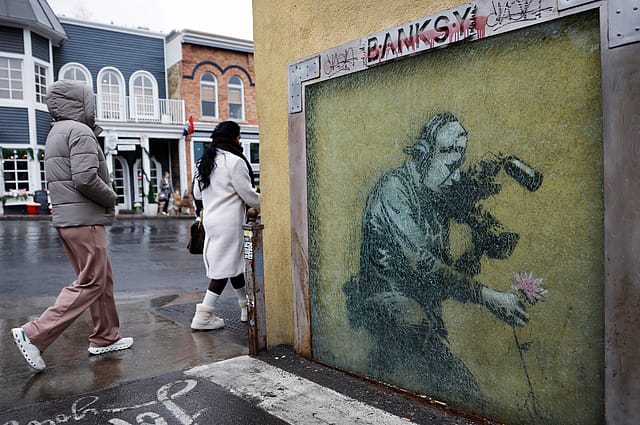
An artist’s name and backstory play an important role in the way we value his or her creations. Vincent van Gogh may have sold almost nothing when he was alive, but in the fame that followed after his death – achieved by no small contribution from the publication of the letters he exchanged with his brother that helped present the story of an intense and dedicated painter who died young – just having van Gogh’s name attached to a painting drove those works to rank among the most expensive and culturally iconic works in history.
The appeal of the street graffiti artist Banksy worked a bit differently. It wasn’t the presence of a name, but rather the absence of it. Banksy was a pseudonym under which to hide his backstory. It was of course necessary since his works were at the end of the day also acts of vandalism. But this anonymity also helped build his mystique and brand.

Zeroing In on ECI
09 Oct 2026 - Vol 05 | Issue 41
Constitutional legitimacy versus political opportunism
The conversation around Banksy is coming to the fore because the news agency Reuters, following a lengthy investigation that took them from Ukraine to London to New York, recently unmasked his identity. The famed guerrilla artist, it turned out, was a bespectacled, middle-aged man from Bristol named Robin Gunningham. The revelation wasn’t entirely a surprise to those who have been closing following the pursuits to decode Banksy’s identity. A British tabloid had linked Gunningham to Banksy about two decades ago.
The latest revelation however does jeopardise the future of Banksy and the value of his works. The subterfuge was of course necessary. Since his work can be viewed as acts of vandalism, the police could, if it knew his identity, prosecute him. But then there was also the way this anonymity lent him an air of mystique and glamour. His works would appear overnight and without warning, on drab public streets and buildings, the subject usually politically-charged, either challenging authority or mocking consumer culture. It was meant to go viral, even before social media virality became a thing.
Banksy is believed to have emerged from the graffiti underground in Bristol and London in the 1990s, but by the mid-2000s, his work began to pop up in cities all over the world, attracting a media frenzy and legions of fans. As his myth grew, so too did the money his artworks commanded, and auctions of his works routinely fetched astronomical sums. Banksy also did take a lot of effort to maintain his anonymity, from getting those in his inner circle, as is rumoured, to sign non-disclosure agreements, to having his company, the oddly-named Pest Control Office, be responsible for authenticating his works. He even changed his legal name from Gunningham to David Jones, it turns out, according to the Reuters article, after a tabloid had previously outed his identity.
Some have suggested that since he had already been outed once before, perhaps the public continued to play along because they wanted their favourite street artist to remain anonymous. Best to believe your anti-establishment artist is an unsolved riddle than to admit that he is really a middle-aged lad from Bristol.
This time, however, the veil of anonymity has been yanked off a bit too forcefully to ignore. The mystery of his identity has been central to his mythology. Now it is gone.