The Alchemist in Blue: Designer Shani Himanshu gives slow fashion and traditional crafts a chic spin
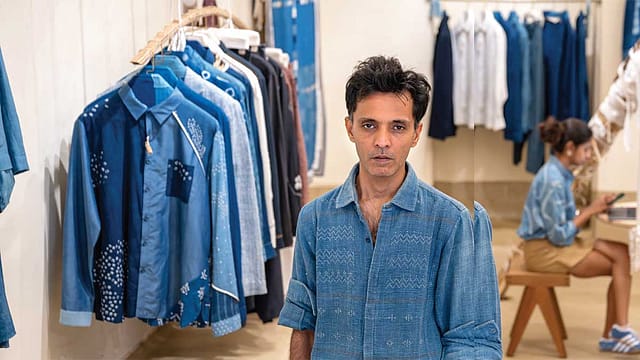
SHANI HIMANSHU’S fingernails are always stained a faint shade of blue—coloured by the hundreds and thousands of times he has dipped his hands into an indigo vat. Sometimes known as ‘blue gold’, indigo has been part of India’s material culture and crafts traditions for centuries, arguably millennia—its extraction passed on as generational knowledge among communities and families. Much of the early use of indigo in other civilisations is believed to have come from this region; so precious and lucrative was the dye that colonial rulers tried to coerce its cultivation and extraction, leading to the Indigo Revolution of 1859. Close to two centuries since, indigo has again captured popular imagination for its rich hue as much as its eco-friendly values. But while many profess a love for indigo, Himanshu has dedicated years of hands-on engagement with the dye with both R&D and design innovation. Little wonder that that 11.11/eleven eleven, the label he founded in 2009, and helms with business partner Mia Morikawa, is often identified by its many shades of indigo chic.
Vats of indigo, and other colours, are a common sight at the headquarters of 11.11/eleven eleven (located in Delhi’s Okhla neighbourhood), a brand that has become a quiet favourite among crafts-loving fashion buyers as well as famous faces over the years. Yet, it is surprising to see indigo vats also set up at the brand’s new flagship store, tucked among boutiques, restaurants and old-school stores in the city’s popular Lodhi Colony market. It piques consumer curiosity but the display serves a greater purpose. “We wanted to bring an indigo vat into the store, and it is actively in use. People will do store work but they will also take care of the vats through the day and keep dyeing,” says Himanshu, adding that such vats can be nurtured to last longer than human lifespan. “Dyeing is quite meditative as a practice, so how can such practices come into an active store experience?” The intention is to make people who work with the brand part of the process. He says: “When selling a garment, if you know what it takes to make it, the dialogue is different.”
We are meeting at the new store a few days before its formal opening. Himanshu, dressed in an indigo shirt from the brand, moves through the store, talking about its different features while supervising finishing touches. He has a quiet, thoughtful demeanour, letting his work do the talking—and everything from the store design to the seams of a garment have stories to tell. The 11.11/eleven eleven team has approached store-building like mounting an art exhibition—skipping shutters and window displays; carving out walls to create niches for display; building a detachable bamboo cantilever arch that looks like an installation but serves as a partition for the space; using craft, colour and minute details as hat-tips to the brand’s creative grammar and philosophy. Himanshu has collaborated with architects for the space, as well as an agro-waste company to replace plywood with sustainable boards, a glass artist to create floral hooks and terracotta sculptures to make small figures that are sprinkled across the space holding miniature vats of dye—expressing the brand’s processes while also offering visual fodder for Instagram.
THE MAKING OF the store echoes Himanshu’s design philosophy and his distinct perspective on reimagining Indian crafts for a contemporary, global market. Himanshu notes that it is often organic products that must be highlighted and labelled to present its credentials. “Clothes have to be made in the purest way possible—it can’t be harming the body. But when we are making clothes, we can’t write everything about how it is made,” says the designer. “First, you need to love a design. Then, where it comes from and what it is—if the wearer wants to know more. Keeping this aspect in mind, there was always a question of how we tell the story. If we are not talking about a product being organic or naturally made, then the space and materials need to speak for it.”

Growing up in Gujarat, Himanshu studied at National Institute of Fashion Technology (NIFT) Gandhinagar followed by a degree at the Domus Academy in Milan and worked at brands like Diesel before launching the brand as 11.11/eleven CellDSGN (many industry seniors and older clients still call it CellDSGN) with Morikawa subsequently joining as partner and co-founder. The brand’s appeal has been, since its early years, rooted in the emphasis on natural textiles—handspun and handwoven—all naturally dyed, and incorporating crafts such as bandhani and shibori tie-dyeing, Tangaliya weaving and kantha embroidery among others.
The world of 11.11/eleven eleven is immersive, with its team firmly invested in learning and working closely with the people and processes that contribute to product design. Natural dyeing, both an art and a science in its own right, is integral to the processes. Himanshu helms this aspect of the brand with Adheep AK, who oversees research into colours and also trains team members to learn the craft. Today, the brand has an extensive lineup of indigos, going from pastels to intense midnight hues. The natural dye repertoire extends beyond the blues, into every colour in the shade card, using ingredients that range from pomegranate shells, harda flowers and madder roots to alum and rust. Years of hard work has gone into these innovations, observes Himanshu. “We have worked with a lot of natural dyeing artisans across the country for many years. But there were always questions to be resolved. People often say that natural dyes are high-maintenance—it bleeds and rubs,” he says. “So we started doing it ourselves, with a lot of R&D and came up with answers—natural dyes that will not rub, the darkest of indigo, colours that will last longer.”
IF ITS ENGAGEMENT with crafts is deep, the brand’s designs are contemporary and global—designed with an eye on everyday living. Think anti-fit topwear and dresses which seem to float over the body, jackets and pantsuits that seek equilibrium between quality construction and relaxed fit, handspun denim that imbues an Indian artisanal language into jeans,. “There are classics we keep refining and new designs that we add to each collection. For example, our bandhani is a classic, but we come up with new patterns. We apply different textiles and crafts on the same styles of garments. The artworks change with seasons. But we also keep the old designs— for us, they are as new and seasonless.”
Over many seasons and collections, the brand has added new materials and products to the mix. Step into the brand’s store, or browse online, and one comes across home goods, stationery and even games. Materials such as bamboo have become part of the material repertoire, and Himanshu speaks of working with a 75-year-old artisan who made Raavan effigies to develop new designs. Among other innovations, Himanshu and his team have developed an indigo paste— showcased at Goa’s Serendipity Arts Festival in 2024, it can be applied to printing and the brand is working with artists and artisans to explore potential uses.
The clothing and other products have found an international appeal—India and the US (where Morikawa lives) are among 11.11/eleven eleven’s biggest markets though the brand also has a retail presence in Japan and Europe. It finds appeal among everyday consumers as well as celebrities, from entrepreneur and investor Nikhil Kamath to actor Dev Patel. Kamath may have a lot to do with increased awareness of the brand—a repeat client, he often speaks fondly about the designs and has worn the label on his podcast including a particularly popular episode with Narendra Modi. But 11.11/ eleven eleven’s biggest Internet-breaking celebrity moment came last year when Hollywood star Brad Pitt wore one of the brand’s indigo-dyed Tangaliya shirts in his hit film, F1, shining a spotlight on the traditional weaving technique from Gujarat.
The brand has always engaged with artists and creative practitioners who “are doing something meaningful with their work”, even bringing them into runway shows as models. But a strong celebrity endorsement hits different, especially when it is a star like Pitt. It does not turn attention only on the label, but on the craft too—that, Himanshu says, is where the impact lies. “This brings the recognition and opens up a world for the craft. Even today, Tangaliya artisans have photographs of Brad Pitt wearing the shirt,” he notes. “Many brands have also started building collections and Tangaliya got a boost.”
Slow fashion takes time to bloom. Over two decades in the business, the brand has worked to create timely designs and collections, in tandem with international calendars, while working with crafts. “We have spent 16 years working and it has helped us to understand what is possible, how to do it, which teams to deploy—there’s a system designed for it,” he says. “Now the question is: can we do it consistently? Can we build around it? Can we scale it?”
Himanshu rarely measures his label's success in terms of a collection or design. It emerges in subtle milestones—in a tie-dye dot or an expected shade of dye, in combining bandhani with Kalamkari, in working with artisans, in technical mastery and design problem-solving. In this designer’s heart and head, a life well lived is a constant “learning process”.