Mehfils are drawing new audiences across India to Sufi music and live performances
On a warm evening in April, the lawns of The Upper HSE by Tivoli in Delhi were filled with guests so opulently dressed that many might have thought they were attending a wedding. In fact, they were attending a mehfil hosted by IBTIDA-Ek Mehfil, and dressed for it, as befitting the old tradition. In front of the stage, white-upholstered mattresses with dark velvet bolsters covered the floor, so people could recline on them. As the announcer for the evening said, it is also the tradition for listeners to sit on the floor, so they, as fitting, are seated lower than the artist.
Rekha Bhardwaj, a singer acclaimed for her Sufi music and ghazals as much as her Bollywood numbers came on stage alongside the accompanying band. She wryly commented that the audience must all be very fit to sit on the floors. She added, “This setting, with these mattresses, takes me back to my childhood, when mehfils would go on all night at my home.” Before starting the evening, she asked the audience to have a moment of silence for the late singer Asha Bhosle, who had died earlier that day. The thunderous reception to her renditions showed how eager audiences are for evenings of classical entertainment.

Losing Memory
16 Oct 2026 - Vol 05 | Issue 42
The making of a medical and social emergency
Some might say that the tradition of mehfils and baithaks, where a gathering hears a performance of classical music, or Sufi music or poetry, is outdated. But as the growing number of gatherings, concerts and festivals across Indian cities indicate, it has never been more popular. IBTIDA-Ek Mehfil, which hosts events of mehfils and baithaks, music, poetry, art, and Sufi music, has seen their success story only grow over the years. As Tanvi Bhatia, who founded IBTIDA-Ek Mehfil with Anubhav Jain, tells Open, “There is an immense appetite for these kinds of mehfils and baithaks. When we started in 2019, it was just us and two or three bigger IPs in this space, apart from some senior veterans in the industry. Now, mehfils are happening everywhere, even in restaurants. Audiences like these experiences”. This is indeed the case. The last two months alone have seen several musical events as well as in cultural festivals of these, particularly in the national capital. IBTIDA-Ek Mehfil have also been hosting evenings in other metropolises such as Mumbai, and more recently in Hyderabad featuring the Sufi qawwali ensemble Nizami Bandhu.
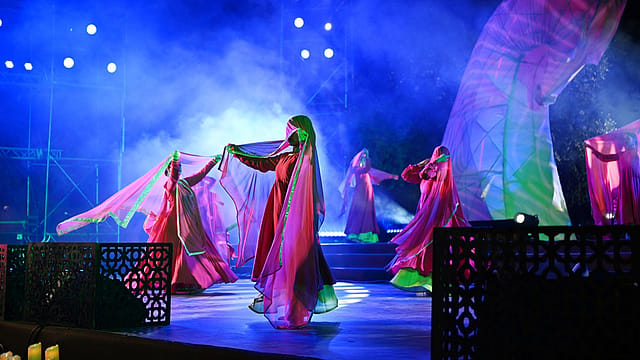
In March, many Delhi residents flocked to the 26th edition of the Jahan-e-Khusrau Sufi music festival. On its first day, there were long queues for the main music event, at the mehfil arena, where two 20-foot white sculptures accessorised on the stage. Two horse heads, their long necks curved, faced each other. They dwarfed the stage, and lent a whimsical note to the event. Architect Meera Ali, elegantly dressed in white, waved her hand towards the giant installations saying, “This is a new concept for this year, ‘The Steed of Longing’, as this is the year of the horse. Muzaffar has created these stages, and these horses. It is a new phase of Jahan-e-Khusrau,” she said.

Ali and her husband, filmmaker and cultural revivalist Muzaffar Ali, are the duo behind the festival. Muzaffar Ali, his wife explains, has been on the Sufi path since 1989, since he started his film ‘Zooni’ on Kashmir. “When we settled in Delhi afterwards, that stayed with him and it developed into this movement, dedicated to taking Sufi music forward and it is a music of love and surrender.” The performances on the first day included an intense, haunting fusion piece by a collective of artists around the world including Sina Fakhroddin, from Iran and Frenchman Loic Sanlaville. Other highlights of that evening included a dance led by acclaimed Kathak virtuoso Sanjukta Sinha and a performance by the Lakhwinder Wadali who sang of the Sufi saints on stage. Another was a dastangoi performance by Syed Sahil Agha who kept up a lively, engaging recital, ranging from Amir Khusrau to Nizamuddin Auliya. Ali comments that when she and her husband started this festival back in 2000, people didn’t really even know what Sufi music was. “The Jahan-e-Khusrau in its way has been such a trailblazer, that today there are so many other festivals of its kind,” she says. “Now everyday there is a Sufi festival or a Sufi concert.”
One such festival is already extremely popular. The Sufi Heritage Festival in Delhi hosted its second edition this year, and is already a favourite among locals. Founder Yasmin Kidwai, filmmaker and a former Municipal Councillor, had conceptualised it as a festival specifically for the city, along with cofounder Himanshu Anand. “I was looking to see what could best represent Delhi,” she says. Her answer was “the spirit of Sufism”. As I understand, it is a state of being which allows you to be without borders. Delhi is that state,” she says, adding that there is such a huge resonance, because while Sufism lets you be, it’s also very community oriented. It brings people together.
There are two stages in the Sufi Heritage Festival: Bebak, and Sama Mehfil. Kidwai explains, “Bebak means fearless. It was deliberate, to connect with younger indie artists and give their own interpretation of Sufism.” On the other hand, Sama Mehfil focuses on practices of recollection through music and spiritual performance. In the latest edition, playback singer Sona Mohapatra, demonstrated through musical performances, how Sufism and Bhakti are not so different from one another, and what these musical traditions meant to her. Singer and songwriter Daler Mehndi also performed, but returned to his Sufi roots instead of doing his popular Bhangra act.
The setting of such events also has a great deal to contribute to the experience. The Sufi Heritage Festival was held at Sunder Nursery. This, Kidwai explains, was a deliberate choice. “You have the Nizamuddin Darga on one side, the Damdama Saan on the right side, and Rahim’s Tomb in front of it. There is the whole Indraprastha city angle. The whole junction of this place was very symbolic for us.” Located in the same complex as Sunder Nursery, Humayun’s Tomb had earlier served as a venue for editions for Jahan-e-Khusrau. Ali said, “We were there for 20 years, and it was the perfect venue. I think we outgrew it because it was limited to 2000 seating. We didn’t want to go into a stadium format, as we wanted to keep it intimate and personal. But 1,500-2,000 seats weren’t enough and we had to expand.” However, the Jahan-e-Khusrau’s current venue—Purana Qila, with its ancient, sprawling grounds, and flowering trees, makes for a fitting backdrop to the event.
Bhatia agrees that the charm of heritage monuments is important for mehfils, and other traditional music events and festivals. “Last year we were in Safdarjung’s Tomb. We wanted to move away from auditoriums and big stadiums, to these heritage spaces which are more intimate, like havelis and old courtyards.” Another notable aspect is the real enthusiasm and appreciation among the audience, as well as the variety of people in attendance. Contrary to those who may say that attending mehfils and listening to Sufi music belongs to a niche or even an older audience, many of the youth and Gen Z have taken to these traditions. Bhatia says, “One reason for starting IBTIDA was that we wanted to bring back the old-world nostalgia, and at the same time make it accessible to the younger audience, where they understood they understand the culture and the music.”
Delhi has always had a culture of mehfil but Bhatia argues that this is the first time it has been glamorised in India. “There has been a huge shift in the music industry, not only for mehfils and baithaks. There is now something for everything, from those who want the smaller, more intimate formats, to those who want something on a larger scale.” Kidwai gives her perspective on this recent change, saying, “I think that post Covid, there is a craving for community or gatherings, for having connections. This is a lasting shift.”
Rekha Bhardwaj agrees to this sense of a shared experience. “Beyond the performance, it is the act of sharing, of music, love. I feel that artist and listeners are all on one wavelength.” The tradition of holding mehfils, and holding big stages to listen to Sufi music, is popular again as it evokes nostalgia, and brings people together in an intimate space.