Party of One: Dining and Drinking Alone In India
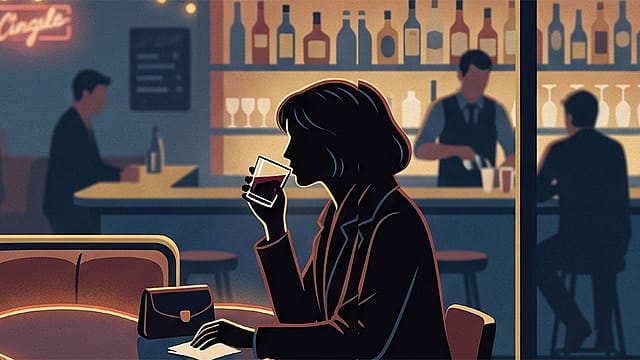
ON A TUESDAY EVENING at Lupa on Bengaluru’s MG Road, Pooja R, a 36-year-old marketing manager, sits alone with a glass of red wine. She is watching people cross the room and meet up after work, the city shedding one version of itself and picking up another. She takes herself out every other week, or when the pressures of work and domesticity build past a certain point, and lingers until she is ready to go back to her life. “When I dine alone, it is the only time I express my true choices, without thinking about what others would like,” she says. “The cuisine, the pace, the kind of space.” Late last year, she was between jobs. She found herself going out alone a lot, sitting by herself in public and insisting that she deserved a good meal regardless of circumstances. She was also working something out—what she wanted the next chapter of her life to look like, what she owed herself. In the noise of other people’s evenings, she could finally hear her own thoughts clearly.
Solo dating, the practice of taking yourself somewhere nice without occasion or apology, is gathering steam in India. It is not about loneliness or an absence of options. It is about the particular pleasure of your own company, at a restaurant, a bar, a movie, a museum. In the week we reported this story, one of us in Bengaluru, the other in Delhi, we went out alone and called it work.
The Bengaluru evening was at one of the city’s top cocktail bars, Muro. It was Saturday, and the room was full. At the counter, bar manager Debdyuti Majumder rolled her eyes at a devoted drinker’s off-menu order but mixed it anyway before getting started with the writer’s order, The Good Apple—gin, green apple, yuzu, jasmine, cucumber. Satish Shankar, the head of the bar, recommended the turnip cakes without hesitation, saying he would eat them himself if they didn’t hit the spot—and they did. When the drink arrived, the riboflavin glowed green on top of a coaster studded with LEDs, instantly turning heads. One of those heads belonged to Stalline Andrade, a 33-year-old seated three stools away, martini in hand.
Back after two months away under his nutritionist’s orders, Andrade wanted to know why someone had ordered a “morning drink”. The inspiration was, in fact, a yuzu Negroni consumed at the legendary SG Club in Tokyo. Andrade works for a consultancy, but if you listened to him discuss carbonation pressure, the pour sequence and garnishes, you’d mistake him for a mixologist. In fact, one of India’s best-known mixologists has promised to present him with a ‘Fernet Coin’, the bartending fraternity’s secret token of recognition, first minted in San Francisco as a ritual between bartenders sharing a shot of Fernet-Branca at shift change, a way of saying: I see you, I know what this life is. Not that Andrade has ever worked a shift behind a counter. But two years of solitary attendance have folded him into the bar's institutional memory here. People like Andrade, who have been sipping their way into the cocktail canon at the city’s best watering holes, swear that the best drinking companions are the ones who actually make the drinks. “I only solo date here,” he told me. “Never take a date to the upstairs bar. I consider it my sacred haven.” The conversation went where conversations go when no one is trying to impress anyone, spanning exes, AI, neurodivergence and the correct volume for a bar.
In Delhi, the evening ended at a jazz bar in Safdarjung, where two different waiters asked the writer, at different points in the night, whether someone was joining. Both times the answer was no. Both times, there was the brief sensation of having failed to fill in an invisible form correctly. Then a group of musicians started playing classic jazz numbers, and the sensation passed. Arjun Sagar Gupta, musician and founder of The Piano Man, led the musicians on the keyboard and occasionally on vocals. Attention shifted toward the stage, and being alone no longer mattered. Gupta said that he estimates roughly 10 to 15 per cent of his audience on any given night arrive alone. Many are regulars. They come for the music, and sometimes leave having made new friends. “We are event-driven, so we have a very high rate of people coming on their own. I would say many of them come on their own habitually; it’s a very common thing for us,” he said.

Arijit Bose, one of Asia’s most respected bar operators, who built Bar Spirit Forward and Wine In Progress in Bengaluru, among others, has spent years thinking about what Indian bars make of solitary guests. The drinking culture in India, he says, was historically organised around being with a group. “Everything was about celebration,” he says. Newer bars are arranged differently, with intimate spaces, lower noise, and one bartender for every three or four seats at the counter. “People may want to be alone,” he says, “but not unnoticed.” At Bar Spirit Forward’s 12-seat counter, solitary customers stay an average of 90 minutes. At Wine In Progress, they may linger for up to two-and-a-half hours. People remain seated inside their own thoughts with surprising comfort. For women especially, going out to a bar alone “is a way of defining freedom,” Bose says. The bartenders are central to this, hired not simply for technical skill but for the ability to recognise who wants conversation and who has come specifically not to be touched by the evening around them.
Hussain Shahzad, executive chef of Hunger Inc Hospitality Private Limited, the group behind Papa’s, The Bombay Canteen, O Pedro and Veronica’s, keeps a close eye on the solo dining scene. At Papa’s, a chef’s table restaurant in Bandra, around 20 to 30 of approximately 200 monthly guests arrive alone. “When a solo diner walks in, we take the responsibility of entertaining them,” Shahzad says. They leave card games at tables, or offer doodling books and origami paper. The solo guest is no longer seen as a problem. The group has also introduced the Canteen Experience, a smaller-format tasting designed specifically for one person to move through multiple courses at the Bombay Canteen. O Pedro, too, has a similar format.
CAFES HAVE LONG made peace with solitude. Catering to the laptop crowd, the journal writers and the people who are killing time between meetings is more or less their business model. A dinner reservation for one is a different order of intention entirely. Globally, the numbers suggest solo dining behaviour is no longer marginal. According to OpenTable, solo dining reservations in the United States have risen 29 per cent over the last two years, with comparable increases in the UK and Germany. In India, solo diners, according to figures from District by Zomato, spend 1.5 times more per person than groups. They are not cutting a sorry figure—they are treating themselves.
Online, photographs of solo dates have become a genre unto themselves. One wine glass, one plate, and a notebook beside the cutlery. People have started photographing these meals and posting them on Instagram, turning private moments into shared ones and aloneness into aspiration. In Delhi, the Instagram account @tableforonedelhi documents meals eaten alone across the city. At one level, it functions as a recommendation. At another, it records a woman eating alone as a rejoinder to the waiter who asked if she had been stood up. In Bengaluru, a woman set out to document 50 solo dates and found, by the end, that she had also documented a city. What begins as a meal alone becomes, over time, a kind of cartography, a woman mapping the city on her own terms, one table at a time.
“I am not talking about laptop-and-lunch. Deliberately taking the time to spend quality time with yourself leads to surprising outcomes,” says Anupama S, a Bengaluru-based clinical psychiatrist, who has watched postpartum depression dismantle modern women. “Motherhood is often accompanied by the slow disappearance of preference, appetite, and the sense that one’s own desires carry legitimate weight in a household reorganised entirely around the needs of a new life,” she says. She began prescribing solo dates, two a week. Within a month, the effects were visible, she says. While depression does not resolve on restaurant tables, women were returning to places they had loved before the pregnancy, sitting alone at a table they had chosen themselves, in a room whose noise and light they had selected, ordering food they actually wanted. “Going out alone to face the world as a new mom is a bigger deal than a spa or other self-care rituals,” Anupama says. A spa happens to you while you lie still. The bar, the restaurant, the solo evening in a room of strangers is an experience that you construct yourself, one decision at a time. Where to sit. What to order. Whether to stay. Whether the next drink is worth it. For women already lost inside the seamless service of early motherhood, where the body exists primarily as a resource for another person’s survival, these are not small decisions. They are the mechanism by which one remembers oneself.
Eating alone is a ritual for many, says Arijit Bose, who walks into Miguel’s in Goa every Monday evening and orders a steak and a Manhattan. “I turn my phone off and enjoy talking to strangers and making them laugh. I need those two hours to myself every week,” he says. The people who feed cities for a living are often the most deliberate about eating alone.
Radha Arumugam, a 50-year-old manager at a multinational auto firm, had eaten every meal of her adult life in the company of others. With husband, children, in-laws, colleagues—the Indian table as it has always been arranged, for everyone, and for no one in particular. Then her younger son left for Canada, her daughter for the US, and she found herself, one Thursday evening, sitting alone at a restaurant on Nungambakkam High Road. She had not planned it. The hostess showed her to a table, and she ordered the fish curry and a glass of wine, and sat there for two hours feeling, she says, as though she had discovered a room in her own house that had always been there and that she had simply never opened. She goes out almost every week now, sometimes to the same place, sometimes somewhere new. “All my life I ate what the family wanted,” she says. “South Indian on weekdays, something lighter for my husband’s digestion on weekends. Now I order what I want, and I sit with it, and it is the most peaceful two hours of my week. I don’t care—for once—who is watching.” In Chennai, where the culture of eating is communal and bound up with hospitality, she says the hardest part was the first five minutes. The looking around and wondering what the others thought. “It passes quickly,” she says. Arumugam has started recommending it to her friends, women in their 50s, many of whom are surprised to find that there is something left to discover about themselves at a table.
What is happening at the table is also happening on the road. Solo travel has become one of the fastest-growing categories in global tourism, driven by the same hunger that sends Radha Arumugam to Nungambakkam on Thursday nights and Arijit Bose to Miguel’s every Monday. The desire is not just to be alone. It is for the self that only shows up when no one else is making demands on it. Young people are booking solo trips the way an earlier generation booked package holidays. So are people in their 50s, newly unencumbered, discovering that the world looks different when you travel through it on your own terms. The solo dinner and the solo journey come from the same place. A person deciding, sometimes for the first time, that their own company is worth the occasion.