Sculpting Truth with Shilpa Gupta: The artist's ambitious show in Berlin is a cross-generational dialogue
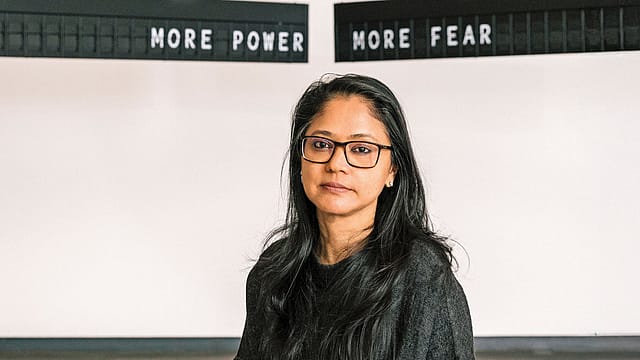
ON A DRIZZLY Tuesday afternoon recently, I found myself in Berlin—at the historic entrance of Hamburger Bahnhof: Nationalgalerie der Gegenwart. I was looking for What Still Holds, billed as Mumbai-based Shilpa Gupta’s biggest show in Germany. Before heading there, I was momentarily distracted by artist and musician Lina Lapelyte’s participatory public artwork, which greets visitors as they step into the museum. As a former railway terminus, Hamburger Bahnhof has plenty of space within its cavernous bosom to accommodate artists of all stripes and their oversized, alchemistic visions of Gideon. The Lithuania-born Lapelyte has transformed the central exhibition hall into a playground, having scattered 4,00,000 wooden cubes on the floor which people are free to arrange and rearrange into seemingly endless configurations.
Like Lapelyte, Shilpa Gupta, too, is a patron saint of participatory gestures— but of a different kind. Her What Still Holds is less playful and more meaningful. Yet, it can be seen as an adventure. In the making for over a year, the exhibition is loaded with the atmospheric heaviness of history, language, political structures, freedom, injustice, censorship and the social anxieties of our fraught times. These are Gupta’s recurring themes and she brings her characteristic intensity to the Berlin show.
What Still Holds has been conceived by curators Sam Bardaouil and Ulya Soley as a cross-generational dialogue between Gupta’s postmodern spirit and the experiments of Germany’s post-war master, Joseph Beuys (1921-1986). Gupta recalls that the first time she heard of Beuys was when she saw one of Atul Dodiya’s pop paintings in which he merged an image from Beuys’ iconic I Like America and America Likes Me with another great performer of the 20th century, Mahatma Gandhi. She sees this contextual exhibition as an opportunity to learn more about Beuys. Gupta, who graduated from Sir JJ School of Art in 1997, says, “At JJ, we had a traditional syllabus, so we didn’t actually know who someone like Joseph Beuys was. By the time we reached the final year in 1997, we had just been introduced to Op Art and Pop Art from the 1960s. I only got a chance to see his works much later in life when I started travelling to Europe as an artist.”
Till Fellrath, one of the directors of Hamburger Bahnhof, argues that Gupta’s work complements Beuys’ idea of ‘social sculpture’, which sought to reimagine art as an altruistic medium with the power to bring people together and transform society. “Shilpa’s art doesn’t fit into a box and that’s exactly what we wanted. Her work has a strong connection to the South Asian context. But, at the same time, it is universal and globally relevant,” Fellrath says, adding that the museum’s permanent collection of Beuys gives them the creative leeway to invite different artists to critically engage with the canonical German figure whose work continues to both mesmerise and baffle audiences.
For Gupta, showcasing alongside Beuys is a rare honour. But what such a major show will do to her career, she can’t tell. She believes in performing her duties as an artist, instead of fussing over success and failure. “It’s not something I think about,” she shrugs. “Career is not a word I really associate with. One is simply making works and things flow between art and life,” says the soft-spoken Gupta, who was awarded the prestigious Possehl Prize for International Art in Germany last year and subsequently held a show in Lübeck.

Gupta’s conceptual art revels in quieter ruptures, allowing meaning to appear through rhythmic elegance rather than declarative assertions. At the heart of What Still Holds stands a life-sized steel and concrete sculpture, evocatively titled Truth. Visitors drift in and out of the letters, as though moving through Roman pillars at some ancient ruin site— or between “digital echo chambers,” as the artist puts it. Truth is pure, immutable and as it turns out, subjective. But in Gupta’s delicate hands, truth becomes a tool for resistance.
The 49-year-old recalls that the word ‘truth’ has been dear to her almost since her art school days. “I have been drawn to the words ‘truth’ and ‘misinformation’ from the beginning. In fact, its echoes were there even in my JJ School of Art dissertation. Questions of what we see, what we hear and what might be— of agency, power and deception—have been early and ongoing concerns. Of
course, in the present moment, with the rise of authoritarianism on one hand and the increasing noise of social media on the other, truth feels even more fragile,” she says. “We are already seeing systems of power become brittle, with little tolerance for those who think differently or question. The space for speaking freely is shrinking. I feel it is okay to be different. How can you expect so many people to possibly think, eat or wear the same things?” asks Gupta, adding that the very first iteration of Truth was exhibited at Chemould Prescott Road, Mumbai, in 2011. It started life as a humble paper cut-out. Even further back, in 2008, she made an eye test that read ‘Truth’. Since then, the word has become something of a personal anthem for the artist.
WHILE A CROWD OF youngish museum-goers jostle to take selfies under Truth, her other works beckon visitors with far less grandstanding. Nearby, there are drawings of hand-drawn maps of India, continuing her obsession with borders and modern-day notions of nationhood. “Most of the geographical borders we know today are relatively recent, only a few hundred years old, which is very little when compared to how long we have existed as human beings. They are constructed lines, yet they have become deeply dominant, shaping and controlling our lives in entangled ways,” she says, quickly adding, “Growing up as a woman in South Asia, one becomes aware of lines, boundaries and labels very early in life but then, one finds a way to deal with it.”
The exhibition also features one of her most important works—a motion flapboard piece that mechanically lobs phrases at unsuspecting viewers (for example, ‘When we speak no one listens/When I desagree I am ridiculized’), prompting us to introspect and question how deeply prejudiced we have become as individuals and as a society. The 34-minute-long experimental flapboard, titled Still They Know Not What I Dream, is replete with spelling errors and irregular spacing—the broken sentences on the display board are deliberate, perhaps evoking the fragility of speech for those living under constant surveillance and censorship or those forcibly displaced.
If text and subtext defines Still They Know Not What I Dream, then Untitled (Spoken Poem in a Bottle) is a fever dream of poetry and protest. This haunting, distinctly Duchampian work is filled with voices that have been persecuted in their time (Osip Mandelstam, Mikayil Mushfig), which Gupta attempts to seal and preserve in a series of bottles. A light bulb sombrely shines above, spotlighting the sacrifices of these great men of history. What Beuys achieves with a simple lemon and a light bulb in another part of the gallery, Gupta does something similar with words. Whether thoughts and expressions captured in a bottle are empty or potent, it is for the audience to decide. Listen Air unfolds in a darkened room. Suspended microphones blare several uplifting poems, including Faiz Ahmed Faiz’s ‘Hum Dekhenge’ which became the official theme song of the anti-Citizenship Amendment Act protests of 2019.
Poetry and literature have been Gupta’s lifelong companions. She has drawn from them both comfort and sustenance. Several of her best works engage with language, speech and narration and how it shapes us. She remembers making a zine in art school in English and Marathi in the mid-90s. Her early works also address the role of media and the internet—“the question of whether I am shaped by what I see, or whether what I see is shaped by me,” she says. For Blame (2002), which has been described as an interactive performance of the kind that Beuys would have relished, she hopped onto a Mumbai local train distributing small bottles filled with a liquid the colour of blood—a visceral reference to the Gujarat riots that had devastated the nation just months earlier. Another early show saw her encourage viewers to pick up a large brick made of soap with the word “THREAT” inscribed on it and walk away.
THROUGHOUT HER career, Gupta has consistently redefined what it means to be an artist and what art can do, tossing out the rule book in favour of something fresh, intellectual, innovative and thought-provoking. Her work resists easy categorisation. Art, for her, has never been about having a fixed identity, nor does she want to be pulled down by what she calls the “weight of style.” As she says, “I never wanted to be bound by one specific style. A handmade drawing or a sketch is as close to me as an electronic work or a sound installation.” Her art is predominantly participatory. “I walk half the way and hope the audience walks the other half.”
It took time for the world to understand Gupta’s conceptual process. She has come a long way from 1995, when she showed a video work alongside a senior artist who advised her, “The video would be better switched off because it’s making a noise.” Life as an avant-garde artist has not been easy. There were moments when she had to fold all the contents of her work into a handbag and get on a flight for an exhibition. Recently, she helped raise funds for her show in Kochi. “I cannot say I haven’t had my fair share of dilemmas,” she laughs.
She admits that she was once torn between pursuing science and art. She chose art and she’s glad for it. “While I wanted to be an artist, being one means so much uncertainty. There was a time when it wasn’t even possible to make a living through the kind of practice I do,” she remarks. She worked as a web designer for many years and became a full-time artist only in 2006. Has the journey been worth it? “It’s a privilege to be an artist and it has been possible simply because others have made space for me to show and share my work,” she replies. “So, in a way the journey is not mine alone.”
(What Still Holds is on view at Hamburger Bahnhof: Nationalgalerie der Gegenwart, Berlin, till January 3, 2027)