Global By Design: Is the future of fashion Indian?
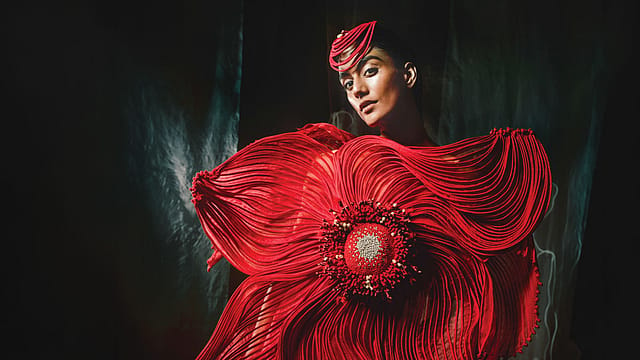
MANISH MALHOTRA IS home after a transcontinental trip that has taken him from the star-studded MET Gala to business in Paris and back to Mumbai where deadlines and ambitions await. On the first Monday of May, he attended the MET Gala—his second time at the fundraiser—wearing a bandhgala with an architectural cape bearing the names and signatures of his artisans.
Also dressed in Malhotra’s designs was Riverdale and Masters of the Universe actor Camila Mendes in a custom gown and jewels. Dwayne Johnson wore an emerald and diamond brooch from Manish Malhotra High Jewellery. Sitting in his office, Malhotra notes that jewellery has become the world’s “first window” to his fashion house. “When I start a vertical, it’s connected to what I’m doing, but it also has its own individual standing. They are from the same thought process but they are independent businesses,” he tells Open.
Jewellery has also sparked curiosity for other verticals. Jennifer Lopez dressed in a custom Manish Malhotra ballgown for her 55th birthday celebrations and more recently, a sari for a Udaipur wedding. “It speaks to our diversity that we can make a gown as well as a sari,” Malhotra says, recalling the outfits. Beyoncé wore one of his sequined and crystal-studded chaps during her Cowboy Carter tour. But Malhotra also has his eyes on business: presenting twice at Dubai Fashion Week, a city where he already has a store; hosting shopping events at Harrods and Selfridges in London; and attending events from Vogue World to the Golden Globes. “I have travelled the world because of the movies. But today I am looking at the same places from a different angle,” he says. Malhotra is laying the groundwork for the future. He is discreet about his plans, adding that he is still at a stage when he is studying the market, thinking and meeting people. But the last three years have made a huge impact for the brand’s presence in the West.
Malhotra is one of the leading names navigating Indian fashion’s journey from a homegrown industry to a global powerhouse over the last few years. Rahul Mishra and Gaurav Gupta are recurring fixtures at Paris Haute Couture Week and Dhruv Kapoor at Milan Fashion Week; KGL, the label helmed by Kanika Goyal, has been shown in New York and London; Falguni Shane Peacock has been on the New York Fashion Week runway. Last year, Shantnu & Nikhil debuted at Moscow Fashion Week and AK-OK by Anamika Khanna at London Fashion Week; designer Sanjay Garg also presented his label, Raw Mango, for the first time in London this year. Among younger labels, Kartik Research, by Kartik Kumra, is having a breakout moment with shows at Paris Fashion Week and a store in New York.

INDIAN FASHION STORES are slowly emerging abroad— Sabyasachi’s store in New York is a gateway to his maximalist world. Anita Dongre opened a store in Beverly Hills last year while Vaishali S has a store in Paris. International celebrities are choosing Indian designers. Gaurav Gupta created custom couture for Lady Gaga and Doechii for the music video of ‘Runway’, their song from the soundtrack of The Devil Wears Prada 2. Gupta’s clientele includes Beyoncé, Cardi B and Serena Williams. Rahul Mishra’s designs have been seen on Ariana Grande, Selena Gomez and Janelle Monae. Anamika Khanna has dressed Kelly Rowland and Colman Domingo while Icelandic singer Björk wore Amit Aggarwal to the Brit Awards 2026.
But to say that India has never shone in the global fashion spotlight before would be inaccurate. Ritu Beri presented a fashion show in Paris in 1999, followed by designers such as Anamika Khanna, Ashish N Soni, Tarun Tahiliani and others on the runways of Milan and London. Manish Arora, who captured global attention with his designs, became the creative director of Paco Rabanne in 2011 though it was an unfortunately short tenure. Sujata Assomull, fashion journalist and former editor of Harper’s Bazaar India, has seen this tide ebb and flow over the years. But this time, Indian fashion may be ready to sustain its moment.
“I do feel that we are at an inflection point,” Assomull says. “For me, the moment it started to change was when Rahul Mishra started showing at Paris Haute Couture Week.” The show coincided with the pandemic when global conversations about the fashion industry began to shift. India’s political and economic heft has grown and it has emerged as an important market for international luxury. Demands for greater transparency reshaped fashion which had been “a closely guarded industry” for years.
“Alongside, Indian fashion matured,” Assomull adds. Designers are more strategic about their expansion plans than ever before. “Every brand is taking a route true to its own DNA and personality. For some, taking the fashion week route has worked—Dhruv Kapoor for instance at Milan Fashion Week. For a brand like Gaurav Gupta, which is all about glamour and beautiful, architectural dresses, taking the celebrity styling route and then going into couture week was a smart decision. So was Rahul Mishra’s move to Paris Haute Couture Week, because he is a very crafts-based designer. Sabyasachi has taken the retail route.”
“Brands often ask how they can go global,” adds Assomull. “But I don’t think there’s a formula. You have to build on your strengths, and you have to be nimble.” What matters the most is individuality and a sense of self. “The West is not looking for another Gucci, Louis Vuitton or Pucci from here. They are looking for brands with an Indian point of view.”
“I don’t want to create clothes that lose connection to their roots,” says Rahul Mishra who launched his label 20 years ago at Lakmé Fashion Week’s GenNext programme and has blazed a trail in global fashion since. In 2014, he became the first Indian designer to win the Woolmark Prize leading to shows at Milan Fashion Week followed by his couture debut on the runways of Paris in 2020. Design has been at the core of his brand-building with collections that grow more audacious every season. “Today’s market, because of large conglomerates globally, has become heavily placement-driven,” he says. “There are many more values in life and in building a brand than simply measuring everything through money.” Mishra values runway shows, organic press, imagery and storytelling—speaking with Open, he delightfully cites various international editorials featuring his designs.
As the brand builds its reputation, label Rahul Mishra has found clients across the globe. Apart from stockists and trunk shows, couture orders are undertaken from the atelier in India, with Mishra’s team travelling to meet important clients. Nearly 50 per cent of Mishra’s couture orders are international, with many non-Indian clients. Besides the US and Europe, the brand has found great popularity in China where it has been a huge hit among celebrities. China remains a hugely influential market for global luxury brands, and Mishra notes that it is a mistake to underestimate it.
For any brand with global goals, sporadic runway shows or red carpet events make little difference. Dhruv Kapoor, a regular at Milan Fashion Week, notes its huge impact. “Over time, buyers, editors and clients begin to understand the evolution of the brand season by season, rather than seeing it as isolated moments,” the designer says. “It also makes us part of a larger global dialogue, where we are able to present our roots while blending them with global cultural references and contemporary dressing codes.”
Shows and presentations are one part of brand-building. “A large focus for us over the last two years has been strengthening our D2C ecosystem and building a stronger direct relationship with clients globally,” Kapoor explains. “We are continuing to grow our international PR network, deepen relationships with stylists and creatives, and expand selectively through retail partners.” His ambition is to build a cultural house through spaces, objects and collaborations so that “the brand feels immersive beyond just the clothing itself”.
Indian designers also represent the country’s crafts heritage. Vaishali Shadangule, designer and founder of Vaishali S, calls it her mission to showcase the potential of Indian handlooms. A decade ago, Shadangule took her first steps with trunk shows, trade events and presenting in New York. During thepandemic, she pivoted to couture on the suggestion of her partner, Alessandro Giuliani. Her 2021 show at Paris Haute Couture Week’s official calendar “helped shift the perception from craft-based to global luxury couture”.
Shadangule has hosted shows in Milan and Paris and debuted at Barcelona Bridal Fashion Week this year; she also opened a store in Paris two years ago. “From Vaishali S’ first show to now, our soul is the same. That won’t change,” she says. “But different markets have given me different exposure and it has refined my design language. I learn every time I speak to buyers and clients. ” Shadangule’s aim is to not only use handloom but create an “unconventional language” for it—one that resonates as fashion around the world.
COUTURE, RED CARPET AND celebrity dressing create an outsized buzz, but there are other success stories. Case in point: Hemant & Nandita. Over the past 12 years, Hemant and Nandita Lalwani have built a luxury resortwear label that retails at over 300 stores, including Revolve, FWD, Bloomingdale’s and Saks Fifth Avenue. “From the word go, our vision and ambition were to create a globally relevant fashion brand coming out of India, one that could sit confidently alongside international labels, as a design-led business with a clear identity and point of view,” says Hemant. “Retail became the natural route for that vision.”
Hemant does not discount celebrity dressing and red carpets. “They create visibility, aspiration, and cultural relevance, and we completely understand their importance. But retail is a different kind of journey,” he says. “One of my favourite memories was when, a couple of years ago, on a trip to Miami, Nandita and I saw a woman walking out of a restaurant wearing one of our dresses. It wasn’t a campaign moment or a styling placement, just someone naturally choosing to wear the brand.” The label recently hosted a luncheon in Miami in collaboration with Big Drop NYC for customers and creators, ahead of a pop-up. “For us, these moments matter because they help build a genuine relationship with the customer and strengthen the community around the brand.”
Another label that has found retail success years ahead and there’s a strict timeline, deadlines and relationship building,” Arora says. “We’ve not skipped a single season in the last 17 years. We religiously showcase during trade show season—earlier we’d participate in trade shows (such as Tranoi), and now we book our own showrooms.”
Arora adds that péro is often stocked at “destination shops”, niche boutiques and stores in luxe holiday spots. “The brand is niche and so is its presence. Boutiques where every piece is hand-picked and the strongly personalised curation feel apt. The way we make is also personal—there is no mass production,” she adds. The label is known for its atmospheric fashion shows and presentations in India, and the péro team aims to create a similar experience for overseas buyers, with immersive showroom experiences and thoughtfully curated packages.
WHEN IT COMES to retail expansion, designers from India share a preference for quality over quantity. As Amrita Khanna and Gursi Singh, co-founders of the label Lovebirds, say: “The context in which clothes are seen matters deeply to us.” The label’s “considered footprint” includes stockists like Harvey Nichols and Liberty in the UK; Neiman Marcus in the US; Ounass in the UAE and Saudi Arabia; Beams in Japan; and Husk and David Jones in Australia. In March, Lovebirds hosted a runway show at Geoffrey Bawa’s Lunuganga Estate in Bentota, Sri Lanka. “We’ve never led with distribution for its own sake. Lovebirds has always been an experience-forward brand, and bringing that internationally means thinking community first, the same way we do at home,” the founders say. “It’s less about scaling a retail footprint and more about finding the right people, the right spaces, the right conversations in each market.”
This is the beginning of a journey. As Hemant says, building a global fashion brand from India “requires extraordinary focus, patience and consistency”. Arora notes the importance of finer detail when working overseas, from global sizing to ensuring that every garment meets the expected standards and creating collections that address what different partners and buyers want.
Assomull says that there is much to do, which includes building a more robust ecosystem at home. “Our fashion week is still not on the global calendar. Even the timing is not right, because the Indian fashion week doesn’t fall within the global cycle,” she observes. It’s important, she says, to observe retail growth and not limit global success to shows and red carpet. “A fashion brand has to have strong roots at home before it can go international,” she adds. “You buy an Italian brand, a French brand or a British one because they are already strong at home.”
India is celebrated for crafts and colour, textiles and embroidery—its own seductive brand of luxury. According to Malhotra, these are the strengths that bring Indian designers to global platforms. “It’s up to you whether you just want to be someone who is just going to be invited as a guest, or you want to be someone who becomes a part of that world—proudly Indian and rooted but still speaking a wider language. Because, then you can speak more about your roots to a wider audience,” he says. “We want to take ‘Made in India’ to the world. We want to take Indian textiles, crafts and embroidery but also Indian construction.”
The moment is rife with possibilities. “In the time of AI, India’s strength lies in exporting reality—art, craft, culture, human touch,” says Mishra. “If we don’t squander this opportunity, more Indian designers will emerge globally—and that will be good for the country, for craft, for culture. India is like a continent in itself. We need thousands of artists to tell all its stories.”