Picasso belongs to Europe, Amrita Sher-Gil belongs to the world
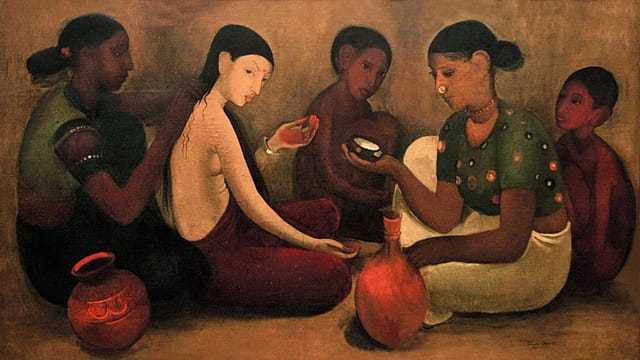
The Netherlands: The retrospective Amrita Sher-Gil: “Europe belongs to Picasso; India belongs to me” at the Drents Museum arrives with the aura of an event long delayed and perhaps therefore emotionally intensified. After months of uncertainty caused by geopolitical tensions that initially prevented the paintings from leaving India, the exhibition finally opened this week as the first major presentation of Amrita Sher-Gil in the Netherlands.
As a South Asian curator who travelled from India to attend the opening in Assen, a small, quiet town in the rural Netherlands that feels improbably distant from the fevered cultural circuits of Delhi, Mumbai or New York, I arrived at the museum with genuine curiosity about who this exhibition was ultimately for. One wondered whether a painter as historically specific and emotionally interior as Sher-Gil would truly find an audience here, far from the geographies that shaped her life.
Rise of the Pivotal Power
18 Sep 2026 - Vol 05 | Issue 38
The BRICS declaration is a strategic victory for Modi
What was striking, then, was not merely the scale of the exhibition itself but the intensity of public anticipation surrounding it. The opening was impressively attended, filled with eager museum-goers, scholars, diplomats and members of the South Asian diaspora. Equally notable was the visible diplomatic presence on both sides: Dutch Ambassador Marisa Gerards; Indian Ambassador to the Netherlands, Tuhin Kumar; and cultural attaché Shweta Kaushik were all present, underscoring that this exhibition was never simply an art historical event. It was also an act of cultural diplomacy.
And one sensed, throughout the evening, the enormous logistical and bureaucratic effort that must have gone into making such a show possible. Organising an exhibition of this scale between India and Europe, particularly involving works considered national treasures, requires a level of institutional trust still relatively rare between museums in the Global South and the West. Having now worked in India for over a decade after more than twenty years in New York, I have come to understand just how differently institutions operate across these contexts: differing conservation protocols, insurance structures, bureaucratic timelines, governmental oversight and attitudes toward cultural property all make such collaborations extraordinarily complex.

During the opening, I found myself speaking with Harry Tupan, the former director of the Drents Museum, who had initially conceived the retrospective years ago. Recalling his first conversation with the director of the National Gallery of Modern Art, he laughed as he described asking whether the museum might consider loaning around 60 Sher-Gil works. “You can have three,” he was told. The anecdote now feels almost symbolic of the transformation that followed.
That the Indian Ministry of Culture and the NGMA eventually agreed to loan such a substantial body of work marks a remarkable institutional shift, one that deserves acknowledgment. Beyond the exhibition itself, this represents an important evolution in how India imagines the international circulation of its cultural heritage. For decades, Indian art shown abroad has often been filtered through familiar civilisational tropes: spirituality, craft, ornament, antiquity. Even after living in New York for more than twenty years, I saw relatively little that fundamentally disrupted Western expectations of South Asian art histories. To encounter an artist like Sher-Gil presented in Europe not as ethnographic supplement but as a central protagonist of global modernism feels genuinely significant.
In this sense, the retrospective operates not only as an art exhibition but as a subtle exercise in soft power, though perhaps a more intellectually meaningful form of it than the term usually implies. Sher-Gil’s work complicates every easy binary through which India is often culturally consumed abroad: East versus West, tradition versus modernity, nationalism versus cosmopolitanism. That Indian institutions chose to send these works abroad in such numbers suggests an important confidence not merely in the paintings themselves, but in the sophistication of the histories they carry.
But the real triumph of the exhibition is not logistical. It is curatorial. The show succeeds in repositioning Sher-Gil not as a peripheral “Indian Frida Kahlo”, a comparison often lazily repeated in European institutions, but as one of the foundational artists of global modernism itself.
The exhibition design itself deserves particular praise. Meticulously conceived without becoming overbearing, it manages the difficult balance of contextualising Sher-Gil’s life while still allowing the paintings to breathe. Throughout the galleries, the curatorial language remains attentive to atmosphere, memory and movement rather than relying on spectacle.
One of the exhibition’s most elegant gestures is the repeated invocation of South Asian architectural forms through cascading paper-cut jaalis spelling out “Amrita” in Devanagari script. These suspended interventions are neither decorative nor literal; they function almost as thresholds between different emotional and geographical worlds that Sher-Gil inhabited. The effect is unexpectedly lyrical—a contemporary design gesture that quietly echoes the layered permeability of Indo-Islamic architecture itself.
Equally inventive is the circular radial timeline tracing Sher-Gil’s brief but astonishingly mobile life across Budapest, Paris, Shimla, South India and Lahore. Rather than presenting biography as linear inevitability, the design suggests orbit, recurrence and fragmentation, a fitting metaphor for an artist constantly negotiating multiple identities, languages and aesthetic inheritances.
The archival photographs are among the exhibition’s most intimate revelations. Images taken by her father Umrao Singh and later by family members capture a strikingly self-aware young Sher-Gil whose presence oscillates between vulnerability and performance. There is something almost Lolita-esque in certain portraits, not in any reductive sense, but in the way adolescence, theatricality, sensuality and cultivated intelligence collide within the frame. The photographs become crucial not simply as documentary material, but as evidence of the unusual cosmopolitan and culturally hybrid milieu from which Sher-Gil emerged: aristocratic, intellectual, deeply European and deeply South Asian all at once.
The chromatic design of the galleries is also remarkably assured. Different periods of Sher-Gil’s life unfold through shifting wall colours that subtly register emotional and geographical transitions. There are expected South Asian tonalities, saffron orange, muted earthy greens, but also far more surprising choices: powder pinks, pale pastels and deep aubergines that evoke a distinctly European modernist sensibility. The palette resists easy orientalism. Instead, it mirrors the instability and multiplicity of Sher-Gil herself, an artist who never belonged entirely to any singular visual tradition.
The exhibition’s title, drawn from Sher-Gil’s famously audacious declaration, “Europe belongs to Picasso, Matisse, Braque…India belongs to me”, is less boast than manifesto. It frames the exhibition as an argument about ownership, artistic inheritance and modernity. The curators wisely resist presenting Sher-Gil as a derivative colonial subject trained in Paris before “discovering” India. Instead, the retrospective reveals how fiercely she dismantled the hierarchy between European modernism and Indian visual experience.
Drents Museum’s decision to leave works by Pablo Picasso, Henri Matisse and Georges Braque in dialogue with Sher-Gil is one of the exhibition’s smartest gestures. Rather than elevating European masters above her, the juxtaposition subtly reverses the gaze: suddenly it is Picasso and Matisse who appear provincial beside the emotional density of Sher-Gil’s Indian subjects. The comparison exposes how much European modernism depended on abstraction and formal experimentation, while Sher-Gil retained an ethical commitment to human presence.
Walking through the galleries, one sees not a synthesis but a tension. Sher-Gil’s early Parisian paintings display the academic discipline and post-impressionist fluency absorbed at the École des Beaux-Arts, Paul Cézanne’s structuring of form,Paul Gauguin’s flattened bodies, Amedeo Modigliani’s elongated melancholy all flicker through the work. Yet once she returns to India in the 1930s, the palette deepens into earth pigments and bruised reds; bodies become heavier, slower, almost sculptural. The retrospective makes clear that this was not an abandonment of European modernism but its critique.
Her great paintings of women—Three Girls, Bride’s Toilet, Hill Women—remain devastating precisely because they refuse ethnographic spectacle. These are neither nationalist icons nor romantic peasants. Sher-Gil paints stillness as social condition. Her women inhabit interior worlds thick with fatigue, resignation and latent solidarity. The silence in these canvases feels almost architectural.
What emerges most forcefully in the exhibition is Sher-Gil’s radical understanding of loneliness. Even her self-portraits resist vanity. The gaze is often withdrawn, self-absorbed, withholding. Contemporary viewers accustomed to confessional self-imaging may find these paintings startlingly opaque. Sher-Gil paints herself not as personality but as unresolved consciousness.
However what is surprising though, is the degree to which the exhibition domesticates Sher-Gil herself. The paintings retain all their sensuality, alienation and psychic force, but the woman behind them is rendered curiously legible, almost too easily absorbed into the familiar mythology of the tragic modernist genius. What recedes in the retrospective is the radical instability of her identity: Sher-Gil was not merely a cosmopolitan painter moving between Europe and India, but a fiercely unconventional figure who resisted the moral and social codes of her time with unusual intensity.
Her bisexuality, emotional restlessness, sexual autonomy and refusal of bourgeois femininity were not incidental biographical details; they shaped the emotional architecture of the work itself. The charged interiority of her female subjects, the sensuous but unsentimental treatment of the body, the recurring atmosphere of estrangement and unfulfilled intimacy, all emerge from an artist acutely conscious of existing outside prescribed categories. Sher-Gil’s modernism was inseparable from this personal iconoclasm.
Yet the exhibition touches these aspects only lightly, almost cautiously. In doing so, it risks flattening Sher-Gil into a safer art-historical figure: a pioneering Indian woman painter rather than the deeply disruptive presence she actually was. At a moment when museums are increasingly willing to engage artists through the complexities of gender, sexuality and self-fashioning, the restraint here feels conspicuous.
Also, for all its ambition, the retrospective reveals one notable absence. Given Sher-Gil’s profoundly intertwined relationship with undivided India, particularly Lahore, where she lived, exhibited and ultimately died, the exhibition stops short of becoming the truly transnational retrospective it could have been. Important works connected to her Lahore years remain in Pakistan, including paintings held by theLahore Museum. At a moment when museums worldwide are rethinking colonial cartographies and national ownership of artistic legacies, this felt like a rare missed opportunity for the Drents Museum to imagine Sher-Gil beyond the borders created after Partition. A fuller collaboration between institutions in India and Pakistan could have produced not merely an exhibition, but a historic act of cultural reunification around one of South Asia’s most singular modernists.
The retrospective ultimately argues that Sher-Gil was not simply the founder of modern Indian art, as she is often described, but one of the rare artists who forced modernism itself to become multilingual.
And perhaps this is ultimately what lingered most powerfully while leaving the museum that evening and stepping back into the stillness of Assen: the unlikely but moving sight of a deeply complex South Asian woman modernist, restless, bisexual, aristocratic, intellectually hybrid, resistant to categorisation, occupying the centre of a major European museum with seriousness, scale and ambition. For many South Asian viewers, especially those shaped by diasporic experience, that visibility carries an emotional charge difficult to overstate.
(Amrita Sher-Gil: 'Europe belongs to Picasso, India belongs to me' will be on view at Drents Museum, The Netherlands, till September 20, 2026 )